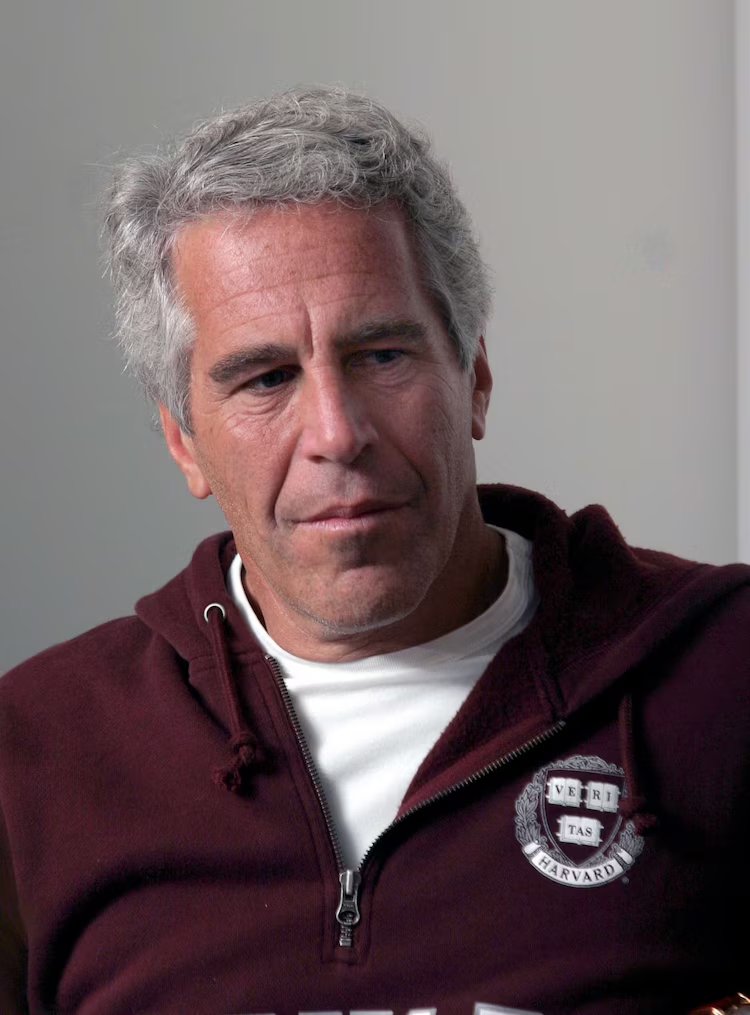
United States — Newly released documents from the Jeffrey Epstein case reveal extensive connections between the disgraced financier’s circle and Mexico, showing frequent travel to the country, business discussions, and references to social gatherings at tourist destinations. The material also indicates that the Federal Bureau of Investigation (FBI) pursued leads related to Epstein’s alleged illicit activities in Mexican territory.
The conclusion emerges from messages contained in an archive released on Friday, January 30, in the United States as part of the Epstein case. This material contains multiple itineraries and conversations that place Mexico not only as a transit point but as a destination for members of his circle, with constant references to beaches, private flights, parties, and “models.”
One example illustrates the tone—and opacity—of part of the exchange: in the early morning of January 4, 2013, a person wrote to Epstein a phrase suggesting personal interests: “She really likes the Mexican boy…” The thread does not allow identification of who it refers to or what exactly the expression means, or whether it involves a minor.
But to gauge the type of interlocutors Epstein had, in that same email the businessman suggests that people like ‘Aziz,’ ‘Ike,’ and Elon—an individual who is probably Tesla owner Elon Musk—might want to visit his infamous private island—site of multiple sexual abuses—if they flew to the United States.
The documents consulted do not record surnames that would allow confirmation of the identity behind those names.
Hundreds of messages and documents released by the United States Department of Justice, from which a new and extensive archive was made public on Thursday, January 29, have been reviewed. The material shows a trail of connections between Epstein and his entourage with Mexico, and it also shows that the FBI followed some leads related to the American financier’s alleged illegal activities.
It is estimated that only 1% of documents related to this case have been released.
Carlos Salinas in the Messages
As part of the investigations into the businessman’s activities—who died on August 10, 2019, in a Manhattan prison, according to the official version—the FBI reviewed thousands of emails associated with Epstein’s accounts. The archive, covering communications from 2007 to 2019, functions as a puzzle of relationships: business, invitations, flight logistics, and conversations that stretch into elite circles.
In that map, Mexico appears repeatedly. Visits to destinations such as Tulum, Puerto Vallarta, and Cancún are described, in addition to Mexico City. In several mentions, “models,” “parties,” and “beautiful women” are discussed, vocabulary consistent with the hedonistic tone that appears in different sections of the archive.
For example, on September 8, 2017, a user—with identity withheld—wrote to Epstein from Mexico City:
“Hello Jeffrey… I am in Mexico City and we just had an earthquake, ugh… There are two model girls, one from Masha, another from Monaco, who are considering sending you their CVs and photos. Most likely you will have new candidates soon.”
The messages also reflect, in addition, knowledge—at least circumstantial—of high-profile figures.
In one of the emails dated November 15, 2016, Epstein wrote to David Stern—identified as a former JP Morgan banker—telling him that he had met former Mexican President Carlos Salinas de Gortari at a dinner of billionaires along with John Brockman, one of New York’s most influential literary agents.
In that same message, Epstein added that Salinas “supposedly” was building a house on the property of former Qatari Prime Minister Hamad bin Jassim bin Jaber Al Thani in Marrakech and concluded: “Me too.”
The content does not prove a sustained relationship, but it does offer a window into how Epstein moved—or sought to present himself—in circuits of high social and economic capital.
Planes, Toluca, and Mexican Buyers
The emails also account for conversations about aircraft and possible Mexican buyers. In March 2015, Larry Visoski—Epstein’s pilot—discussed the possible sale of a Boeing 727.
In the conversation, a “Mexican buyer” is inquired about, with a note: Epstein was not satisfied because the interested party planned to use the plane to “fly people to Los Cabos.”
Among the people who, according to the material reviewed, maintained correspondence with the financier or his entourage with references to Mexico, appear:
- Boris Nikolic, businessman linked to biotechnology and indicated in documents from the entourage as a potential heir.
- Jes Staley, former Barclays executive.
- Brock Pierce, businessman linked to cryptocurrencies.
- Gino Yu, developer who proposed projects and experiences in Tulum.
- Andrew Farkas, business contact who sent inventories of properties to consider.
- Diana Chomsky, identified in the material as linked to Oxfam Mexico and daughter of Noam Chomsky.
In the section on economic interests, the exploration of acquiring real estate and tourism assets is outlined. Among them, a contact sent inventories that included the possibility of Epstein buying the Marina de Cabo San Lucas.
In December 2014, moreover, a person from Epstein’s circle discussed the possibility of canceling a trip to go see someone identified as “Br=ck” (sic) in Costa Careyes, requesting to book flights to Puerto Vallarta to then continue to London, with a possible stop in Tulum. The reference is fragmentary, but it again places Mexican destinations in the narrative of the magnate’s circle.
“The Women Are Beautiful”
In some messages, the country is openly portrayed as a leisure setting. “I am in Puerto Vallarta. The place is beautiful and the women are beautiful,” reads a text sent to Epstein’s personal account at 01:00 on November 11, 2018. The author’s identity appears classified in the material consulted.
Another relevant message—for its explicit mix of “project” and “party”—comes from Gino Yu. Written from Tulum, the developer invites Epstein to finance the construction of a pseudoscientific research laboratory for spiritual retreats in Quintana Roo.
In the same tone, he suggests the social component of the trip: “Damn, I think we could even organize some of the best parties.”
Dated January 7 (without the year being clear in the extract), an additional message mentions the availability of a model for an event:
“We could already have a model for the event and we already have a very nice place here in Tulum.”
The “Video Vault”
Among the chest of data reviewed is a complaint received by the FBI on July 19, 2019, when Epstein was already rotting in a New York prison. An American citizen, identified as Kenneth Darrell Turner, called from Mexico to the agency’s National Operations Center and claimed to have found a vault with sexually explicit material allegedly owned by the financier.
According to the report, Turner said that, “jointly with the federal police,” he located a vault with approximately 10,000 videos of minors from Guatemala, Honduras, and Mexico.
An FBI agent later recorded—in a document dated October 9, 2019—that Turner claimed to have some type of relationship with authorities in Mexico and that he worked with a former South African official.
In that same document, it is stated that Turner maintained that a former Navy Seals commander, Richard Marcinko, was in custody in Mexico City on charges related to a child sexual abuse network, and that a Mexican official—whom he said he knew only as ‘Jorge’—had in his possession recordings of Epstein and other American citizens involved in sexual acts with minors.
The report itself records a crucial fact: Turner did not provide evidence to support his claims. To verify the story, an FBI agent requested the legal attaché at the United States Embassy in Mexico to review Marcinko’s alleged imprisonment and consult with Mexican authorities about the alleged video evidence.
The lead did not yield verifiable results and, subsequently, Turner expanded his story with increasingly difficult-to-prove elements, including alleged assassination attempts. The complaint ended up discarded.
Medina Mora and Sarukhán: The Lead Since 2009
A final segment of the material reviewed shows that, since 2009, there were attempts to explore a Mexican angle in the case. In an email sent to lawyer Bradley Edwards, it is stated that a member of his firm met with then-Attorney General Eduardo Medina Mora and with the Mexican ambassador to the United States, Arturo Sarukhán. According to the email, in that meeting, trafficking networks operated by drug cartels were discussed.
The message adds that the firm saw there a possibility: identify a Mexican victim that would allow legally linking Epstein to federal crimes in the United States. The phrase shows the logic of that moment: the search for a case that connected, with evidence, a circuit of sexual exploitation with transnational criminal networks.
“This is the first time that two key officials of the Mexican government confirm this. For now, if we can prove that Jeffrey Epstein is involved in human trafficking for his sexual needs, even if it is a single victim, he will be linked to a federal crime that is becoming the number one investigation topic by the FBI, ICE, Interpol, and other security agencies.”
Discover more from Riviera Maya News & Events
Subscribe to get the latest posts sent to your email.