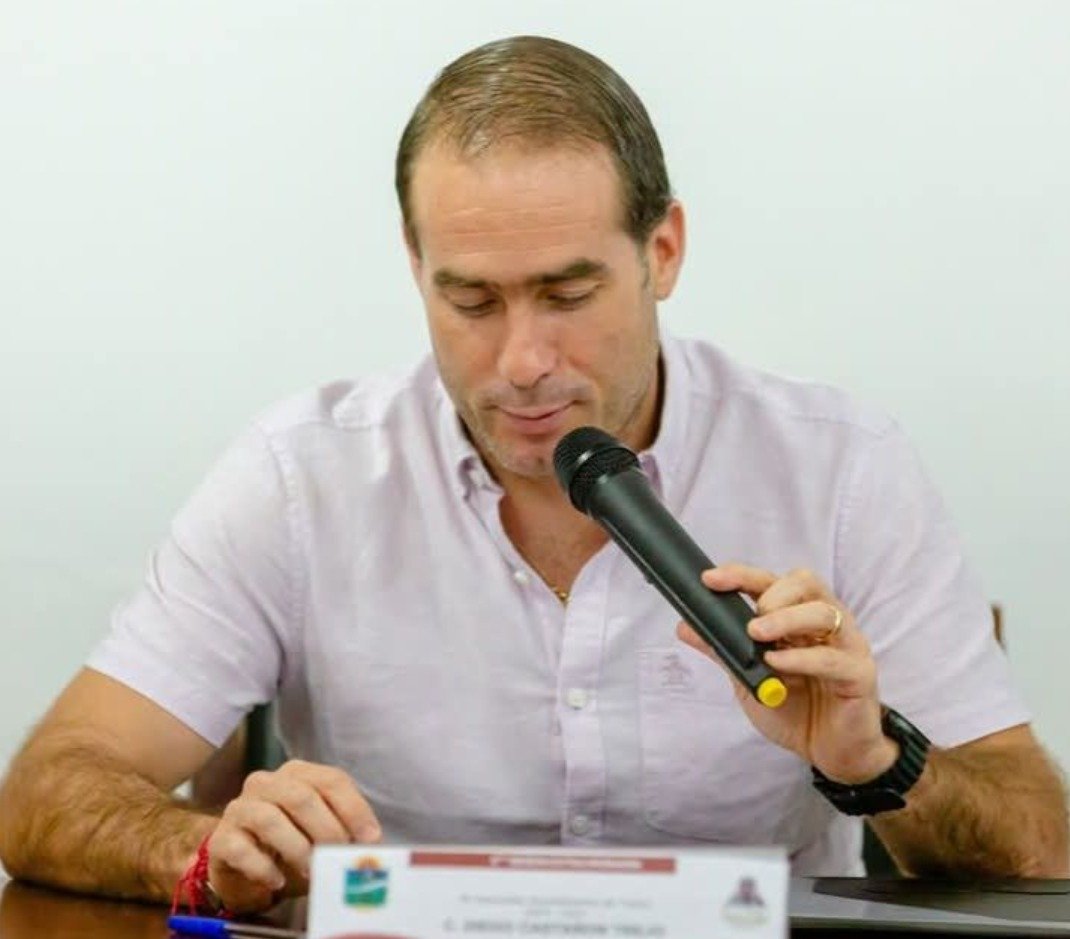
Chetumal, Quintana Roo — The municipal government of Tulum, led by Mayor Diego Castañón Trejo, has been legally prevented from collecting the Public Lighting Fee (DAP) in 2026 due to its failure to comply with an obligation established in its Municipal Finance Law. This omission occurred despite recent reforms to the law intended to circumvent a Supreme Court of Justice of the Nation (SCJN) ruling that had declared the previous collection system unconstitutional.
The SCJN’s ruling invalidated Tulum’s previous DAP collection system, prompting a reform to the Municipal Finance Law of Tulum that modified the collection system starting in 2026. The new system establishes that the fee be calculated by dividing the total cost of public lighting by the number of service users, setting it in monthly installments, similar to the system implemented in the municipality of Isla Mujeres.
However, the same article of the law that establishes how to determine the collection indicates that this fee must be published in the State Official Gazette no later than December 31 of the year prior to its application. The government of Diego Castañón failed to publish the DAP fee for 2026 by the deadline of December 31, 2025.
This failure to establish the DAP fee for this year could be either a premeditated act or an administrative error. Regardless, it legally prevents the municipality from collecting the DAP, potentially resulting in a loss of more than 36 million pesos to the municipal treasury. This amount represents the collection target for this fee established in the Tulum Municipality Revenue Law for 2026.
Given the administration’s demonstrated tendency toward administrative decay, there is a possibility that the government of Diego Castañón may attempt to demand the DAP through the Federal Electricity Commission (CFE) bills to Tulum residents despite this omission. However, any such collection would be completely illegal and arbitrary, as it would not be based on a previously established fee as required by its Finance Law.
This situation is notable because Isla Mujeres did publish its fee for 2026 on December 31, 2025. Tulum and Isla Mujeres are the only municipalities with this new DAP collection system based on determining a fee, an attempt to avoid the declaration of unconstitutionality that the SCJN applied last year to previous regulations in both municipalities.
According to Tulum’s new financial legislation, based on this fee, collection should be made from property owners with CFE contracts through their electricity bills, in amounts that should not exceed 5% of their total private consumption billing, acting as a maximum cap. Meanwhile, users without CFE contracts, meaning owners of vacant or rural properties, would be charged the fee directly in monthly installments or in full along with the Property Tax, according to their chosen payment method.
Furthermore, if the municipality attempts to collect only by applying the 5% to CFE bills, it would be circumventing the SCJN ruling. In October 2025, the Court invalidated precisely this collection system for Tulum, considering it a tax on private energy consumption without any relation to the public lighting service.
At that time, the first two paragraphs of Article 143 Quater of the Municipal Finance Law were invalidated for contravening the principles of proportionality and tax equity, since the public lighting service is of a general nature and cannot be measured based on the private energy consumption of each user.
Along with the 5% charge on CFE bills, the Court also invalidated charging property owners without electricity contracts a fee set at 2 UMAS, equivalent then to 226.28 pesos monthly, for being an unconstitutional differential treatment established for the same service.
Unfulfilled Steps
The Court determined that municipal contributions for public lighting must be set based on the actual cost of the service provided and not on external factors such as private electricity consumption. This was supposedly corrected with the reform to the Municipal Finance Law of the Municipality, carried out on December 10, 2025.
The correction established a new collection system based on a fee calculated by dividing the service cost by the total number of users, including all property owners in the municipality, both those with CFE contracts and those without.
The formula textually states: “Article 143 Quinquies.- The payment of the Fee for the provision and maintenance of Public Lighting monthly will be the corresponding amount derived from the result of dividing the total sum of the concepts contained in the fractions provided for in Article 143 Quater divided by the sum of the number of services registered with the Federal Electricity Commission in the Municipality, the number of owners or possessors of ejidal, rural, suburban or urban properties that do not have electricity services contracted with the Federal Electricity Commission, and have the benefit of the public lighting service and maintenance provided by the Municipality.
The resulting amount will be collected in monthly installments in each bill issued by the Federal Electricity Commission to its users. The payment period for this contribution will correspond to the billing periods for electricity supply service issued by the Federal Electricity Commission to taxpayers, and its amount may not exceed 5% of the amounts that these taxpayers must pay individually for their electricity consumption.
The resulting amount will be published by agreement in the Official Gazette of the State of Quintana Roo no later than December thirty-first of the immediately preceding fiscal year.
Article 143 Sexies.- Owners or possessors of real estate in the municipal territory that have electricity services contracted with the Federal Electricity Commission will make the payment in installments for each of the contracted services through the bill issued by the Federal Electricity Commission to its users.
Article 143 Septies.- Owners or possessors of ejidal, rural, suburban or urban properties that do not have electricity services contracted with the Federal Electricity Commission, and have the benefit of the public lighting service provided by the Municipality may choose to pay the fee for the provision and maintenance of Public Lighting at the time of paying the property tax; or make the payment deferred within the twelve months of the corresponding fiscal year, requesting the corresponding statement from the Municipal Treasury, which must be covered within the first ten days of the corresponding period.”
Since Municipal Treasurer Vicente Aldape Moncada and Mayor Diego Castañón Trejo did not issue the fee established by the Municipal Finance Law by December 31, 2025, there is legally no basis for collecting the DAP from Tulum property owners during 2026, either indirectly or directly.
Additionally, the agreement signed in 2023 with the CFE for collecting the 5% on private consumption bills is no longer valid, as it was based on the articles invalidated by the SCJN in the previous text of the Finance Law, in a ruling of unconstitutionality that nullified all derived acts.
In fact, in the last bimonthly period of 2025 billed by the CFE in Tulum, dated from October 30 to December 30 of the year, the state-owned company no longer charged the 5% DAP on bills to users who measured their private consumption during that period, due to the SCJN’s invalidation of the previous regulation and all its effects.
On the other hand, the only municipality that published its DAP fee for 2026 on December 31, 2025 was Isla Mujeres, because it has the same collection system as Tulum, in an attempt to avoid the unconstitutionality that the Court also ruled against its previous collection method.
The case of Isla Mujeres, although it complied with publishing its fee, is not exempt from contradiction and controversy, as previously exposed, because everything indicates that only the formality was fulfilled, but it will continue using the same collection system previously invalidated by the SCJN, which is the 5% charge on private electricity billing, without taking the fee as reference.
Another controversy is that, both in Tulum and Isla Mujeres, their reformed laws intend to charge users as part of the service cost also the salaries of Public Lighting Directorate employees, the cost of materials and additional maintenance expenses, not just the cost of electrical energy and lighting fixtures consumed by public lighting.
For this reason, and also because its calculation formula did not include owners of vacant properties but only property owners with CFE contracts, in Isla Mujeres the DAP fee established based on its Finance Law is the high amount of 6,083 pesos annually per user, equivalent to 507 pesos monthly and 1,014 pesos bimonthly, a cost higher than the average Property Tax.
Tulum would have to determine a somewhat lower figure, since Mayor Diego Castañón set in his Revenue Law that he wants to collect 36 million 395 thousand pesos from DAP in 2026, with more users than Isla Mujeres, although this figure does not represent the service cost, which the Municipal Treasury also did not present in a timely manner.
But due to the omission of publishing the resulting fee, any collection that the government of Diego Castañón makes this year on the DAP will be illegal and arbitrary, because it was not published within the deadline set by its law.
For this reason, any user affected by the DAP charge on each bimonthly electricity consumption bill can legally fight not to pay it, although for this only the path of the amparo lawsuit remains, to which generally only businesses or consortia with sufficient income to pay for lawsuits have access. Municipalities like Tulum take advantage of this situation to capture their citizens as hostages of their arbitrary acts.
Discover more from Riviera Maya News & Events
Subscribe to get the latest posts sent to your email.