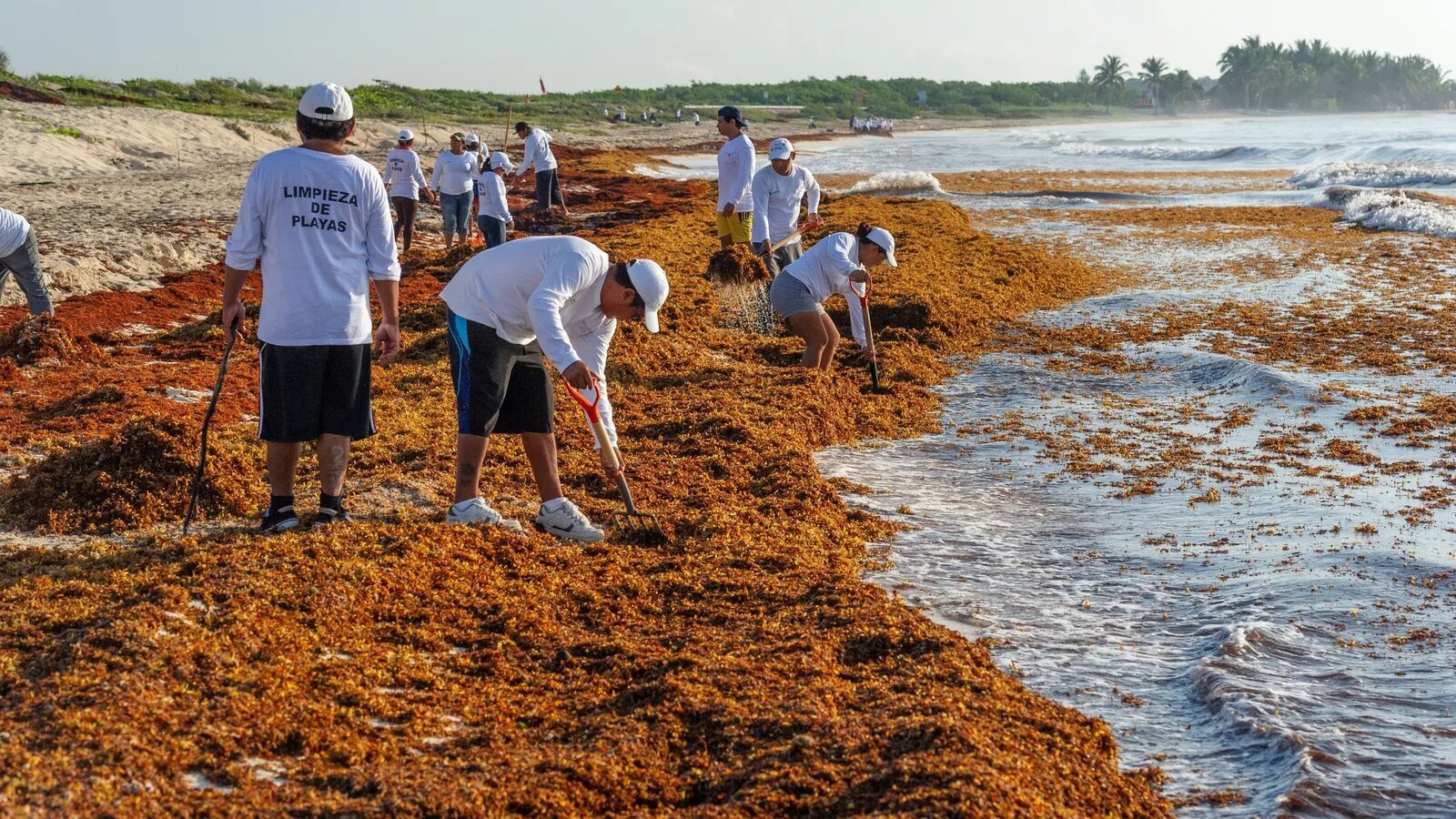
Yucatan Peninsula, Mexico — As massive waves of sargassum continue to inundate Caribbean coastlines, Mexican scientists are advancing a scalable solution that could transform one of the region’s most persistent environmental problems into a source of energy, biomaterials, and agricultural products.
Researchers estimate that as much as 40 million tons of sargassum are currently circulating in the Atlantic and Caribbean, much of it destined to wash ashore along the Mexican Caribbean, particularly in Quintana Roo. The uncontrolled accumulation of the seaweed has affected beaches, tourism, marine ecosystems, and municipal budgets for nearly a decade.
In response, scientists from the Centro de Investigación Científica de Yucatán (CICY) are scaling a biorefinery process designed to address two long-standing barriers to sargassum utilization: its high heavy-metal content and its complex biochemical structure, both of which have historically made industrial use costly and inefficient.
“We developed a process that precisely targets these two points to make its utilization more profitable and effective,” one of the researchers explained.
From Seaweed to Energy and Industry
The process begins with the extraction of alginate, a natural polymer widely used in the food, pharmaceutical, and cosmetic industries as a stabilizer and thickener. According to the research team, one kilogram of sargassum can yield approximately half a kilogram of alginate-rich residue.
Rather than discarding what remains, the team feeds this residue into an anaerobic digestion system, where it is converted into biogas, a renewable fuel capable of generating electrical energy.
“We use that residue to generate a biofuel, which is biogas, and it can be used to generate electrical energy,” the researchers affirmed.
The final byproduct is a nutrient-rich sludge, which can be commercialized as a soil enhancer or biofertilizer, creating a closed-loop system with no waste.
Developing New Biomaterials
Beyond energy, the project is also exploring biomaterials made partially from sargassum to reduce dependence on imported or petroleum-based raw materials. “We are working with sheets made with 40% sargassum and 60% recycled plastic,” the team noted.
These composite materials could be used in construction, packaging, and industrial applications, offering a lower-impact alternative to conventional plastics.
The Logistics Challenge
The primary challenge now is scale and logistics, driven by the extreme seasonality of sargassum arrivals. “During peaks with massive arrivals, there can be up to 60,000 tons of sargassum in a single day. There is sufficient raw material, but logistics must be organized to store it throughout the year and use it consistently,” the researchers emphasized.
This would require collection hubs, drying and storage facilities, and coordinated transport systems along the coast.
Where the Biorefinery Would Be Located
The proposed semi-industrial biorefinery is being developed in Yucatán, at facilities operated by CICY, with the intention of serving Quintana Roo’s coastal sargassum collection efforts. The location allows proximity to affected beaches while operating inland, reducing environmental risk and infrastructure strain along the shoreline.
CICY already operates semi-industrial machinery capable of processing 500 kilograms of sargassum per day, and the project recently secured nearly 5 million pesos in funding from the Secretaría de Ciencia, Humanidades, Tecnología e Innovación as part of a technological maturation program.
A National Effort With Global Implications
The initiative is part of a broader collaboration involving more than 15 institutions from Mexico City, Querétaro, Yucatán, and Chihuahua, reflecting nationwide economic and scientific interest.
“We have been working with sargassum for 10 years, practically since it arrived in Quintana Roo. We are very close to the problem,” the researchers said.
Their warning remains stark: “There are 40 million tons in the sea that will end up on the beaches.”
If successfully scaled, the project could mark a turning point—shifting sargassum from an environmental liability into a renewable resource, while offering a model that other Caribbean nations facing the same crisis could adapt.
Discover more from Riviera Maya News & Events
Subscribe to get the latest posts sent to your email.