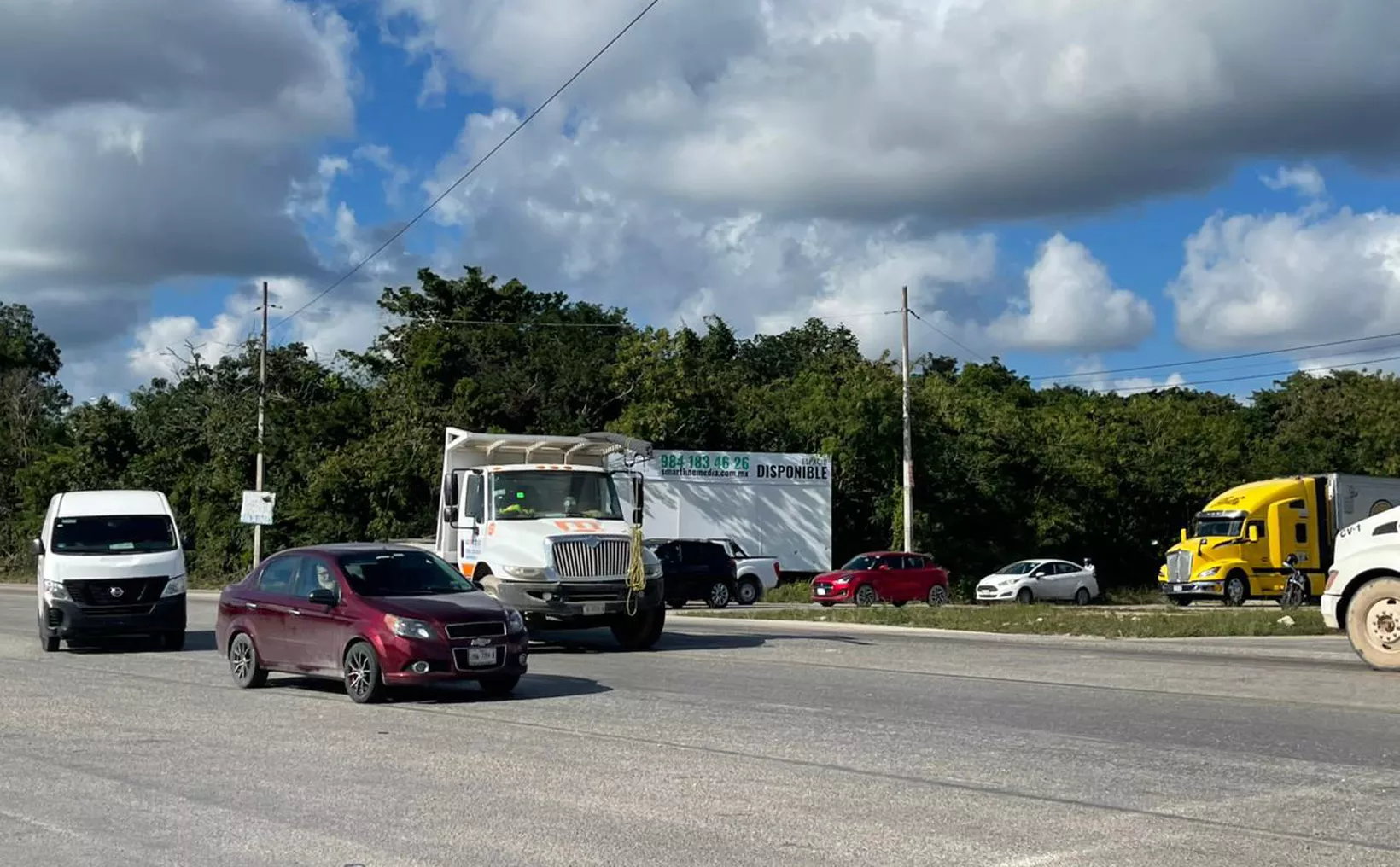
Quintana Roo, Mexico — The Mexican Ministry of National Defense (Sedena) has submitted two major infrastructure projects to the Ministry of Environment and Natural Resources (Semarnat) for environmental permits, with a combined value exceeding eight billion pesos for the state of Quintana Roo.
The projects include the Cancún-Sur Bypass, which will expand Huayacán Avenue to its junction with Highway 180, with an investment of 3.121 billion pesos. The second project is the Maya Train cargo terminal in Chetumal, with a planned investment of 5.047 billion pesos.
Both projects are awaiting environmental permits from Semarnat, where the executive projects were submitted. The projects are promoted by Tren Maya SA de CV, a subsidiary of the Olmeca-Maya-Mexica Airport, Railway, Auxiliary Services and Related Services Group (Gafsacomm).
Cancún-Sur Bypass Project
For Cancún, authorities are preparing the Cancún-Sur Bypass, which will expand Huayacán Avenue to its junction with Highway 180, located behind Cancún International Airport. This route will in turn connect with Highway 307 (Cancún-Chetumal), with an investment of 3.121 billion pesos.
This roadway will directly link federal highway 180 (Cancún-Airport branch) with federal highway 307 (Cancún-Playa del Carmen) and with the new Multimodal Rail Cargo Station.
“This plan involves the construction of a Bypass that guarantees and relieves unnecessary traffic to the Cancún Passenger Station (Highway 180D) and will subsequently allow handling the traffic generated by the Multimodal Cargo Terminal,” the project description adds.
Chetumal Cargo Terminal
The Chetumal cargo station contemplates an impact on 47.81 hectares of vegetation cover, within a total polygon of 101.4623 hectares corresponding to the Project Area. The land to be impacted is located in the southwestern part of the municipality of Othón P. Blanco, parallel to highway 307 Chetumal-Cancún, approximately 900 meters west of it. The nearest town is Xul-Há, located 2 kilometers to the south, and Bacalar is 10 kilometers away.
The terminal includes facilities for crew accommodation, tetra antenna, gasoline dispatch, washing area, scale, public warehouse, roads, vehicle access booth and railway control booth, construction zeros, transformer room, customs building, parking maintenance workshop, National Guard, welcome wall, administrative office, maneuvering yard, water treatment plant, intermodal platform, territorial reserve, hazardous waste area, car maintenance workshop, diesel and gasoline tanks, totem, public road and inspection roadway.
The terminal will improve connectivity and logistics in the region, integrating into the context of the Maya Train between Chiapas, Tabasco, Campeche, Yucatán and Quintana Roo. It will facilitate more efficient access to national and international markets, allowing for more agile transportation of goods and reducing delivery times.
Cancún Bypass Technical Data
- 68.512 hectares of medium-height forest will be impacted
- 15.394 kilometers of right-of-way length
- 39.00 meters width
- 3 lanes per direction
Discover more from Riviera Maya News & Events
Subscribe to get the latest posts sent to your email.