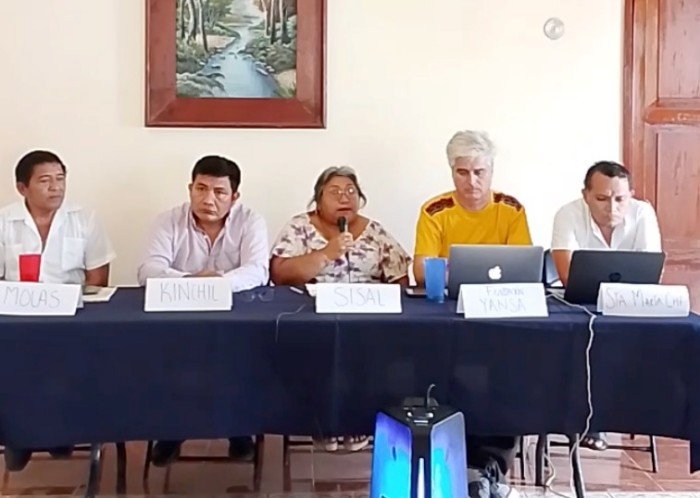
Mérida, Yucatán — Representatives of the Maya communities of Molas, Sisal, Santa María Chí and Kinchil announced Friday a statewide march on Aug. 9, International Day of the World’s Indigenous Peoples, to denounce territorial, environmental and access-to-justice conflicts they say affect their communities across Yucatán.
At a news conference, community leaders and members of indigenous councils detailed specific grievances they said reflect a pattern of rights violations by private interests and government agencies.
Rogelio Narváez, a member of the Original Indigenous Council of Molas, said that since the San Gerardo pig farm in Santa María Chí was closed, the transfer of pigs to other farms near the community has increased, bringing more truck traffic, bad odors and risk for residents. He recalled that after a truck broke an electrical cable in an accident, residents of Molas protested last weekend and later tried to hand a letter to the municipal office asking for information about the vehicles and requesting a community assembly. Instead, he said, they received an acknowledgment describing them as “people who invade the lands in Chuntuak,” a characterization he called offensive given that they are residents of the community.
Narváez said they subsequently filed a new letter to Mérida Mayor Cecilia Patrón Laviada requesting that any decision concerning the truck passage be put to residents in a community assembly.
Fátima Cob, a member of the Indigenous Community Council of Sisal and the FAISPIAM committee, said the Hunucmá city council has delayed the opening of 4 Poniente Street, a project approved by the community assembly and funded by the Social Infrastructure Contributions Fund for Indigenous and Afro-Mexican Peoples and Communities. She said that although the street opening was announced nearly four months ago, the council has not taken the necessary steps and has not endorsed a document required for submission to Mexico’s Environment Secretariat (Semarnat) and the Federal Attorney’s Office for Environmental Protection (Profepa). She also expressed concern that people outside the community have built structures along the street’s planned route.
Wilberth Nahuat, municipal commissioner of Santa María Chí, said the community is still waiting for Profepa’s environmental assessment of damage attributed to the company Pecuaria Peninsular, a document he called indispensable before accepting any meeting with the environmental authority. He said several legal proceedings related to the closed pig farm remain pending and expressed concern that the problem is moving to other communities such as Molas.
“The farm is already closed and they are removing everything they have there, but unfortunately they are taking the problem somewhere else,” he said.
Nahuat called on the public to join the march on Aug. 9, which will start at 10 a.m. at the Remate de Paseo de Montejo and end at Plaza Grande in Mérida. He said the mobilization aims to bring together indigenous peoples, collectives, organizations and citizens who consider their rights violated, and to denounce the criminalization of community defenders and the lengthy legal processes facing many communities.
The conference also touched on the upcoming consultation on the proposed General Law on the Rights of Indigenous and Afro-Mexican Peoples. Federico May, a representative of the Kinchil Community Council, said the initiative will be fundamental for the future of indigenous communities, but said there is still little information about its contents. He called for informed participation in the consultations scheduled for August.
Together with the Yansa Foundation and other civil organizations, the groups announced a free virtual seminar on Aug. 3, 5 and 7 in which specialists will analyze chapters of the initiative, including self-determination, territory, indigenous consultation, women’s rights, direct budgeting, cultural heritage and indigenous jurisdiction. Organizers said the goal is for communities to arrive at the consultations with concrete proposals to strengthen the future legislation and ensure informed participation.
More Politics
- Quintana Roo Electoral Body Orders Councilwoman To Pull Videos Criticizing Mayor
- Latinus Audio: Businessman Says He Gave Money to Marina del Pilar’s Campaign
- Arizona Correctional Officer Accused of Smuggling Ammunition for Sinaloa Cartel Faction
- US Ambassador Warns Cartels Pose Terrorist Threat at 9/11 Ceremony in Mexico
- US Northern Command Praises Mexico’s Anti-Drone Efforts