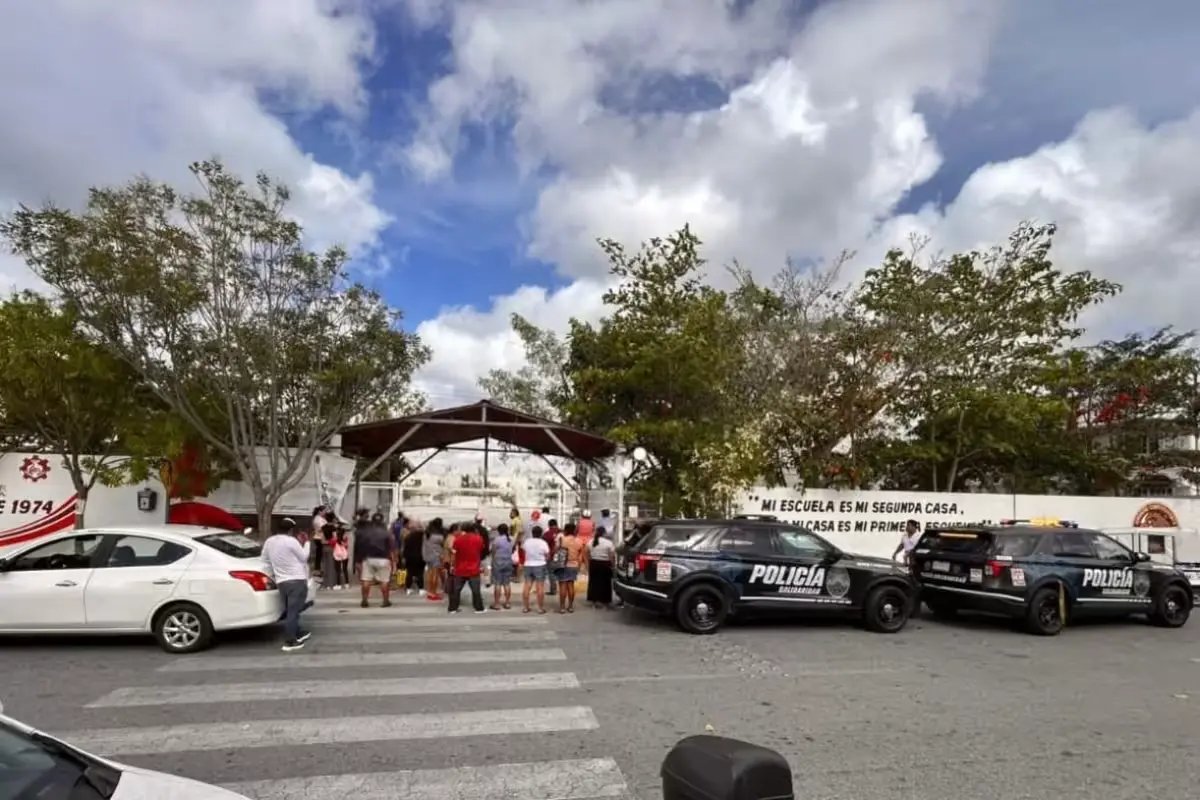
Quintana Roo — Students in Quintana Roo are facing threats to their dignity, health, safety, and youth, according to parent associations and youth mental health analysts. They argue that a comprehensive strategy is needed, starting with moral and ethical education at home, reinforced by academic education in schools, and supported by all three levels of government and educational authorities.
Young people are at risk when irregularities occur at their schools, as seen in incidents this March. These include students involved in a drug retail network outside their school, middle school girls drugged by marijuana-laced food provided by a teacher, students erupting in anger due to bullying and threatening others with a knife, and teachers maintaining romantic relationships with students.
Psychologist Amauri Félix notes that values, which are increasingly neglected in practice and teaching, are qualities that help young people reason and distinguish between good and bad, right and wrong, and honorable and dishonorable actions. “There are tools young people can use to ensure full development during their student years. Morality, judgment, assertiveness, and ethics, like other values, are acquired at home. Each individual develops them in their own way, but it is crucial to guide young people in developing these concepts for their benefit,” Félix said.
“Unfortunately, in current times, parents have largely disengaged from teaching values because they often lack them themselves, and young people find these values on the streets, not in the best way,” Félix added.
According to Sergio Acosta, president of the Quintana Roo Parents’ Association, the state remains the second in the southeast region with the best conditions for students, after Yucatán, followed by Campeche, Chiapas, and Tabasco in last place due to documented cases.
These recent cases have been documented and shared on social media, with young students often the first to expose such grievances through posts or messages to their parents. “We must work together—the school community, parents, students, school authorities, and the three levels of government. There are deep social problems that cannot be fixed with a warning or a note explaining a child’s misbehavior to their parents,” Acosta said.
“It is regrettable that among teaching staff, there are professors who even have romances with students and have given them harmful substances. There is protection from authorities and unions, but these individuals must be sanctioned to the full extent of the law because they are endangering our most valuable asset: our youth,” Acosta emphasized.
To prevent such altercations, like the student who attacked another with a blade, the debate over implementing the so-called “Backpack Operation” has reopened. This measure, which aims to prevent dangerous objects, harmful substances, and prohibited items from entering schools, was discontinued due to recommendations from the National Human Rights Commission and the Supreme Court, which deemed it unconstitutional and a violation of children’s rights.
Experts suggest the state still has an opportunity to curb these irregularities through integrated efforts involving all parties in educational centers, where students should receive education for their proper development and academic formation, as their future intrinsically depends on it. Failure to do so correctly could negatively affect young people in the future.
Discover more from Riviera Maya News & Events
Subscribe to get the latest posts sent to your email.