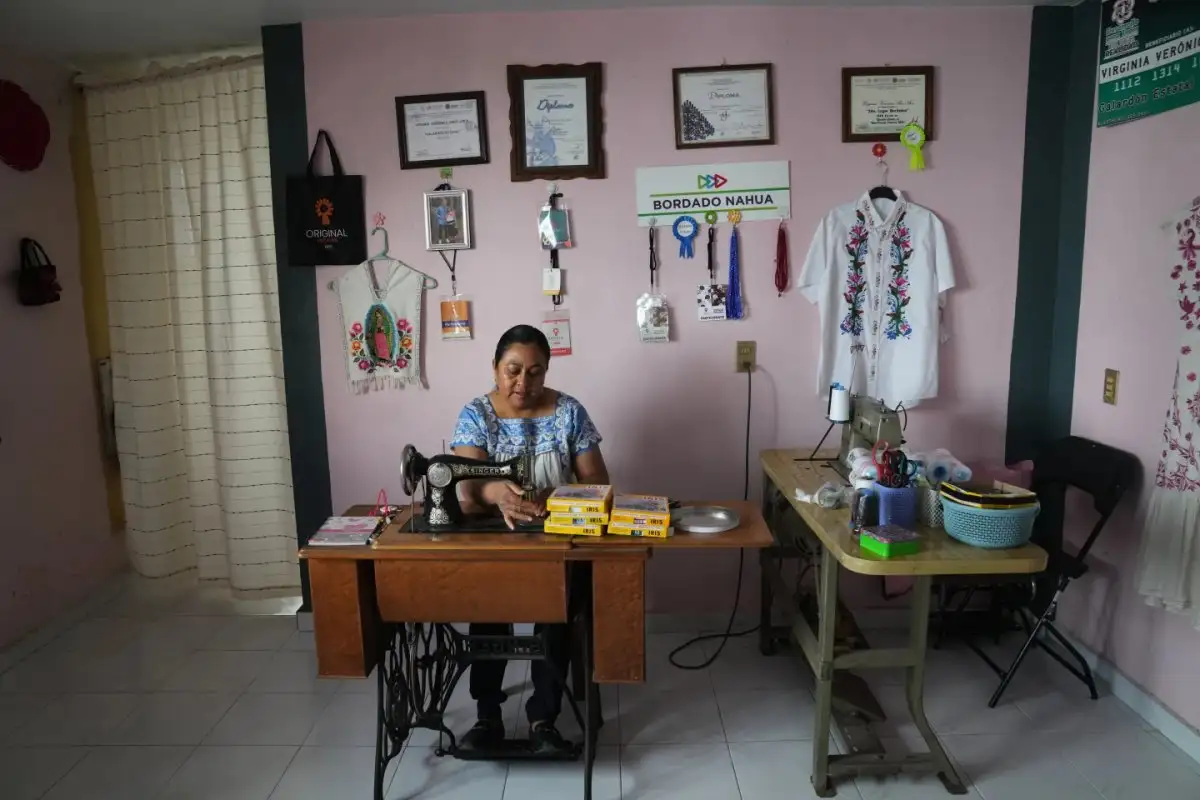
In the Mexican mountain town of San Isidro Buen Suceso, Virginia Verónica Arce Arce begins her days as she has for decades: seated before her antique Singer sewing machine, guiding bright threads to create intricate patterns passed down through generations.
Arce is part of a group of talented indigenous artisans collaborating to create the colorful embroidered dresses and huipiles (traditional blouses worn by indigenous women) that have become a staple in Mexican President Claudia Sheinbaum’s wardrobe and earned her a spot on the New York Times’ “most stylish” list.
A Platform for Artisans
The president’s style caught the attention of the New York Times, which this month included her in its list of the most stylish people of 2025, saying she had drawn attention to the country’s indigenous fashion by wearing “embroidered clothing.”
Arce learned the art of Nahuatl embroidery from a young age thanks to her father. Her motifs of flora and fauna from La Malinche mountain in the state of Tlaxcala, in central Mexico, became her signature and soon caught Sheinbaum’s attention.
The president wore one of Arce’s embroidery designs sewn onto an elaborate purple dress to lead her first celebration of Mexico’s Independence Day on September 15.
When the president stepped onto the balcony of the National Palace to wave the Mexican flag, millions of Mexicans saw Arce’s work.
“It was very emotional,” said Arce, describing how her family gathered around the television to watch the familiar stitches. “When she came out and put on the dress, it was very emotional to see her, with the embroidery from Tlaxcala and, above all, from my community.”
Reused Garments
It wasn’t the first time Sheinbaum had worn something made by Arce. Sheinbaum wore one of her traditional huipiles during her presidential campaign, and later Olivia Trujillo Cortez, one of the president’s seamstresses, adapted it into a formal suit.
Sheinbaum’s team often recycles her clothing. When Sheinbaum has worn a blouse or dress multiple times, she asks to readapt the garment into a suit or jacket, giving them new life without spending too much, said Trujillo.
Using embroideries and textile patterns from indigenous artisans in Oaxaca, Chiapas, and elsewhere, Trujillo began producing suits, dresses, and formal ensembles for debates, campaign rallies, and eventually, the presidential palace.
“People from all social strata now want a dress like the president’s. It has become a trend,” said Trujillo about Sheinbaum’s embroidered pieces.
Defending Against Plagiarism
Sheinbaum, like former President Andrés Manuel López Obrador, has exhibited and defended Mexican folk art from plagiarism. In August, her administration accused sportswear company Adidas of “cultural appropriation” and copying the design of huaraches, traditional footwear made by the Zapotec indigenous people of Oaxaca.
In 2021, the federal government asked brands like Zara, Anthropologie, and Patowl to publicly explain why they copied embroidered blouses from indigenous communities in Oaxaca to sell in their stores.
These pre-Hispanic shoes and garments, whose patterns and weaves vary by region, were viewed with contempt for centuries in Mexico. There were even periods during colonial times when huipiles were burned in public bonfires as part of an effort to eradicate everything that came from indigenous peoples.
For years, if someone wore a huipil “it looked bad,” said the president, adding that contempt for that clothing, which is an expression of racism, persists in some parts of the country to this day.
From Discrimination to Pride
Claudia Vásquez Aquino, an artisan from the state of Oaxaca and one of the many women behind the president’s signature style, is grateful that Sheinbaum is showing the world the value of indigenous clothing.
Sheinbaum took the oath of office on October 1, 2024, wearing an elegant ivory-colored dress with a round neckline, long sleeves, and colorful floral embroidery on part of the skirt. The dress was designed and embroidered by Vásquez in the style of the southern state of Oaxaca and made by Trujillo.
“You have no idea how significant this is for every artisan,” said Vásquez, who still remembers how as a child she would change out of her traditional clothing when going to the city to avoid being mocked.
“We went to the extreme of taking off our huipil and putting on a blouse or casual pants… we didn’t want to arrive in the capital looking like an indigenous woman,” she said. “Today everything has changed.”
Discover more from Riviera Maya News & Events
Subscribe to get the latest posts sent to your email.