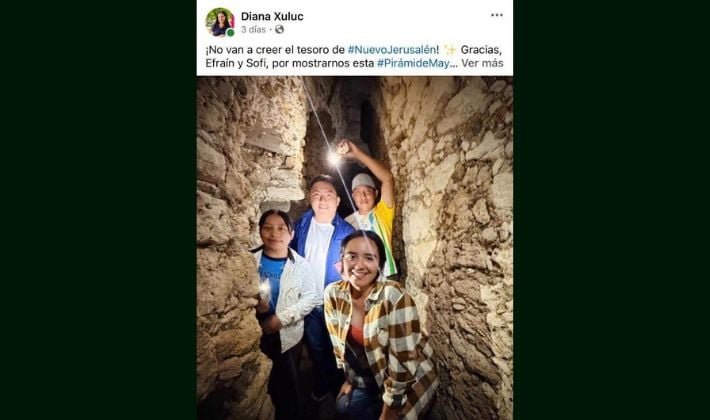
Bacalar, Quintana Roo — Mexico’s National Institute of Anthropology and History (INAH) has opened an administrative inquiry into a Bacalar municipal official who entered and filmed at a Maya archaeological site that is not open to the public, saying it never authorized the visit.
The institute announced the move after Bacalar city councilor Tania Casa Madrid publicly complained on social media that Diana Xuluc, the municipality’s director of youth affairs, had entered the site at Nuevo Jerusalén, a community in the Bacalar municipality.
Casa Madrid filed her complaint with the INAH Quintana Roo Center. It followed a post on Xuluc’s own social media accounts in which she posed alongside the ruins and highlighted the majesty of the Maya pyramid. She was accompanied by other people, according to the complaint.
INAH said it would open the corresponding administrative procedure to determine responsibility.
“All access to archaeological zones requires the express authorization of the institute,” the agency said. “Consequently, through the INAH Quintana Roo Center, the corresponding administrative procedure will be initiated in accordance with the regulations applicable to the protection of archaeological heritage, in order to determine responsibilities.”
The institute said that any entry to, or activity at, archaeological zones and sites requires its express authorization, and it called on municipal authorities to respect the established procedures for protecting the country’s cultural heritage.
More Culture
- Pre-Hispanic Frog Pendants From Tren Maya Route Shed Light on Ancient Maya Trade
- Mayatek Brings Technology and AI Talks to Mérida, Entirely in Maya
- Five Finalists Chosen for Xmatkuil Fair Ambassador Contest
- Yucatecan Filmmaker Wins Ariel Award for Cliff Divers Film
- Same-Sex Marriages Nearly Triple in Yucatán as 2025 Sets an Eight-Year Record