Cancún — Mexican President Claudia Sheinbaum will visit the area on Friday where the Tren Maya charging station will be built, a site set to become a key piece for regional mobility.
The visit coincides with the progress of another strategic project: the expansion of Huayacán Avenue, a work promoted as part of a new road circuit that will integrate directly with the Níchupté Bridge, whose inauguration is scheduled for December.
A Route Responding to Cancún’s Accelerated Growth
Governor Mara Lezama highlighted that Cancún is experiencing growth that demands new mobility solutions. She recalled that for years, the city depended almost entirely on Kabah Avenue to connect entire sectors, causing constant congestion.
In this context, she explained that the expansion of Huayacán Avenue is part of a plan that also includes the extension of Chacmool and other routes that will soon be announced. All these works, she said, aim to give cohesion to the east of the city and improve access to areas that now concentrate new residential and commercial developments.
A Project Coordinated with Defense and Linked to the Tren Maya
Mara Lezama indicated that the expansion is directly linked to the Tren Maya charging station, making it necessary complementary infrastructure to handle the flow generated by this new logistics node.
She recalled that the first step was already completed with the construction of the bridge carried out by the Secretariat of National Defense (formerly Sedena). Since then, work has been coordinated with the military commands involved in the Tren Maya—including General Vallejo and General Águila—to advance the pending sections and define the start of the road work.
The complete route adds about nine kilometers considering the already constructed bridge. “It is a very advanced project; we hope it can be resumed soon to conclude what remains,” she stated.
Donated Lands to Free Up the Right of Way
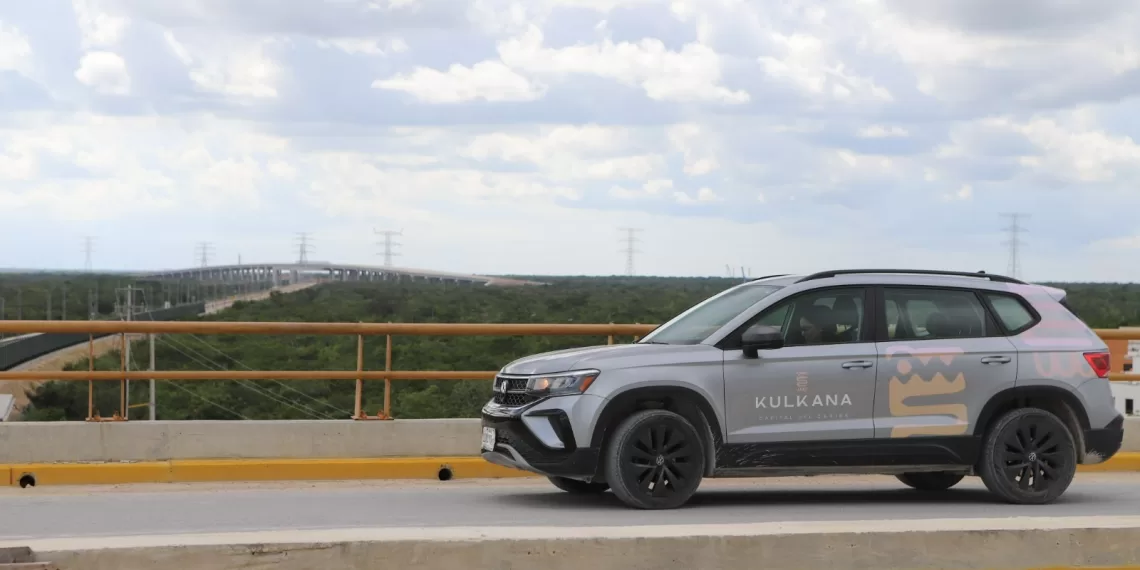
The governor confirmed that land availability was decisive in moving the project forward. Private companies such as Desarrollo Kulkana and Grupo Palace donated the necessary lands so that Defense could begin technical planning and shape the expansion. These contributions, she emphasized, were key to freeing up the right of way.
For his part, Juan José de Errejón Alfaro, general director of Tierra de Armonía, the development company of Kulkana, explained that the objective is to build an integral community that offers services from the early stages and promotes an environment conducive to family well-being.
He explained that the Kulkana residential development is advancing with a vision of a city projected toward 2050, where mobility, the ecological environment, and quality of life are essential parts of its design.
Errejón Alfaro detailed that the extension of Huayacán Avenue, included in the Urban Development Program, will be a key axis for mobility in southern Cancún. The roadway will connect Highway 180 with the outlet zone along about nine kilometers, a section that already shows progress in earthworks.
Benefits That Transcend Development
The project will not only strengthen Kulkana’s internal connectivity. According to the executive, the expansion of Huayacán will function as an additional access for Cancún, with the capacity to alleviate vehicular load during saturation periods, as occurred during construction works in recent years.
The infrastructure will also allow access to strategic facilities, such as the Tren Maya charging station located further south. This connection, he indicated, will contribute to more efficient mobility within the municipality and reinforce links with the region.
Errejón Alfaro emphasized that these advances respond to a long-term vision for Cancún, where new developments must integrate with mobility solutions, services, and environments that favor good living from their origin.
Huayacán and Níchupté Bridge: A Corridor That Will Transform Mobility
The expansion of Huayacán Avenue will integrate directly with the Níchupté Bridge, a work that will be inaugurated next month and will connect more efficiently with the urban area.
The junction between both infrastructures will allow the creation of a continuous corridor that will alleviate the vehicular load on other avenues and provide new access routes to the east of Cancún.
For the governor, this package of works represents a substantial advance toward a mobility model that promotes well-being and development for families.
According to gathered data, as part of the Huayacán expansion, the construction of a bridge at the highway bypass junction is being analyzed, a point that already registers congestion and represents risks for motorists.
Although traffic lights were initially considered, the viaduct proposal has been on the table since 2018 and is part of the improvement proposals for that corridor.
Discover more from Riviera Maya News & Events
Subscribe to get the latest posts sent to your email.