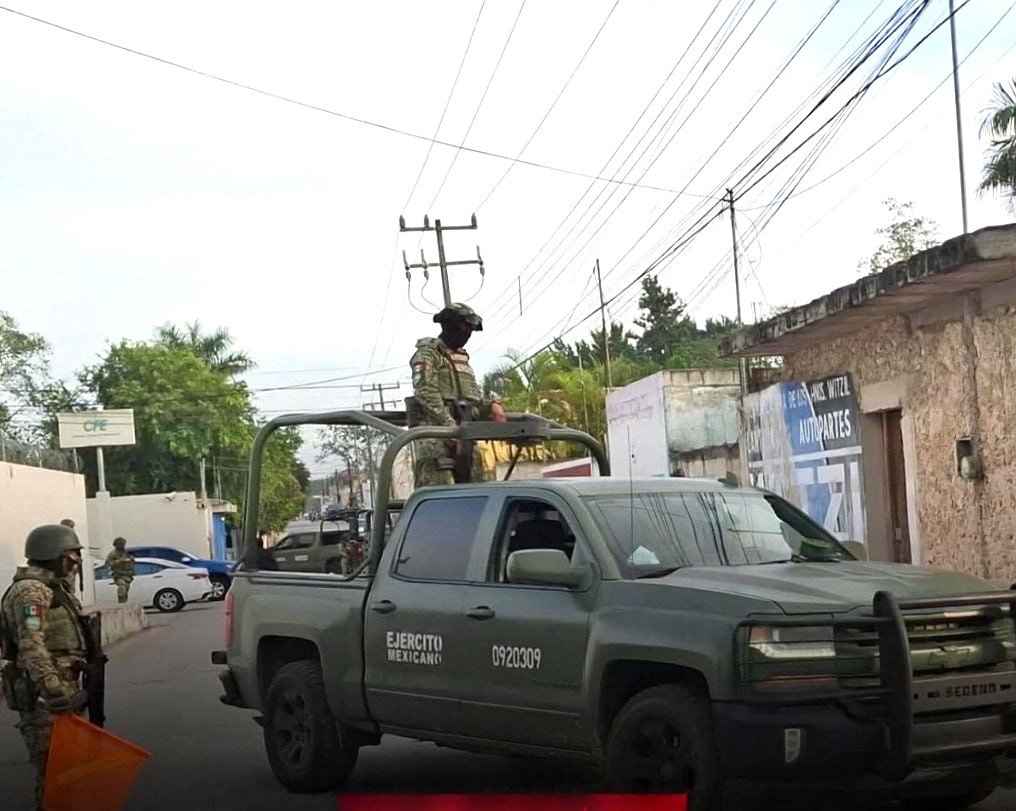
Tizimín, Yucatán — Efrén Ricardo “El Conejo” Alamilla was detained in Tizimín following a series of federal searches and operations that culminated in the early hours of November 27, 2025. His capture is significant, as he is a criminal with over two decades of operations in the region, historically protected by state and municipal police commanders who allowed him to consolidate an active criminal structure that was difficult to touch.
The operations led by the Attorney General’s Office (FGR) and the National Defense Secretariat (Sedena) included interventions at various residences where the capo was presumed to be hiding. The federal presence generated tension in residential areas, especially in homes unrelated to the events, revealing the scale of the operation and the need to exclude local corporations whose members, in the past, would have facilitated the detainee’s impunity.
At a residence in the San José Nabalam neighborhood, federal forces finally captured Alamilla. Several kilograms of marijuana and crystal meth were seized at the location, along with other evidence linked to his criminal activities.
Who is “El Conejo” and Why Does His Capture Matter?
Contrary to what some residents of Tizimín believe, “El Conejo” is not just any small-time drug dealer. The growing void left by the capture of capos like Roberto Nájera Gutiérrez, alias “La Gallina,” a lieutenant of Joaquín “El Chapo” Guzmán, allowed Alamilla to rise in the criminal structure.
The capture of Roberto Nájera Gutiérrez, alias La Gallina, in 2017 marked one of the strongest blows against the criminal structure operating in the southeast of the country. Considered by federal authorities as one of the regional leaders of the Sinaloa Cartel in Yucatán and Quintana Roo, Nájera was detained by the Yucatán Public Security Secretariat at a checkpoint in Tizimín while traveling in a tinted SUV and carrying two long weapons and three short ones, accompanied by two other men.
His name already appeared in judicial records for homicides in Chiapas, as well as in investigations by the PGR for organized crime and drug trafficking from Belize to Yucatán, Quintana Roo, Campeche, and Chiapas. He was also linked to the purchase of ranches in good condition or bankrupt in Tizimín for money laundering operations, as well as to score-settling that left victims in Chiapas and Yucatán.
After his arrest and the deterioration of his criminal network disputed by the Cancún Cartel, Los Zetas, and groups linked to “Doña Lety,” the region experienced an immediate reconfiguration of organized crime, opening spaces for local operators seeking to fill the power vacuum.
It was in this context that figures like Efrén Ricardo “El Conejo” Alamilla found the conditions to rise in organized crime. While he never reached the hierarchical level of “La Gallina,” he held a relevant position locally and was clearly advancing on the path to climb positions within the organization, protected by police commanders who allowed him to operate, expand, and consolidate his criminal network in Tizimín.
Unlike other minor shooters, “El Conejo” managed to move discreetly and with local support thanks to police protection networks and alliances with remnants of the structure left by La Gallina. While he had not yet become a relevant capo for the area, he was a criminal who carried out constant, substantial robberies and small-scale drug distribution in eastern Yucatán.
Security sources indicate that Alamilla took advantage of the power vacuum to consolidate drug sales points in Tizimín and operate with greater freedom, but his structure was not limited to small-scale drug dealing. According to police reports, “El Conejo” led a network of thieves dedicated to home robberies, commercial establishments, and offices, actions that allowed them to finance their operations and keep their distribution points active in collaboration with local characters dedicated to the “underworld of ampa.”
Among these events, they were responsible for the robbery at the offices of the newspaper Diario CAMBIO 22 in Tizimín, where his group stole computer equipment, lamps, wiring, office supplies, construction materials, and various valuable objects—a blow that evidenced the level of organization and operational capacity of his criminal network in the area.
The stolen items from the office exceeded 3 million pesos, according to statements from the property owners. Additionally, the same criminal cell broke into the home of the director of this publishing house, from where they took personal items, electronic devices, and wiring—a second robbery amounting to over 500,000 pesos.
His continued freedom despite arrests demonstrates the corruption and collusion of some local commanders.
With the November 2025 detention by federal forces, the community hopes that this time the case will not be diluted once again.
A Federal Operation Without Local Participation: A Paradigm Shift?
Unlike previous captures, the November 27, 2025 operation did not involve municipal or state police. It is believed that the decision was made to prevent leaks and ensure the success of the operation.
The simultaneous searches were conducted with agents of the Federal Ministerial Police and Sedena military personnel, who secured the perimeters and ensured the evidence.
The intervention by the FGR and Sedena also sends a message: the case will no longer be handled by the same authorities that in the past failed to prosecute the accused.
The seized drugs and the detainee were placed at the disposal of the Federal Public Prosecutor’s Office, which must initiate investigations for crimes against health and organized crime.
The story of “El Conejo” Alamilla reflects how police collusion and corruption allow crime operators to continue committing crimes for years. His detention this time by federal forces is an important step, but the difference will lie in the process advancing without interventions from the protection networks that have operated in Tizimín.
While some neighbors downplay the arrest, the data shows that Alamilla accumulated over a decade of criminal activity and, after the fall of “La Gallina,” consolidated as one of the most relevant distributors and robbery operators in eastern Yucatán.
The Tizimín community and federal authorities must ensure that this time there is no return. Criminals of this profile must remain behind bars to prevent the reoperation of small-scale drug dealing networks and home robberies that for years have harmed families and poisoned the population with the drugs they distribute in Tizimín and the region.
So far, Yucatán authorities have not issued official information from the Prosecutor’s Office. The case remains sealed. In the coming days, an institutional stance is expected, but above all, the outcome of a criminal case that for years left damages, robberies, and direct impacts on society.
Discover more from Riviera Maya News & Events
Subscribe to get the latest posts sent to your email.