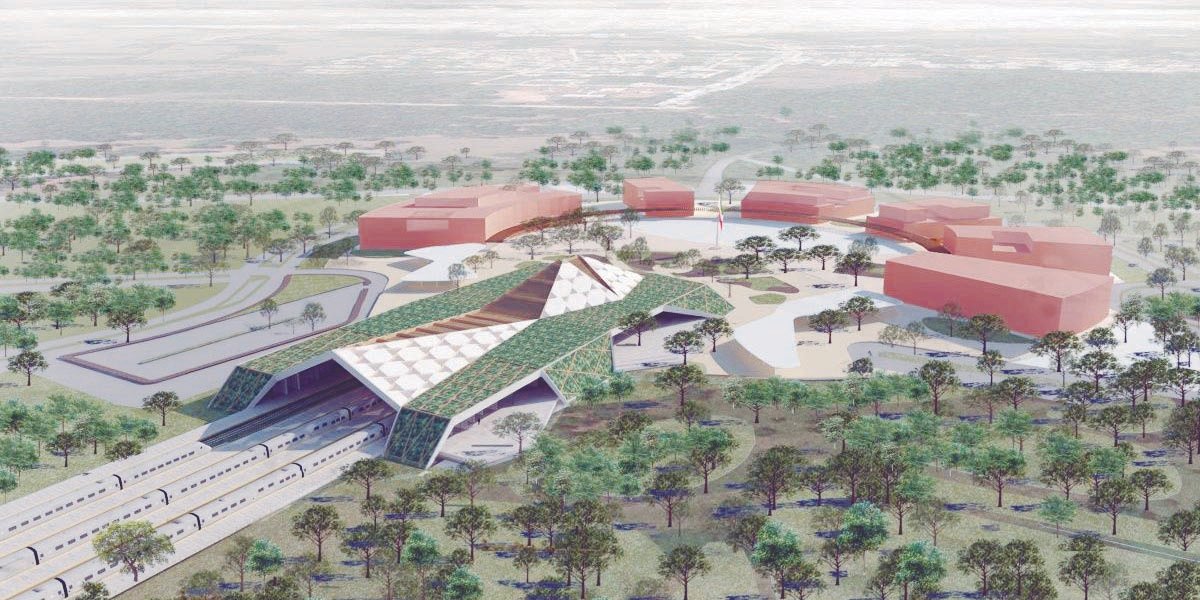
Cancún, Quintana Roo — A federal court has rejected an injunction to suspend construction of the Maya Train cargo terminal in Cancún, ruling that environmental groups failed to demonstrate sufficient evidence of irreversible ecological damage.
The Fifth District Court and the Third Collegiate Circuit Court of Appeals both denied requests from the Mexican Center for Environmental Law (Cemda) to halt work on the multimodal station being built by the Mexican Army. The courts determined that the environmental risks presented were hypothetical rather than tangible.
Judge Alonso Robles Cuétara of the Fifth District Court rejected the provisional suspension on February 26, stating in his ruling that “if no potentially tangible risk to the environment is presented… and not merely hypothetical as in this case, it is clear that the precautionary measure is not justified.”
Cemda had challenged an environmental impact resolution that authorized clearing jungle south of Cancún for the cargo station construction. The organization argued that local ecosystems are interconnected, creating regional risks that have already been demonstrated in the Playa del Carmen to Tulum section where underground river water has turned murky, potentially affecting coral reefs.
The legal battle began in September when Cemda filed the injunction, but the federal judicial system initially rejected it over jurisdictional conflicts before finally admitting it for resolution in February.
Meanwhile, the Superior Audit Office of the Federation (ASF) has identified 57.8 billion pesos in unresolved observations from its 2023 and 2024 public account reviews, primarily concentrated in large-scale infrastructure projects including the Maya Train.
The Maya Train accumulated 20 observation sheets in 2023, with the Palenque–Escárcega section showing the highest individual amount at 1.098 billion pesos requiring clarification. Other sections with significant amounts include Izamal–Cancún (422.6 million pesos), Escárcega–Calkiní (396.3 million pesos), and Playa del Carmen–Tulum (362.1 million pesos).
The audit documented missing supporting documentation, promoted administrative responsibilities against more than 20 public servants, and issued recommendations for deficiencies in control and performance.
Despite the volume of resources flagged, the ASF reported recoveries of only 37.1 million pesos, with 14.1 million coming from the Maya Train’s Section 5 South. This represents a minimal proportion compared to the total under observation.
Other infrastructure projects with significant audit observations include the Mexico–Toluca Interurban Train (528.5 million pesos), the El Cuchillo II Aqueduct (220.2 million pesos), and the Nichupté vehicular project in Cancún (95.9 million pesos).
Discover more from Riviera Maya News & Events
Subscribe to get the latest posts sent to your email.