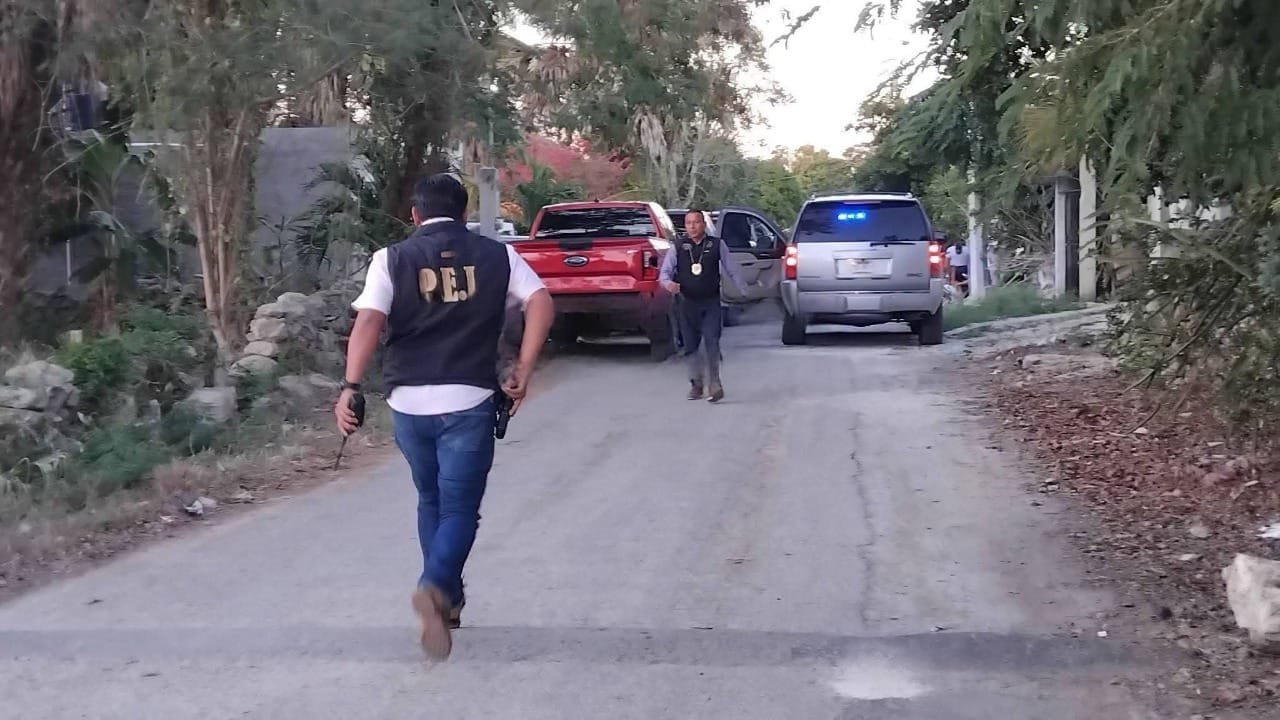
Dzilam González, Yucatán — Images from Dzilam González, the municipal seat in eastern Yucatán, circulate on social media with anger and indignation. An armed commando stormed an old bullring in the El Taiwán neighborhood and executed two men instantly; a third died hours later at a hospital in Mérida.
The executions recorded in Dzilam González not only shattered the tranquility of a historically peaceful municipality but also exposed cracks in a security strategy that, while boasting results, minimizes clear signs of organized crime’s advance.
That an armed attack with fatal consequences is classified as an “atypical case” in official discourse reflects the distance between institutional narrative and a reality that has already reached eastern Yucatán, a state that remains safe, yes, but whose peace begins to show dangerous limits when violence is normalized from positions of power.
Victims and Attack Details
The victims, identified as Juan Carlos Valdez G., alias “Nato” or “Juanito” (22 years old) and teenager Ariel K. R. (15 years old), worked for the Rodríguez Interián brothers, heads of the Caborca Cartel in Quintana Roo, and were ambushed by a group that arrived from Limones, Quintana Roo. Luis Kuk T. (Gary, 30 years old) was injured and died at O’Horán Hospital; Emanuel Palomino (15 years old) remains in serious condition.
The aggression, which authorities consider a “settling of accounts,” prompted the Secretary of Public Security to activate “Code Red,” deploy checkpoints and helicopter overflights, and close access routes to Mérida. Despite the operation, no arrests had been reported as of the last update.
A Peace Broken by “Narco Pax” and Cartel Expansion
Yucatán often boasts its tranquility indices. In the last session of the National Public Security Council, Governor Joaquín Díaz Mena recalled that the state ranks first in security and has the lowest rate of intentional homicides in the country.
Federal figures indicate it records 1.03 homicides per 100,000 inhabitants, 12 times less than the national average. This perception of security makes Yucatán a refuge for families of drug lords themselves, who “invest” in cattle ranches and tourism to launder money.
The journalistic investigation by Diario CAMBIO 22 states that the entity has become the “money laundry” for cartels and that an unwritten rule of “narco pax” allowed criminal groups to reside and make investments without violence.
This truce was broken with the arrest in Mérida on December 10, 2025, of Jacobo Rodríguez Interián, operator for the Rodríguez Interián brothers and close to José Gil Caro Quintero, leader of the Caborca Cartel, which would have triggered the armed attack in Dzilam.
The organization, the same investigation notes, has acquired ranches in the Tizimín-Panabá-Buctzotz-Dzilam González corridor to launder money.
Where is the Strategy?
In his live broadcast following the massacre, the governor lamented the events and classified them as atypical for the state; he assured that they already have information about the aggressors and sent condolences to the families. Perhaps it is time to move from speeches to action.
While officials tour fairs, deliver aid, and boast photographs, organized crime invades like a cancer the most tranquil communities.
Yucatán is not immune to the national context. According to the 2025 National Survey of Drug, Alcohol, and Tobacco Consumption, experimental consumption of illegal drugs among Mexican adults increased from 10.6% to 14.6% between 2016 and 2025.
Although the south of the country, including Yucatán, maintains the lowest figures and does not record significant increases in illicit drugs, experts warn that alcohol is normalized and serves as a gateway to other addictions.
Yucatán remains, in statistical terms, one of the safest states in the country, and it would be dishonest to deny it. This condition is not accidental; for years, a containment was built that, with tacit agreements, calculated omissions, and selective surveillance, managed to keep organized crime out of the public eye and away from open violence.
This uncomfortable but effective formula allowed preserving social peace, though it also normalized silences, gray areas, and an official narrative that rarely dared to name what was really happening beneath the surface.
However, the events in Dzilam González demonstrate that this strategy is beginning to fail. Minimizing executions as “atypical cases” does not make them nonexistent; on the contrary, it exposes an institutional response that clings to the discourse of success while reality begins to overflow it. The line is thin. Yucatán remains safe, yes, but security is not sustained with denial or reassuring statements. It is sustained by confronting what does not work, breaking pacts of silence—including those of much of the local press—and accepting that peace, when not reviewed, ends up breaking.
The arrival of gangs like the Caborca Cartel threatens to expand drug retailing to fishermen, cowboys, and construction workers who consume cheap drugs and put their health and social fabric at risk.
Tranquility is not defended with advertisements or photos; it is defended with intelligence, coordination, and prevention programs.
The state cannot allow cartels to dictate who lives and who dies, nor to appropriate ranches and beaches as sanctuaries.
It is urgent to reinforce the presence of federal and state forces, attack the finances of organizations, and, above all, build alternatives for young people. Otherwise, newspaper headlines will no longer speak of an “atypical case” but of the normalization of violence in a state that until now boasted of living in peace.
Discover more from Riviera Maya News & Events
Subscribe to get the latest posts sent to your email.