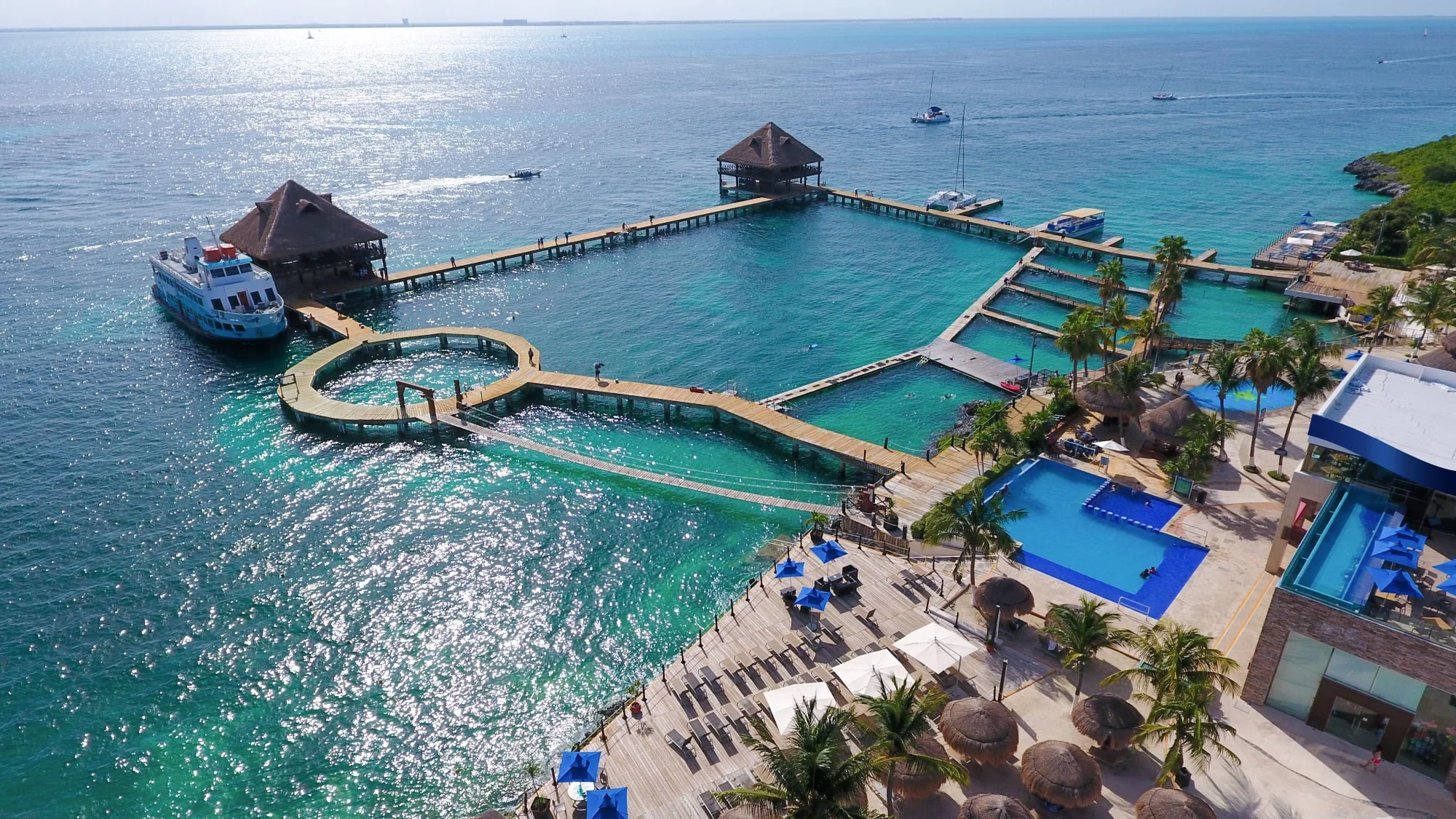
Isla Mujeres, Mexico — Just a 40-minute ferry ride from Cancún lies the open-air aquarium of Dolphin Discovery on Isla Mujeres, a site promoted as a magnet for Instagram vacation photos with packages allowing parents and children to swim with intelligent, playful mammals in the turquoise waters of the Caribbean. Its marketing showcases a gift shop filled with marine souvenirs like dolphin plush toys, t-shirts, and keychains in all sizes and colors. It also shows visitors enjoying the pool, bar, and unlimited buffet while waiting for their turn for activities.
What is unlikely to appear in photos and advertisements are the dead animals. At least seven dolphins and other marine mammals have died in the past year at parks operated by Cancún-based Dolphin Capital Co. The deaths occurred amid an administrative crisis triggered by the company’s growing debt and costly expansion into the United States. The company owns the facility on Isla Mujeres and dozens of similar attractions in eight countries.
With the expansion, the company faced significant repair costs, explains Grey Stafford, an industry consultant and former president of the International Marine Animal Trainers Association. “If they didn’t have a plan to rebuild these facilities, then the fault is theirs,” he says. “This was no secret.”
At the park the company operates in Panama City, Florida, a 14-year-old dolphin named Jett died from head injuries last spring. He was one of three dolphins that died there in the past year. According to court documents, Jett died while performing in water so dirty it likely reduced his visibility, causing him to hit the shallow bottom during a show. In May, Samira, a female dolphin, died at the same park after swallowing pieces of concrete that had broken off from a poorly maintained pool, according to a federal report.
This summer, inspectors in Mexico revealed that a manatee and a sea lion had died at another Dolphin Discovery park located in Puerto Aventuras, south of Cancún.
The company was founded in 1994 on Isla Mujeres with only four dolphins. Years later, it added two similar parks in the area, and in 1999, lawyer Eduardo Albor took control, progressively adding more attractions in the Caribbean and Mexico. Growth surged in 2015 when the company purchased locations in Italy, Argentina, and Florida, expanding to 30 parks, nearly 300 dolphins, dozens of other marine animals, and 2,600 employees. But in the process, Albor accumulated over $225 million in corporate debt, according to court records.
Workers, who requested anonymity as they were not authorized to speak with the press, describe a chaotic environment under Albor’s management. They say the company’s name on their pay stubs changed every month, and parks struggled to acquire basic supplies, such as pool chemicals, because suppliers were not being paid. Some of the acquired parks had serious animal welfare deficiencies, which Albor promised to fix but never did, according to court records. One worker noted that the company has already had to close several parks and uncertainty persists about which might be next. He attributed the losses to how Albor managed the group’s investments.
Last year, creditors Prudential Financial Inc. and Cigna Group sought to take control of Dolphin Capital and appointed new administrators, who placed the company under the supervision of a bankruptcy court. On April 11, the new team entered the corporate building in Cancún, personally owned by Albor, and changed the locks, with support from local police and private guards. In response, Albor called the Cancún prosecutor, who ordered state police to help him regain control, according to his lawyers. The next morning, he arrived with about twenty armed men and took over the building.
U.S. bankruptcy judge Laurie Silverstein ruled that the new administrators, not Albor, should run the parks. But the ousted executive purchased payment terminals at a Costco in Cancún and used them to divert ticket revenue to allies still working at the company, arguing it was the only way to avoid business disruption. The conflict paralyzed employees, who did not know who their real boss was. One of them said the terminal trick lasted three months before being discovered and noted that Albor had paid a group of loyal collaborators to make the change in the parks’ payment machines. The new administration and lenders declined to comment.
At the center of the dispute are the dolphins, manatees, and sea lions. The animals, which attracted 3.5 million visitors and generated $159 million in revenue in 2023, are part of the collateral that U.S. creditors seek to sell to recover Albor’s pending payments. In a transfer conducted last year, the company sent four dolphins to the Georgia Aquarium in Atlanta as part of a breeding agreement. Managers claimed their total value was $1.8 million, though they could sell for less, according to court documents. In October, the company announced it would sell a pair of bottlenose dolphins to a park in the Florida Keys for $500,000.
However, creditors might face difficulties selling more specimens. Mexico banned the import and export of dolphins in 2006, so those in the country must remain there.
Moreover, with the industry in decline across the continent and governments tightening regulations, demand has plummeted. A park near Niagara Falls has said it might euthanize dozens of whales because it cannot afford their maintenance and is prohibited from selling them to a Chinese buyer. Most of the industry’s growth has occurred in Asia. China, for example, has over 100 ocean-themed attractions, nearly triple the number in 2015, according to the China Cetacean Alliance, an activist group.
Albor attributes the financial problems to the Covid-19 pandemic, which paralyzed the global economy when governments ordered people to stay home. “We were prepared to have the company’s best year in 2020,” he stated in a bankruptcy hearing in Delaware, where the case is being heard. “We closed the entire business in a single day.” After the pandemic, Albor continued his expansion and acquired several locations, including the Miami Seaquarium, one of the oldest and most problematic marine mammal parks in the United States. The park, opened in 1954, sits on a 38-hectare waterfront property owned by Miami-Dade County.
By 2022, when Albor paid $15 million for the site, it already required urgent repairs to the stadium, water filtration systems, and various animal habitats, as recorded in court documents. The lease contract required these repairs, but “negative reports began to emerge almost immediately,” the county stated in a complaint.
Shortly after Albor took over the Seaquarium, U.S. regulators found that staff had reduced the food rations of some animals without consulting the veterinarian. A bottlenose dolphin named Cobalt lost 47 kilograms, 17 percent of his body weight, in four months because trainers reduced portions to make him hungrier (and thus more obedient) during shows, according to a 2022 report from the U.S. Department of Agriculture (USDA).
The animal became so thin that his ribs were visible, and he began to “gently bite” visitors and trainers, a behavior that, while not causing harm, alarmed several inspectors.
Later, regulators found a layer of debris in the pool where a five-year-old dolphin named Elelo lived, and veterinarians extracted a plastic zip tie and a piece of concrete from his stomach.
The county attempted to cancel the Seaquarium’s lease due to structural issues and animal health violations.
Last year, Albor responded that the company had invested over $2 million in animal care and more than $1 million in improvements, so it should retain the concession as the only entity licensed to care for those specimens.
On October 17, the new administrators obtained court authorization to sell the lease to a developer planning to build a marina, various shops, restaurants, and a smaller aquarium without dolphins.
In a low-rise building area of Cancún, the former headquarters of Dolphin Capital appears empty. Only a few faded flyers and stickers on the sidewalk recall its marine past. Court records indicate the new management team has regained control and operations have stabilized, according to a park manager. The new administration planned to auction some assets in Mexico in November.
Still, some activists fear financial solutions will sideline the animals. “We are concerned that companies may try to evade their obligations through bankruptcy declarations. In the bankruptcy framework, the maintenance, care, and relocation of marine specimens must be prioritized since most of them are not suitable for reintroduction into the wild,” according to the Mexican Center for Environmental Law (CEMDA).
Mexican authorities are paying attention to the case. Senator Mayuli Martínez stated she will ask environmental authorities to ensure the animals’ welfare. “We know that when there are economic problems, investors try to recover their investments, but animal welfare is our priority,” the senator said in a telephone interview.
The new owners bear the weight of a brand and a business model that has been targeted by activists for decades.
In August, one of Dolphin Discovery’s parks in Cancún closed suddenly, and workers said they were transferred to another site without prior notice.
For Mariel Bravo, director in Mexico of Empty the Tanks, an organized group seeking to close such attractions, the news is positive, especially if the closure is permanent.
“We want this generation of dolphins in captivity to be the last,” she says, “so they can retire with dignity.”
Discover more from Riviera Maya News & Events
Subscribe to get the latest posts sent to your email.