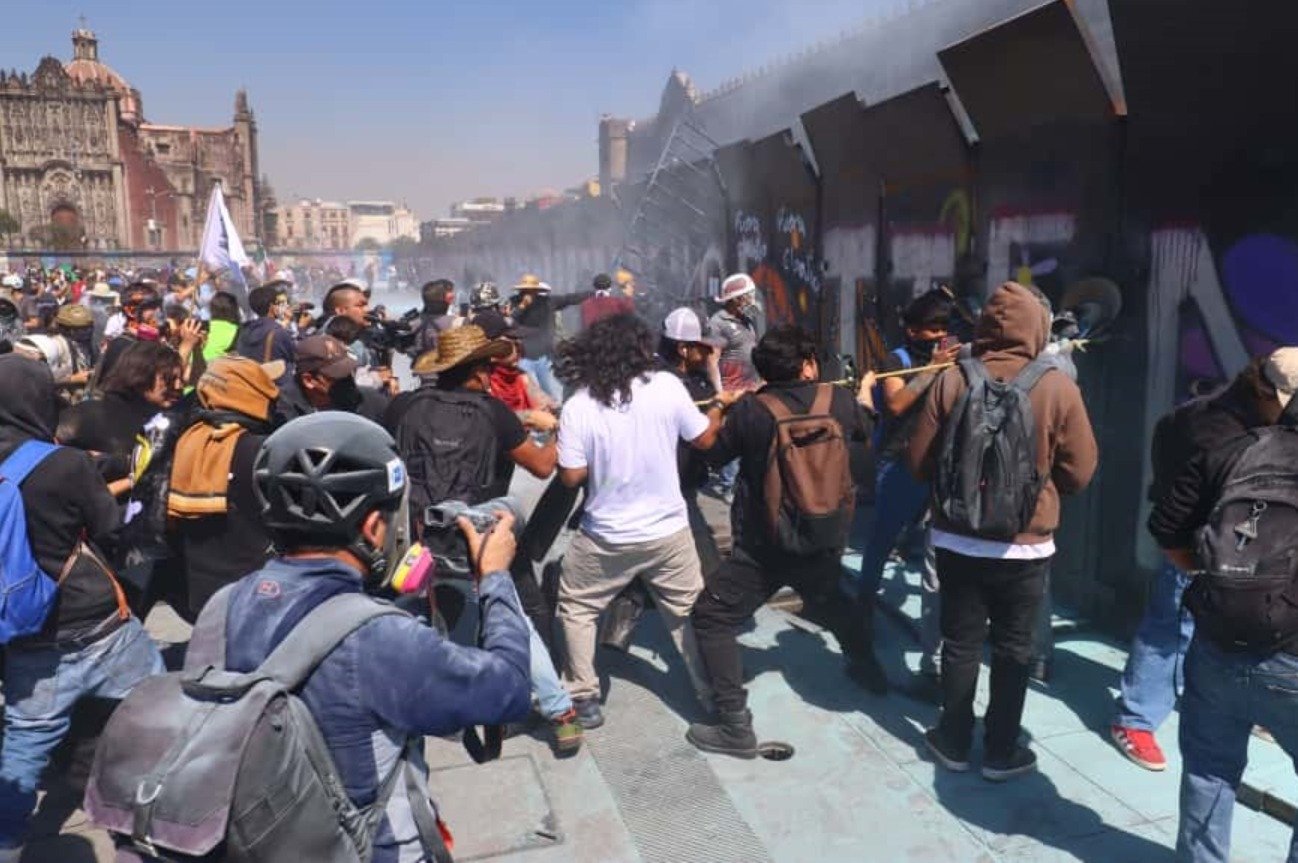
Mexico City — A march by young people identifying with the “Generation Z” movement turned violent on Saturday, November 15, as participants clashed with police upon reaching the Zócalo, the city’s main square. The demonstration, which began at the Angel of Independence and proceeded toward the city’s historic center, escalated when protesters attempted to tear down metal barricades installed around the National Palace.
Violence Erupts on the Zócalo Plaza
On the main plaza of the Zócalo, the march turned violent; participants sought to knock down the metal barricades, and in response, received a cocktail of tear gas and pepper spray from the other side. Protesters threw all manner of objects, primarily rocks.
Young people participating in the so-called Generation Z march arrived at the Zócalo and began to strike the metal barricades that authorities had installed since the previous Wednesday. A group of people tried to tear down the metal fences installed in front of the National Palace; from the other side of the barrier, smoke from fire extinguishers was launched.
Regarding the low turnout of young people at the march identified as Generation Z, a man named Rodrigo stated, “the narco-government has been effective in domesticating the youth.” The grandmother of Carlos Manzo also attended the mobilization, joining the contingent identified with Generation Z.
Police Deployment and Official Statements
The Secretary of Security for Mexico City, Pablo Vázquez, reported that 800 deployed police officers were “watching over and guarding the march, accompanying it from a distance.”
A tweet from the outlet La Silla Rota was embedded in the report, stating: “Hundreds of people begin to arrive at the main plaza of the Zócalo capitalino, while a group of protesters has already jumped the barricades placed at the National Palace.”
From the Angel to the Zócalo
The mobilization was disseminated primarily through social media by young people who claim not to belong to any political party. Although the Generation Z movement has publicly clarified that it did not directly organize the march, various groups and sympathizers who identify with that label adopted the name to articulate the call to action.
In Mexico City, public calls established the Angel of Independence as the meeting point from the morning of Saturday, with a departure estimated between 10:00 and 11:00 hours.
The planned route advanced along Paseo de la Reforma, continued along Avenida Juárez, incorporated onto Eje Central, and sought to enter the capital’s Zócalo via 5 de Mayo. In response, the Secretary of Citizen Security implemented a special operation to accompany the route and regulate traffic on Reforma, Avenida Juárez, Eje Central, and the streets leading to the Plaza de la Constitución. Traffic disruptions in the central zone were anticipated for a good part of the day.
The Government of Mexico City reiterated that the right to protest is guaranteed but emphasized that the historic perimeter would remain guarded. La Silla Rota confirmed that several buildings, including the National Palace, Bellas Artes, the Metropolitan Cathedral, and businesses along Paseo de la Reforma, had been protected with barricades since Wednesday of that week.
What Does Generation Z Demand?
The public slogans circulating in the convocations place the fight against violence and the demand for justice first, along with general demands for opportunities for youth. Furthermore, the demand for security following the death of municipal president Carlos Manzo was stated as one of the strongest slogans during the march.
Although the Generation Z movement has acknowledged that it was born in an environment where opposition political actors attempted to influence its initial formation, organizers insist that their participation in the march is limited to the voluntary involvement of members, not an official convocation.
Beyond Mexico City
Although the mobilization on November 15 would have its core in Mexico City, the call to action has had an echo in other states across the country. On social media, collectives and users have announced parallel gatherings in at least a dozen state capitals, though without centralized coordination or official routes.
The states with the highest prior activity are Jalisco and Nuevo León. In Guadalajara, youth groups called for a gathering at the Monument to the Boy Heroes, from where they planned to march toward the Historic Center. In Monterrey, the calls concentrated at the Explanada de los Héroes, in front of the Government Palace. In both cases, the calls have been spontaneous, dispersed, and promoted by users without visible organizational structures.
Calls to action have also been made in Puebla, Querétaro, the State of Mexico, Morelos, Chihuahua, and Yucatán.
Discover more from Riviera Maya News & Events
Subscribe to get the latest posts sent to your email.