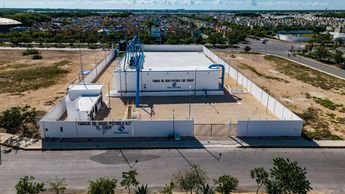
Cancún, Quintana Roo — In June 2022, a majority of residents in Cancún (Benito Juárez), Puerto Morelos, and Isla Mujeres voted in a citizen consultation to remove Aguakan’s concession for potable water service. However, nearly four years later, authorities in Quintana Roo have not fulfilled the public’s will to ‘expel’ the private company.
Legal and judicial obstacles, along with a lack of political will, have allowed the company to continue operating in four municipalities in the northern part of the state, as confirmed by MILENIO.
Although the consultation was also held in the municipality of Solidaridad (Playa del Carmen), there was insufficient participation there for the results, which were also against Aguakan, to be binding.
In 2023, following the consultation, the state Congress and local government took actions to revoke by the end of that year the concession that Aguakan has held since 1993, which was extended in 2014 until 2053. However, the company filed injunctions, successfully pausing adverse decisions, and the litigation is stalled in the federal judiciary.
The Eighth District Court, based in Cancún, granted the company a suspension, allowing it to continue operating. Currently, the injunction is under review by the First Collegiate Court of the Twenty-Seventh Circuit.
Therefore, citizen activists believe the case should be taken up by the new Supreme Court of Justice or, as a last resort, that the current federal government intervene to revoke Aguakan’s concession, similar to how the closure of the Calica limestone mine in Playa del Carmen was achieved by order of former President Andrés Manuel López Obrador.
“In the case of Calica, which is also a very strong company with significant economic interests backed by the U.S. government, it was achieved; the company is closed. They are still fighting, still trying to reopen, but because the federal government became decisively involved, they have not been able to remove that prohibition on continuing to exploit nature,” says Enrique Burton, an activist with the Asamblea Social del Agua.
Exorbitant Bills, Hours Without Water, and Lack of Pressure
In the municipalities where Aguakan operates, citizens are fed up with exorbitant charges, lack of water supply, and defective service.
In the Paraíso Maya housing unit, east of Cancún, there are multiple testimonies of grievances. Juana Muñoz explains that her monthly household budget was drastically affected by Aguakan: from October to November, her water bill increased from 282 pesos to 1,200 pesos. Thus, without explanation, it grew almost fivefold.
For December and January, her bill dropped to 616 and 615 pesos, but she considers it still excessive, as only she and her eldest son live in her social interest apartment, and they are hardly there because they go to work all week.
Juana does not understand the skyrocketing amounts. She says that in recent months she did not consume more water than usual, did not change her habits, and has no leaks. But she claims this is not an isolated incident; dozens of her neighbors suffer from it. She has noticed a pattern: bills spike periodically.
“Every seven months they send me a very expensive bill, because I have all the bills and I check when,” she says angrily. The worst part is that despite her anger and complaints against the company, the woman is forced to pay, because if she does not, her service is cut off.
This has happened to many in that housing unit, and what they have done is ‘hook up’ to the potable water network. It is common to see hoses connected directly from the street pipeline to rooftops to fill buckets and containers in the apartments.
Nearby, in the neighborhood known as Región 103, Diana Becerra explains that the problem in that area is that when water arrives, it comes with very low pressure.
“Before we had water from 7 to 11 in the morning and in the afternoon, from 3 to 10, but they took away the morning water. Now we only have from 3 in the afternoon to 10:30 at night, but sometimes it arrives until 6, with very low pressure, and by 7 or 8 it’s already cut off. So, we don’t have any, and it doesn’t reach the rooftop tanks. We have to be filling buckets, pots, everything we have on hand to have water,” she recounts.
In other cases, it is worse because water arrives only in the early morning, which complicates things further.
“It arrives without pressure, and we have to connect electric pumps to get a little up to the rooftop tanks. But if it arrives at two in the morning, I connect my pump and fall asleep, the pump stays connected all night and burns out, and the electricity bill increases,” says a young man from the Hacienda del Caribe subdivision who prefers not to give his name for fear of reprisals. “It’s not just paying Aguakan anymore, but also paying the Commission (Federal Electricity Commission) and, on top of that, the exhaustion, because it’s a physical strain to be awake waiting for a little water to arrive,” he says.
“The Consultation Was Useless”
Enrique Burton is an activist from the municipality of Solidaridad, where the 2022 consultation did not achieve the necessary participation percentage for the result, also against Aguakan, to be binding. He is the coordinator of the Asamblea Social del Agua organization and claims that democratic exercise had some trickery.
“The consultation was ‘binding’ in the sense that authorities had to address the issue, not that the concession would be automatically canceled; instead of holding a plebiscite, which would indeed be binding to cancel the concession, they only held a consultation,” he reproaches.
Former local deputy Julián Ricalde, who was part of the special commission created in the Quintana Roo Congress to address the Aguakan case, also asserts that the citizen consultation was useless because no one acted to revoke the concession.
“It was useless. It was lying there dormant until we created that extraordinary commission to, first, understand and know who was responsible for acting, because permanently the state, the municipalities, the Congress ‘passed the buck’ to each other; that’s what it was for,” he explained.
Faced with inaction from other authorities, in 2023, the local Congress decided to invalidate the extension granted in 2014 to Aguakan’s concession, which was set to expire in 2023, for an additional 30 years. However, it was due to this decision that the company sought an injunction.
Karina Tiquet, a member of the Asamblea Social del Agua, explains that the company has undertaken strategies to further delay the lawsuit against it, such as not attending hearings, so she believes the intervention of the country’s Supreme Court is necessary.
“What we as citizens would request is that this need, this requirement from the citizenry, be taken up by the Supreme Court of Justice and that this damage and assault and robbery of the citizenry by this company be ended once and for all,” she opines.
Additionally, she believes municipal governments should play a leading role in exercising their constitutional authority to provide potable water service themselves and not through a private company.
“Why do we allow a company to maintain this concession when any of the municipalities in the northern zone could perfectly well administer it and generate infrastructure, especially since Aguakan’s investments are also questionable?” she questions.
Given the impasse the issue faces in the courts, Burton goes further and states that the precedent of the closure of the Vulcan Materials Company mine, known as Calica, should be used to resolve this.
“There is an example that if there is true involvement and decision by the federal government, progress can be made,” he opines.
Discover more from Riviera Maya News & Events
Subscribe to get the latest posts sent to your email.