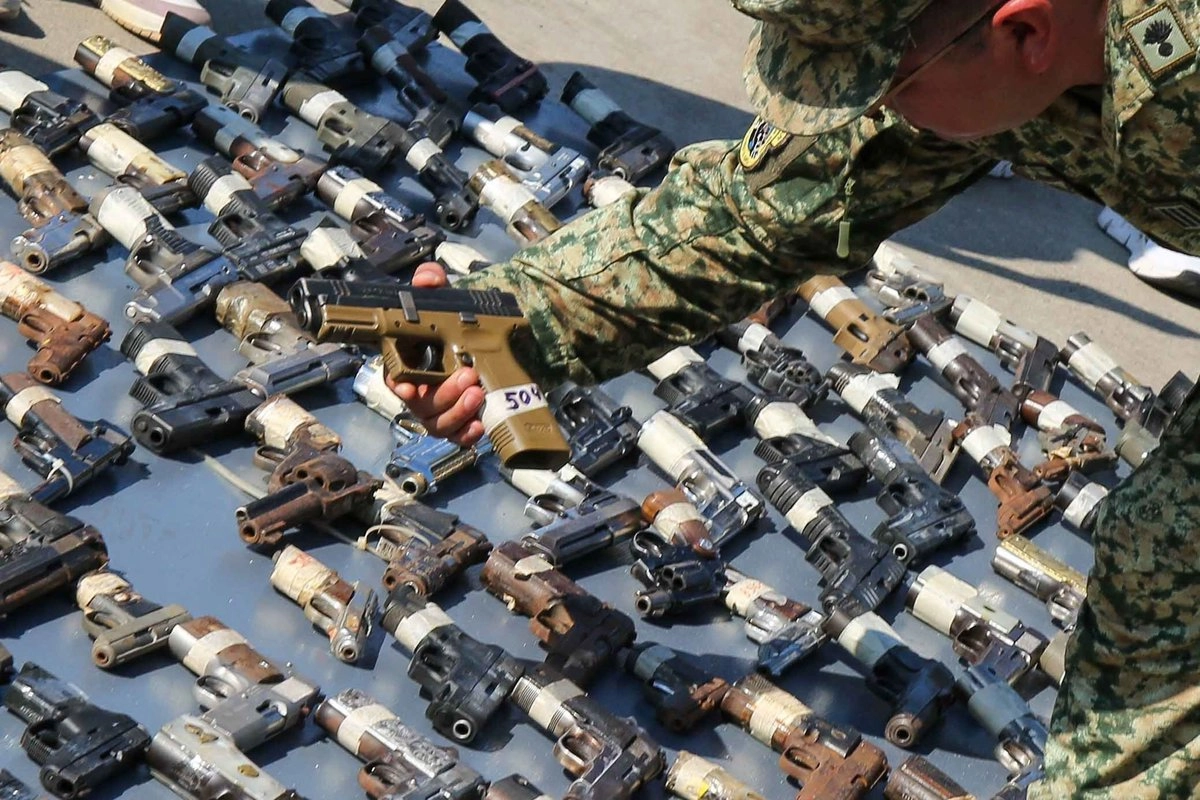
The tracing of the origin of thousands of firearms used in crimes in Mexico reaches a dead end before discovering who originally purchased them. According to the most recent data from the U.S. Bureau of Alcohol, Tobacco, Firearms and Explosives (ATF), 18,249 firearms confiscated in Mexico were traced in the last year; however, in 36 percent of cases it was impossible to identify the initial buyer.
ATF reports indicate this situation is due to various problems, such as altered or erased serial numbers; gun shops and distributors that cannot be contacted because they ceased operations; or tracing requests sent by Mexican authorities that lack complete documentation.
This limitation is critical, as the ATF’s eTrace system represents the only technical tool available to Mexican authorities to attempt to reconstruct the route of firearms trafficking that ends up in the hands of criminals in the country.
The effectiveness of tracing has improved compared to 2019, when the initial buyer could not be identified in almost half of the cases, that is, 49.8 percent of cases. Nevertheless, the 6,572 firearms without an identified buyer in the tracings corresponding to 2024 continue to favor trafficking networks.
The report details the hegemony of the U.S. market in the recovered arsenal. Of the total 25,884 firearms sent for tracing by Mexico in the recent year, 70.5 percent originated in the United States. Of these, 13,004 firearms were manufactured directly on U.S. soil, while another 5,245 were legally imported to the United States from third countries before being illicitly introduced to Mexico.
In addition to identification problems, the data indicate that traffickers have introduced firearms with greater firepower into the country in recent years. While the recovery of revolvers has decreased, the seizure of rifles has increased significantly. In 2019, rifles represented 27 percent of the total firearms confiscated and traced (5,811 units); by 2024, this proportion rose to 37.5 percent, with 9,696 rifles seized in one year. Pistols, however, remain the most frequent weapon and represent approximately 50 percent of the artifacts confiscated and traced each year.
Given this panorama, the governments of the United States and Mexico recently announced “Mission Firewall: Unidos Initiative Against Firearms Trafficking.” This strategy promises an “unprecedented level of collaboration,” with objectives such as facilitating the expansion of the use of eTrace and ballistic imaging technology in all 32 states of the Mexican Republic. Likewise, the United States committed to increasing inspections and bilateral investigations to combat illicit trafficking at the border and achieve more prosecutions of alleged traffickers.
Discover more from Riviera Maya News & Events
Subscribe to get the latest posts sent to your email.