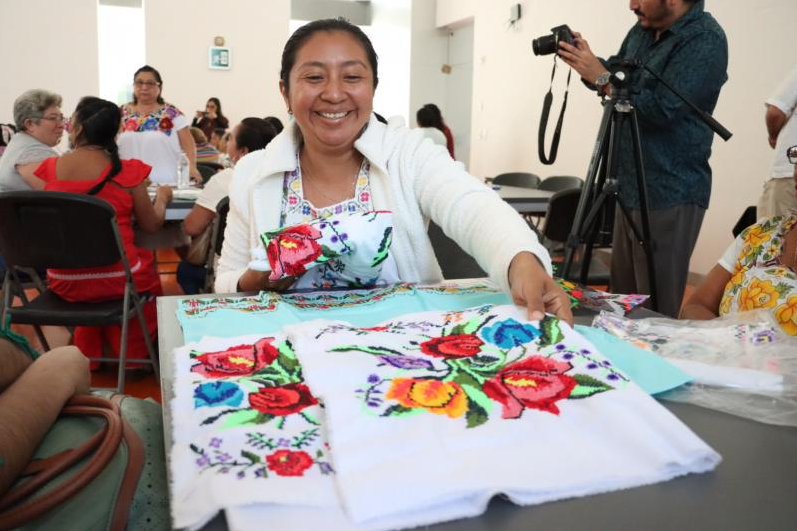
Mérida, Yucatán — Artisans from various municipalities in Yucatán are participating in a training meeting at the Gran Museo del Mundo Maya, promoted by the Secretariat of Culture and the Arts (Sedeculta) and the United Nations Educational, Scientific and Cultural Organization (UNESCO), to strengthen their productive projects and Maya embroidery.
With the purpose of consolidating the work and strengthening the union of the State Council of Embroiderers of Yucatán, its first annual meeting began today, attended by artisans and bearers from various municipalities.
Until December 5, the artisans will meet at the Gran Museo del Mundo Maya to participate in various training activities aimed at strengthening their productive projects, which will allow them to enhance their capabilities and generate greater opportunities to turn their artisanal activity into a source of greater well-being and economic certainty.
The program includes specialized learnings such as business models and administrative training; legal and contractual processes; digital communication and practices of product photography and documentation, among other contents.
This meeting is part of the project “We Embroider in Community,” an initiative of Sedeculta in collaboration with UNESCO, which has allowed supporting more than 300 embroiderers from across the state, with the goal of promoting their work and recognizing them as bearers and transmitters of ancestral knowledge about Yucatecan Maya embroidery.
The Meeting of the State Council of Embroiderers follows up on the process started in December 2024 with the certification of 200 Yucatecan artisans, who received from Governor Díaz Mena, in a symbolic act held in the Maya city of Uxmal, the documents that recognize them as master embroiderers, with the knowledge and skills to share them through teaching in their communities and in basic and secondary schools.
During the inauguration of this event, the Secretary of Culture and the Arts, Patricia Martín Briceño, recalled that one of the mandates of the Maya Renaissance has been to generate conditions for women to have the possibility of developing sustainable economic autonomy in their communities.
In congruence with that mandate, the work with the embroiderers has been consolidated with the creation of the State Council, listening to them and making them visible, and putting into practice many of the proposals they themselves have raised to achieve better conditions for the development of their activity.
The official thanked the accompaniment of UNESCO to put into practice a cultural public policy in Yucatán based on a governance model, supported by listening to the artisans, so that they are the ones who guide all efforts for the preservation of this textile art, which is an invaluable cultural heritage and which should also be consolidated as a productive activity.
“It is not enough for the artisanal product to be beautiful, but it must also allow them to live with dignity and in their communities of origin, while contributing to the preservation of these identity knowledges of Yucatán,” expressed the head of Sedeculta.
She also recognized the work that has been done with institutions such as the Yucatecan Institute of Entrepreneurs (IYEM) and the Institute of Training for Work of the State of Yucatán (Icatey), to achieve the professionalization of the activity, with “documents that allow them to transmit their knowledge formally.”
At the inauguration of the Meeting of the State Council of Embroiderers, the Coordinator of Culture of UNESCO in Mexico, Carlos Tejada, and the Specialist in Intangible Cultural Heritage of UNESCO, Salomón Bazbaz Lapidus, were also present, who highlighted the work carried out by the state government, through Sedeculta, to make the Safeguarding Plan for Yucatecan Maya Embroidery a reality from the voice of the artisans, in an exercise of governance that is an example for the entire country.
This meeting of artisans adds to the embroidery workshops taught at the Gran Museo del Mundo Maya, as well as the basic and specialized teaching programs of the Maya language, such as the one starting this day, Introduction to Maya Philology, taught by the linguist and Director of Heritage and Museums of Sedeculta, Fidencio Briceño Chel.
Discover more from Riviera Maya News & Events
Subscribe to get the latest posts sent to your email.