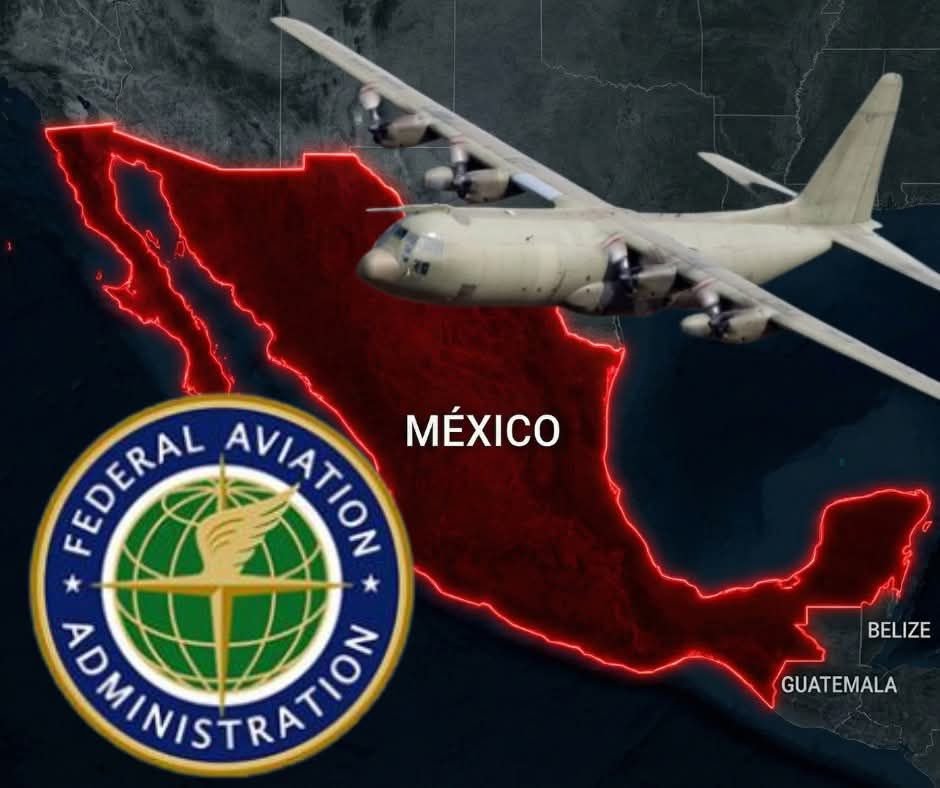
Mexico City, Mexico — The Federal Aviation Administration’s notification of a “potentially dangerous situation” in Pacific and Central American waters due to military operations and GNSS interference is not like the warning the United States issued before attacking Venezuela.
That previous warning spoke of air operations over Venezuelan territory, particularly around Caracas airport; the recent one refers to actions from international maritime waters, using technology that causes communication interference, employed in armed conflicts like in Ukraine.
The notification, in the context of U.S. threats of military actions against targets in Mexico, provoked anxieties and fears in this country, responded to with clarifications from Mexican authorities indicating it was solely for U.S. airlines. This is true, but it does not mean U.S. military operations would respect vessels from other countries. According to U.S. officials, confirmed by Mexican ones, these actions are indeed a prelude to attacks on specific targets in our territory, with the knowledge and approval, even cooperation, of Claudia Sheinbaum’s government.
U.S. officials said there are three targets in Mexico: in Baja California, without specifying where; in Mazatlán, Sinaloa; and at another undetermined point where Nemesio Oseguera, El Mencho, leader of the Jalisco Nueva Generación Cartel, is supposedly located. The first two targets, according to officials from both countries, are different from the takedown of a criminal leader, but with a strategically crucial scope: dismantling the drug cartels’ money laundering network that is using the cryptocurrency USDT, issued by Tether Limited.
According to Mexican officials, the Americans identified these targets in Mexico within their global investigations into this digital currency that is backed by so-called Fiat money, recognized as legitimate for the exchange of goods and services, which does not depend on the backing of a physical asset like gold, but on acceptance for use in payments. USDT maintains a value of 1.1 dollars or its equivalent in assets, with the purpose of reducing the volatility of other digital currencies.
U.S. authorities, according to a report from the National Intelligence Center, entered the market of this cryptocurrency upon finding that it was being used by terrorist groups and drug cartels, and placed a digital bait to achieve its traceability. In this way, a Mexican official specified, they detected two of the main nodes for criminal operations, in Baja California and in Mazatlán. U.S. experts discovered that transactions were being conducted through a popular video game, where they did not play, but used their microphones to talk and negotiate because they could not be intercepted.
According to information on the operations, criminal business revenues were placed in USDTs, originally created for cross-border transactions, which became a method of criminal operation due to the anonymity of those conducting them, and which were sent to a cold cryptocurrency wallet that, by not connecting to the internet network or acting with so-called smart contracts that facilitate and accelerate transactions, were not potential victims of hacking.
Cold wallets are only used for sending and receiving assets. From the cold wallet, within seconds, they are placed in a hot wallet, which is online and allows for smart contracts through platforms known as “Exchange,” through which cryptocurrencies are bought, sold, or exchanged. Authorities from both countries have a list of Mexicans, several from the Jewish community, who manage the “Exchanges” used by criminal organizations, and who are part of what the Americans want to neutralize and eliminate.
According to a U.S. source, the FAA notification alerted U.S. commercial airlines – which should be considered by Mexican and other countries’ airlines flying through the indicated zone – because they began the operation to attack the nodes at an undetermined time, but from what they announced they have a 60-day window. The role the Mexican government is playing in this first part of the operation against criminal organizations’ financing and money laundering networks has not been revealed.
The second part of the operation targets El Mencho, leader of the criminal organization that most concerns the United States and Mexico, for which there are also indications that he has planned terrorist acts during the soccer World Cup this summer. Oseguera’s location has not been specified, but U.S. officials had warned two weeks ago that a drone attack in Michoacán was defined, without specifying in which zone.
The head of the Jalisco Nueva Generación Cartel has been very elusive. In 2021, thanks to a tip from the National Guard, he managed to evade a federal operation on the borders of Guanajuato with Jalisco, and during Andrés Manuel López Obrador’s government, Navy intelligence located him in the municipality of El Grullo, southwest of Jalisco, but when they requested authorization to capture him, the former president denied it and only allowed them to keep him under surveillance. That was, apparently, the best opportunity they had to detain him. In Sheinbaum’s government, operations against that criminal organization have increased, aligning strategic interests with the United States for an operation that achieves his neutralization.
The attacks against the three targets in Mexico were designed unilaterally in Washington, but Mexican authorities have joined in knowledge, information, and possibly operation. The degree of participation and functions that Mexican security forces could have is unknown, but the Americans have not kept them in the dark, as in other moments.
It would be difficult to do so, and would place the United States in a more serious problem with Sheinbaum’s government than the capture of Ismael El Mayo Zambada, because it would mean an attack on Mexican territory where without existing collaboration, it would be a flagrant violation of sovereignty that would force the president to take retaliatory actions to the detriment of both countries.
Discover more from Riviera Maya News & Events
Subscribe to get the latest posts sent to your email.