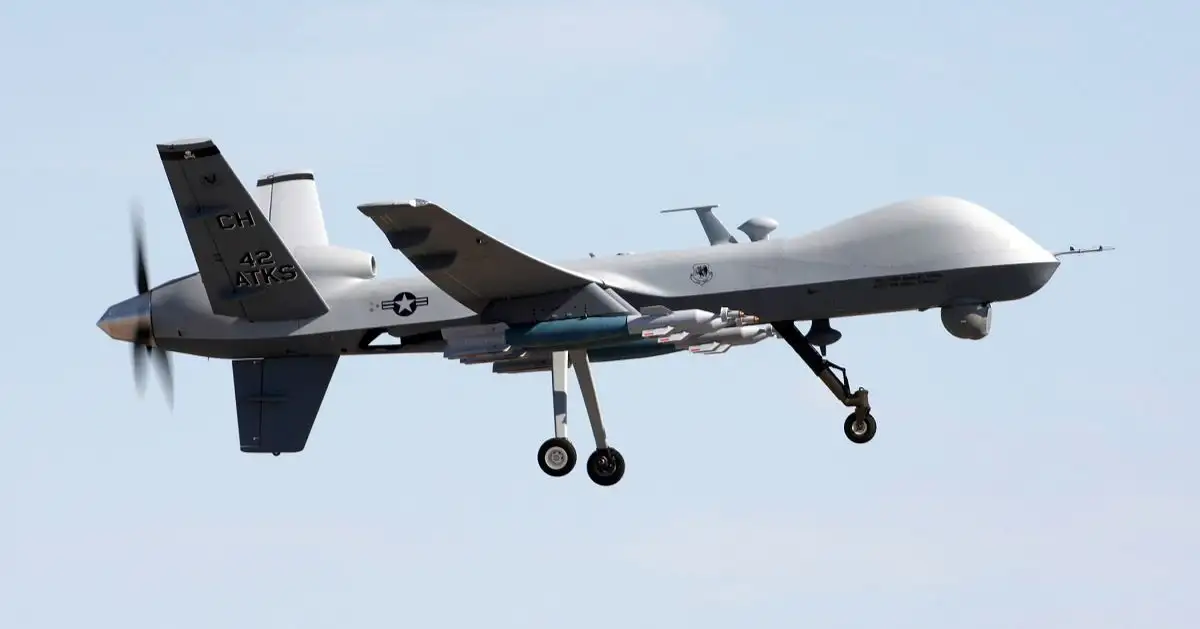
Cozumel, Quintana Roo — The presence of an MQ-9 Reaper military drone, a strategic aerial surveillance platform of the U.S. Department of Defense, in the western Caribbean environment confirms that the region has ceased to be solely a tourist destination and has become a point of international operational interest within the fight against transnational illicit trafficking.
The fact was evidenced last night when residents of Cozumel observed a light flying at low altitude that crossed the island from end to end, initially mistaken for a small plane in trouble or local maneuvers, but which in reality corresponded to this unmanned aircraft integrated into an aerial monitoring scheme that for approximately one month has been operating over the Yucatán Peninsula in coordination with Mexican authorities, focused on the surveillance of maritime routes used for the trafficking of drugs from South America to Mexico.
The MQ-9 Reaper is not just any aircraft; it is a medium-altitude, long-endurance (MALE) system, capable of remaining in flight for over 27 hours, equipped with electro-optical sensors, infrared, synthetic aperture radar, and signal interception systems.
Its primary function is persistent surveillance, identification of vessels, and tracking of organized crime logistical routes. It is the same platform used by the U.S. in conflict zones such as the Middle East, North Africa, and in border control operations in Latin America.
Its presence in the Mexican Caribbean does not occur in a vacuum. For three years, U.S. agencies have intensified monitoring over the South America–Caribbean–Gulf of Mexico maritime corridor, a route used for the transport of cocaine, chemical precursors, weapons, and irregular migrants. The Yucatán Channel, the waters off Cozumel, Isla Mujeres, Holbox, and the eastern coast of the peninsula form part of a geostrategic triangle that connects with Florida, Central America, and the Mexican Pacific.
On the national level, this surveillance is inserted into the Mexican strategy of cooperation in intelligence matters with international partners, at a time when the country faces a reconfiguration of organized crime—fewer open confrontations in some regions, but greater diversification of illicit activities such as retail drug dealing, maritime trafficking, money laundering, and silent logistical control. The peninsula is not a scene of open war, but of discreet operation.
The use of platforms like the Reaper indicates that authorities seek early detection and continuous tracking, not late reaction. These systems allow for the identification of navigation patterns, unregistered fast boats, nocturnal movements, and transfer zones in open sea.
Its deployment responds to a reality: the Mexican Caribbean is a strategic passage within the international narcotrafficking circuit, and aerial surveillance has become a central tool.
In the global context, the use of military drones in non-conventional security operations has become normalized. NATO, the United States, and several Latin American countries have adopted these systems for intelligence, surveillance, and reconnaissance (ISR) tasks. Mexico, although it does not directly operate the Reaper, is part of information exchange and regional coordination schemes.
However, the security of the peninsula is no longer analyzed only in local terms, but within a geopolitical board where transnational crime, strategic maritime routes, and international cooperation converge. High-tech aerial surveillance is a symptom of this new reality.
Discover more from Riviera Maya News & Events
Subscribe to get the latest posts sent to your email.