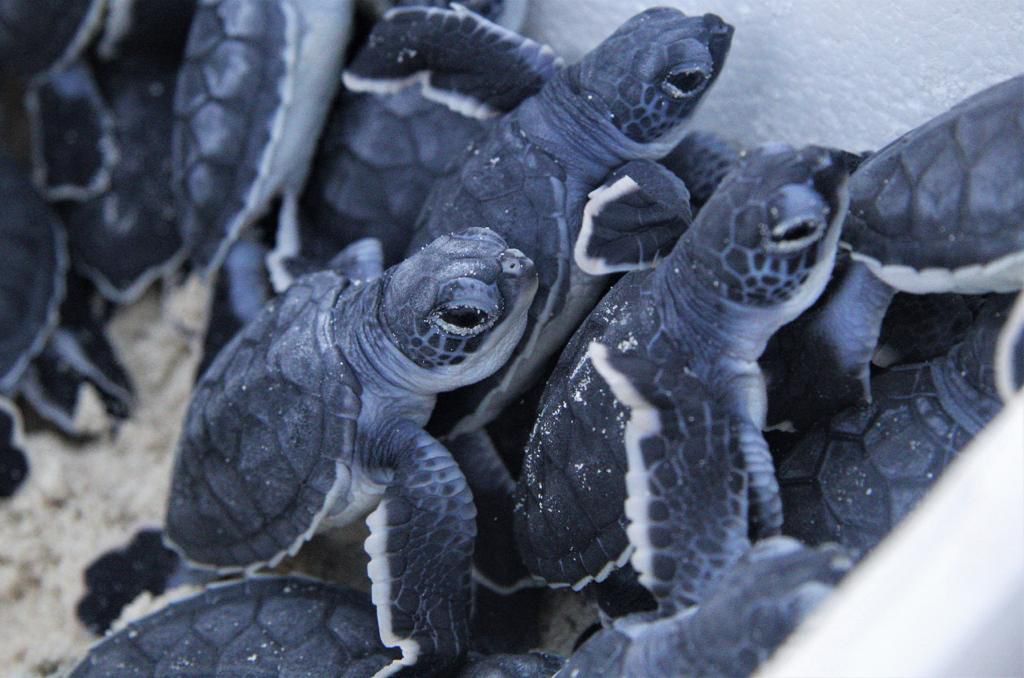
Playa del Carmen, Quintana Roo — More than 20 million sea turtles have been born along the Mexican Caribbean coast over the past three decades, thanks to the Riviera Maya–Tulum Sea Turtle Conservation Program, one of the longest-running and most successful conservation initiatives in the region.
The program operates through 13 turtle protection camps and is led by the organization Flora, Fauna y Cultura de México, with support from public and private institutions. Environmental authorities and civil organizations consider the effort a major success in one of Mexico’s most heavily developed tourist corridors.
According to Guadalupe Quintana Pali, general director of the NGO, the program has not only increased hatchling survival rates but has also documented adult turtles returning to nest on the same beaches where they were born—one of the strongest indicators of population recovery.
“About 30 years ago, turtles began to be marked by removing a small piece of tissue from the plastron and the carapace,” Quintana Pali explained. “That tissue grows with the turtle, allowing us today to identify the year they were born.”
From 1996 to 2025, conservation teams protected 303,586 nests across 13 key nesting beaches. Green turtles (Chelonia mydas) account for 81% of the nests, followed by loggerhead turtles (Caretta caretta) at 18%. Isolated nesting events of hawksbill and leatherback turtles have also been recorded.
Mexico is home to six of the world’s seven sea turtle species, according to Javier Carballar, director of Quintana Roo’s Institute of Biodiversity and Protected Natural Areas. Three species regularly nest along the state’s coastline, particularly in the Riviera Maya, Tulum, and the Sian Ka’an Biosphere Reserve.
“The results are spectacular, especially for green and loggerhead turtles,” Carballar said. “Education has been key—not only for communities and fishermen, but for developers. Turtles nest on the same beaches where major hotels are built.”
The conservation process begins with the rescue and relocation of nests to protected enclosures, shielding them from tourism activity, artificial lighting, and predators. Teams known as “tortugueros” guard nests from animals such as cats, dogs, raccoons, and coatis, and later protect hatchlings from birds as they make their first journey to the sea.
Leonel Gómez Nieto, head of the conservation program, emphasized that the work extends beyond protecting turtles. It also involves building social agreements to reduce threats like pollution, heavy machinery on beaches, and habitat loss.
“Watching a turtle nest no longer brings the same first-time excitement,” he said. “What remains is a deep sense of responsibility—one that goes far beyond emotion.”
Discover more from Riviera Maya News & Events
Subscribe to get the latest posts sent to your email.