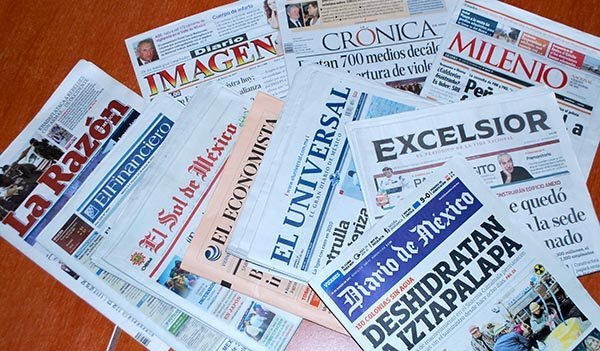
Mexico — Since former President Andrés Manuel López Obrador ceased funding media outlets and drastically reduced federal official advertising, industry discourse has frequently centered on a severe media crisis, citing plummeting revenues for newspapers, radio, and television. This narrative has been used to justify thousands of layoffs across the sector.
However, an analysis of official data challenges this premise. According to the National Institute of Statistics and Geography (INEGI), the "Mass Media Information" sector recorded a revenue growth of 7.4 percent in September 2025 compared to the same month the previous year. This represents the greatest advance among all categories within non-financial services and a growth rate more than seven times that of the rest of the economy.
The data reveals that revenues in the mass media information sector reached an index of 149.8 points by the close of the third quarter of 2025. This indicates that since 2018, the beginning of the so-called Fourth Transformation government, revenues have grown by nearly 50 percent.
Despite this financial growth, layoffs and salary reductions have become a constant in the sector. While revenues rose by over seven percent in September 2025, the number of employed personnel fell by 2.3 percent that same month. The employment index stands at 61.5, meaning almost 40 percent of workers have been laid off since 2018.
Wages have followed a similar trend, falling 1.8 percent in September 2025 and showing a cumulative 20 percent drop compared to seven years prior.
A state-by-state analysis shows the regions where the information sector's revenue has grown the most since 2018: Zacatecas with an increase of 54.5 percent; Jalisco, with 54.1 percent; Mexico City with 43.7 percent; Querétaro, with 31.5 percent; and Tamaulipas with 29.0 percent.
The segment showing the greatest revenue growth, but also the most severe staff layoffs and lowest wages, is "Transmission of radio and television programs."
This surge in sector revenue has led Salvador Villalobos, president of the Mexican Communication Council, to state that companies are in the best position to demonstrate their social commitment through actions. He added that “the media contributed 2.8 billion pesos to the country through the Communication Council.”
Concurrently, a report from the organization Article 19 details a significant shift in official advertising spending. The report indicates that federal-level official advertising remains below approved amounts, while state governments have far exceeded their allocated budgets.
At the state level, 13 governments spent more than double what was authorized in their 2024 budgets. Of these, five spent more than 10 times what was originally approved, exceeding their initial budget by a thousand percent.
Combined spending on official advertising—federal and state—fell from 24.559 billion pesos in 2018 to 13.499 billion (constant 2025 pesos) in 2024, a real decrease of nearly 45 percent in six years. This decline is primarily attributed to a contraction in federal spending: in 2024, the federal government spent 70.7 percent less than in 2018, the final year of Enrique Peña Nieto's administration.
Although states increased their investment, this increase did not offset the national decline and reconfigured the composition of spending. State governments came to concentrate the majority of official advertising. In 2018, 52 percent of spending was federal and 49 percent was from states; by 2024, this proportion reversed, with states accounting for 71 percent and the federal government just 28 percent.
The states with the highest spending on state advertising are Guanajuato, Quintana Roo, Chihuahua, Coahuila, and Nuevo León. It is notable that four of these five entities are governed by the political opposition.
The Article 19 report concludes: “Official advertising aims to inform the public about matters of public interest, such as government programs, campaigns, actions, and services that impact their daily lives. However, when it is carried out without transparent criteria or is concentrated in a few media outlets, it can become a tool for political control. Therefore, transparency is vital to ensure that public spending fulfills its social function.”
A pressing question now, particularly for concessioned media, is to identify what type of advertising is driving the revenue growth across all segments of the "Mass Media Information" sector, as demonstrated by the INEGI figures.
Discover more from Riviera Maya News & Events
Subscribe to get the latest posts sent to your email.