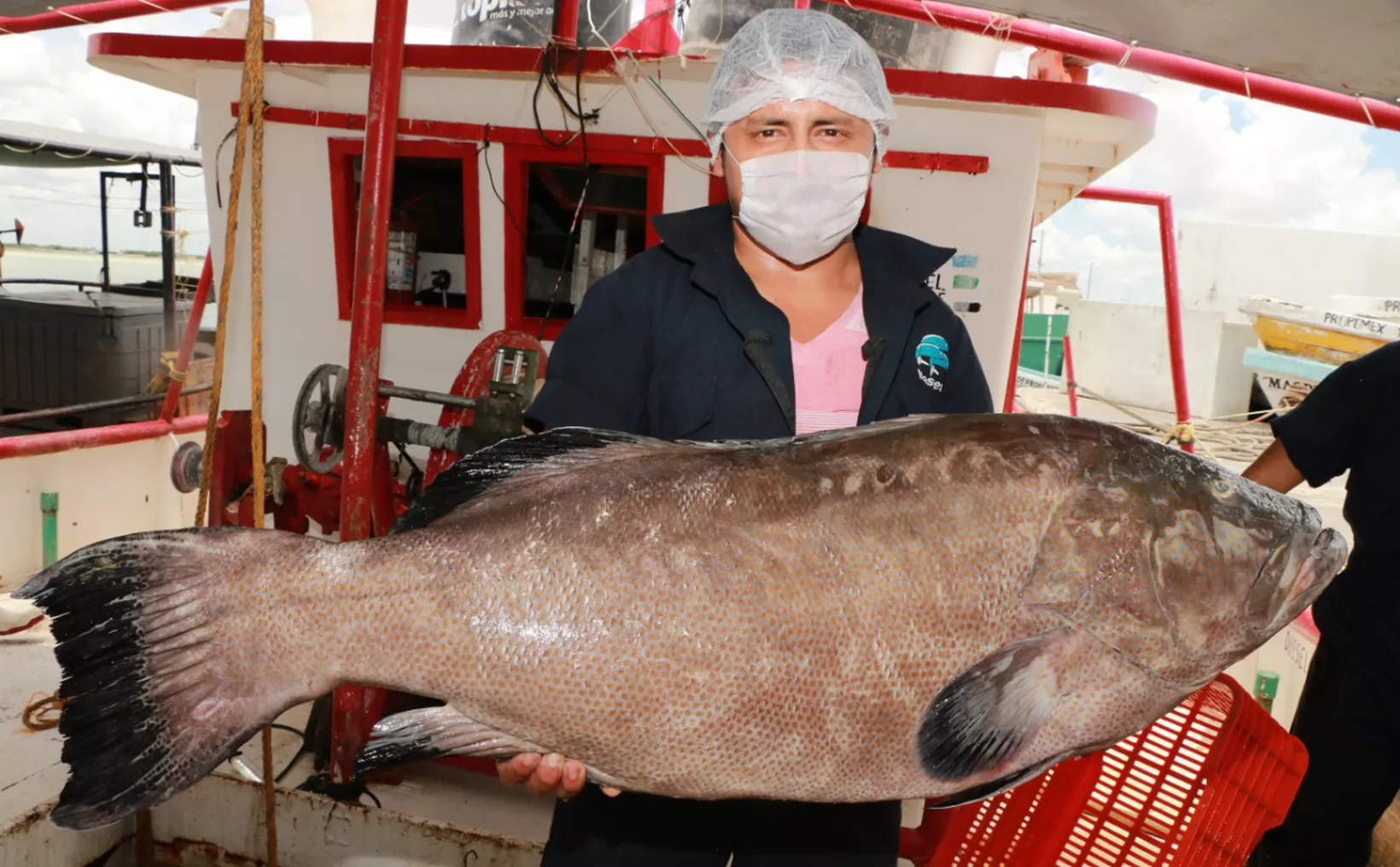
Quintana Roo, Mexico — The lack of fishing sanctuaries in Quintana Roo is putting the grouper, a key species of the Mesoamerican Reef, at risk, warns a scientific study.
An international study reveals that 98% of the analyzed grouper species lack effective fisheries management, endangering the biodiversity of the Mesoamerican Reef. Therefore, the creation of fishing sanctuaries or “no-take” zones is required to preserve these specimens, according to Eloy Sosa Cordero, a researcher at El Colegio de la Frontera Sur (ECOSUR).
According to the recent scientific article “Does fisheries management of groupers effectively protect them?”, the gap between the extinction risk of species and the laws that should protect them is critical. Most grouper species face a management crisis that ignores their status on the International Union for Conservation of Nature (IUCN) Red List.
The study, which included the participation of Eloy Sosa, an ECOSUR researcher, evaluated 50 grouper species globally. The data are alarming: 98% of the species have limited or non-existent management, and only 3% have extensive management measures.
The fact that a species is listed as “threatened” on the Red List does not necessarily translate into fishing laws that restrict its capture.
For the Mesoamerican Reef region, which includes the Mexican Caribbean, species such as the red grouper, the black grouper, and the Nassau grouper are key pieces of the ecosystem. However, their own biology condemns them: they grow slowly and gather in large groups to reproduce (spawning aggregations).
These gatherings are predictable, allowing fishing fleets to capture a large part of the reproductive population in a few days if there are no protected fishing sanctuaries.
Given the ineffectiveness of current measures, the group of experts urgently calls for the implementation of science-based strategies with the creation of fishing sanctuaries. This includes establishing exclusion zones where species recovery is the priority and prohibiting fishing at specific sites during spawning seasons.
They also propose increased monitoring, meaning to stop reporting general catches as “grouper” and start identifying each species to detect population declines in time.
“This work is a call to action for governments to use the IUCN Red List as a binding tool and not just a descriptive one,” the researchers state.
Discover more from Riviera Maya News & Events
Subscribe to get the latest posts sent to your email.