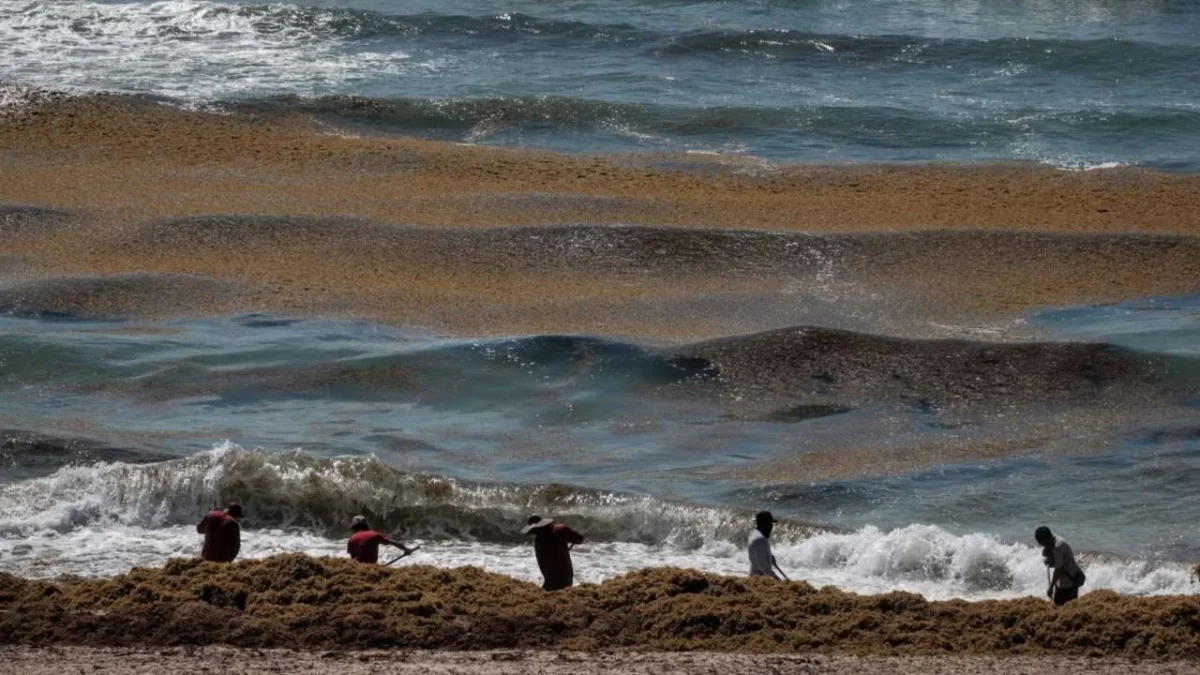
The enormous amounts of sargassum that accumulate year after year in the Mexican Caribbean have become the most serious environmental problem in the area. Although the 2025 season has already concluded, the macroalgae continues to arrive in volumes so high that they are impossible to manage with the available infrastructure, despite efforts by the government and various organizations, warned Adán Caballero Vázquez, a researcher at the Water Sciences Unit of the Yucatán Scientific Research Center (CICY).
“The issue is not local. While a municipality makes an effort, it is not enough; we must work jointly. We should observe other points in the entity, such as the Sian Ka’an Biosphere Reserve or Xcalak. We need to broaden the radar to achieve a significant reduction of the macroalgae. Actions at a regional level are required,” he stated.
Caballero Vázquez explained that it is urgent to stop dumping nutrients into the water, as this pollution fosters sargassum development. He recalled that the increase in sea temperature in the medium or long term will trigger irreversible impact.
Seagrasses Are Declining
He warned that seagrasses are declining alarmingly and cited Isla Contoy as an example, where they have practically disappeared. “This has to do with the deterioration of water quality, and with that, all associated biodiversity is lost,” he emphasized.
The specialist highlighted that, beyond 2025 having been a strong year for sargassum influx, the historical accumulation of sargassum and its residual effect, added to general ecosystem deterioration, constitute a problem that must be addressed on a much broader scale than currently contemplated.
To this is added the lack of budget to study it. “I am sure that only with research will we be able to have solid elements that allow for decisive responses to the sargassum problem, especially in terms of its utilization and mechanisms to reduce its reproductive capacity or its impact on ecosystems,” he affirmed.
Data
“Maintaining water temperatures above 30 degrees for several months or days of the year is serious for the survival of coral reefs,” said Adán Caballero Vázquez, researcher at CICY.
91,000 tons of algae were collected this year in the Mexican Caribbean.
Discover more from Riviera Maya News & Events
Subscribe to get the latest posts sent to your email.