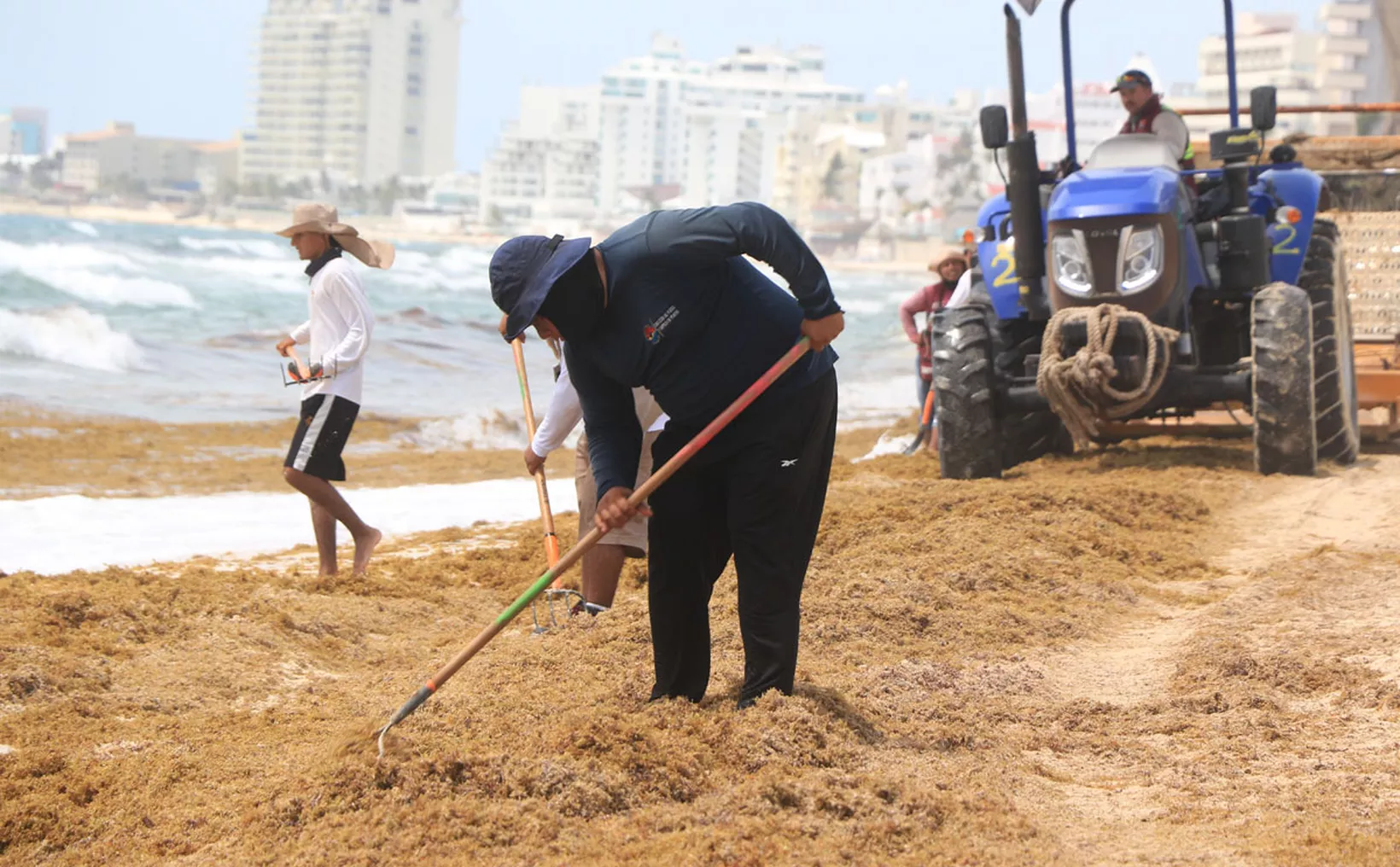
Quintana Roo, Mexico — Authorities are promoting the Development Pole of Circular Economy for Well-being (Podecibi), a project that seeks to transform the so-called “golden tide” into an economic asset. It will be strategically located in Puerto Morelos due to the area’s connectivity. This aims to avoid losses of two trillion dollars represented by the massive arrival of sargassum.
According to Brandon Mex Martínez, director of Special Management Waste at the Secretariat of Ecology and Environment (SEMA), 140 companies and projects that valorize sargassum are currently operating in the state, integrating into a productive chain that seeks to mitigate the financial impact in the region.
He emphasized that the seaweed’s impact is not only visual, as studies by the Inter-American Development Bank (IDB) detail that the damage to Quintana Roo’s coasts represents an estimated annual loss of two trillion dollars, equivalent to 11.6% of the state’s Gross Domestic Product (GDP).
Ecologically, the accumulation of seaweed causes reduced oxygen in the water, leading to the death of marine species and seagrass in key destinations such as Cancún, Playa del Carmen, Puerto Morelos, Tulum, and Mahahual.
He explained that in the case of Podecibi in Puerto Morelos, this is a federal node that will leverage the connectivity of the pier, airport, and Maya Train to process sargassum on a large scale in the state.
“The federal project is an instrument that promotes the circular economy as an engine of development. While there are already other development poles, this one will be specifically for sargassum, and it is intended to be in Puerto Morelos so that the necessary connectivity for this major federal project is available there.”
For this purpose, he stated that there is a plot of land in the eleventh municipality for the comprehensive use of this fishery resource, generation of circular productive chains, reduction of environmental impacts and disposal costs, all aligned with the Circular Economy Law and the Mexico Plan.
He also highlighted the creation of the Quintana Roo Sanitation and Circular Economy Center, with an initial investment of 40 million pesos and the use of technologies such as anaerobic reactors to combine sargassum with sludge and wastewater, generating biogas or valuable byproducts.
The urgency to incentivize these circular economy projects is supported by the increase in seaweed arrivals. 2025 marked a historic maximum with 96,891 tons collected, with July being the critical month and Playa del Carmen the most affected municipality.
Additionally, he explained that the containment deployment includes 7,500 meters of marine barriers that will be added to the existing 9,500 meters, and in coordination with the Secretariat of the Navy, there is the vessel ARM Natans BS0-101, 11 other sargassum vessels, 22 smaller boats, four aquamarine sargassum vessels, one crane, three cargo trucks, three pressure washers, plus 500 active personnel in sargassum collection.
To face this volume, Quintana Roo has the State Environmental Monitoring Center, the first of its kind in Latin America, which allows for prediction of arrivals with 1 to 3 weeks’ advance notice and daily reports at 3 a.m. to coordinate crews and machinery to make collection of this now fishery resource more efficient.
Discover more from Riviera Maya News & Events
Subscribe to get the latest posts sent to your email.