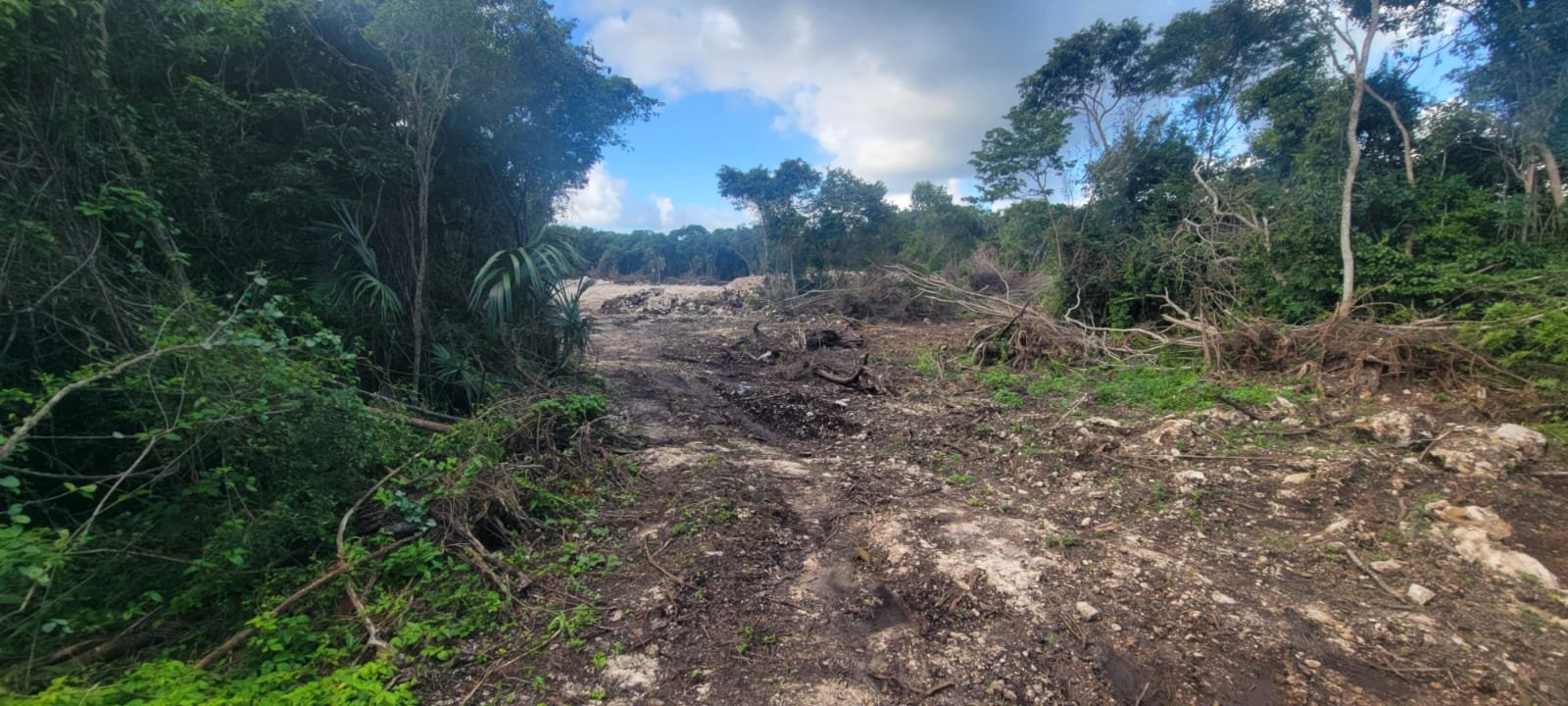
Chetumal, Quintana Roo — The Environmental Impact Statement (MIA) for the Perfect Day Mexico project has not yet been authorized, but Royal Caribbean has already begun preparing the land for construction by starting the demolition of 71 existing buildings on part of the site. However, the cruise line is violating the specifications for the disposal of these special management waste materials that it proposed in the document.
The company told the Ministry of Environment and Natural Resources (Semarnat) that during the preparation stage, it would use temporary storage sites within its own property for waste generated by demolition. Additionally, for all cases of final disposal of solid waste, it would contract third-party services, but did not present the details of that management.
Today, one of the sites where it is dumping demolition debris was revealed. The site is located alongside the Mahahual-Xcalak highway, near where it intersects with Mantarraya Street in the community and the La Divina Esperanza settlement, south of the town.
This is an old, closed material bank—an excavated site that nearly reaches the water table. It is unknown which authority gave permission to deposit demolition debris at this location, which is part of the polygons regulated by the Urban Development Program (PDU) of the Mahahual Urban Center.
However, any permit would be irregular, as the geolocation of the abandoned material bank shows it is in an area classified by the PDU as High-Density Residential Use Zone, code H-3. This zone expressly prohibits establishing sites for receiving materials and waste from building demolition, including material from land clearing and brush cutting.
Furthermore, using land located on the outskirts of Mahahual violates what was promised in its own MIA. The cruise line told Semarnat that areas for the temporary disposal of this debris and waste would be within the project’s property, so it would not affect areas outside it.
“In this case, as part of the primary separation of waste, areas within the property will be set up for the temporary disposal of this waste. The areas to be conditioned for this purpose will be part of those intended for infrastructure placement; areas that are not meant to serve the formation of the project areas will not be affected,” the company stated.
“The areas will be clearly differentiated and indicated to avoid the dispersion and mixed disposal of waste and, at the same time, facilitate handling for removal and recycling,” it added.
It is supposed that within its property, waste would be separated into wood, scrap metal, rubble, and mixed and glass waste, and then sent to authorized recycling centers, with the expectation of recovering up to 50% in reusable materials.
Likewise, it states that non-recyclable demolition waste would be handed over to “collection companies authorized by the state government.”
This is because demolition waste is classified by environmental regulations as special management waste, so materials are not supposed to be mixed during accumulation but separated.
However, in the waste dumped south of Mahahual, mixed materials are observed, clearly indicating non-compliance with regulations on special management waste.
The MIA for Perfect Day Mexico, presented by Royal Caribbean on December 9 but with evaluation starting only on January 8, indicates that the property where the project will be developed currently has 71 pre-existing buildings, whose total removal is required to allow the placement of new infrastructure for the water amusement park.
The cruise line estimates that demolition will generate approximately 68,200 tons of waste, including reinforced concrete, asphalt concrete, masonry, brick, plaster, concrete, and ceramics.
It states that the diversity of construction methods and materials will require differentiated treatment and disposal, so it considers the possibility of reusing or recycling certain materials, although the feasibility of such use will depend on the specific analysis conducted at the time of dismantling.
It notes that the demolition of existing structures will be executed in phases, as free areas are needed for the placement of new infrastructure. In the activity schedule presented in the MIA, it allocates a period of 7 months for this.
Overall, the site preparation stage contemplates an estimated duration of 11 months, considering the simultaneity of prior activities and the technical processes associated with land preparation.
The MIA explains that demolition will include the complete removal of structural and construction elements, such as foundations, swimming pools, concrete, metal, and wood structures, sheds, and light covers, sheets, and covers made of natural products.
It states that once the components are dismantled, “the debris will be transported to a temporary storage area intended for the classification and separation of reusable or recyclable materials.”
“Recoverable materials will be channeled according to valuation criteria, while those without reuse potential will be managed as construction and demolition waste under applicable regulations,” it says.
However, the document does not specify the temporary disposal sites nor certify that they have compatible land use, because it is assumed that waste would be deposited in areas of the project’s own property, which does have compatible land use, and not outside it, as is being done.
It adds that the general demolition procedure begins with the selective removal of removable components, such as doors and windows, carpentry, ironwork, wiring, pipes, electrical appliances, mechanical equipment, and air conditioning systems.
Then, this material will be classified for recycling, reuse, or donation when possible.
It adds that, in the case of sanitary fixtures or materials considered contaminants, they will be sent to authorized sites for final disposal or destruction, as appropriate. However, again, it does not present the geolocation maps of these sites nor certify that they have land uses compatible with these activities.
Discover more from Riviera Maya News & Events
Subscribe to get the latest posts sent to your email.