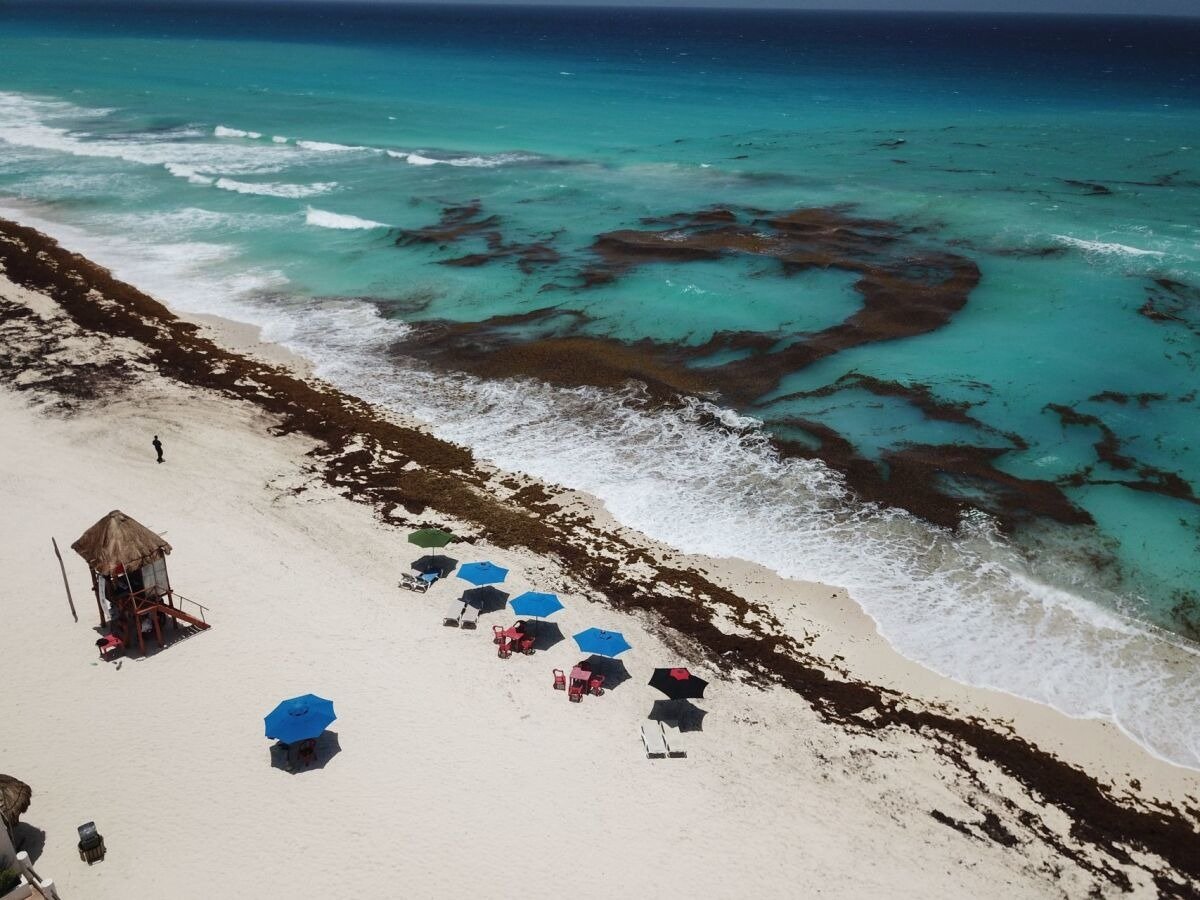
Quintana Roo, Mexico — The sargassum season in Quintana Roo has begun atypically in January 2026, with arrivals already recorded in at least five tourist destinations including Mahahual, Xcalak, Tulum, Puerto Morelos, Playa del Carmen, and Cozumel.
Authorities at all three levels of government are washing their hands of the matter, claiming it is a natural phenomenon and that they can do nothing about it. However, over the past two decades, billions of pesos have been spent on research, funds coming from public coffers that have so far yielded no results.
Recent expenditure budgets for Quintana Roo show evidence that millions of pesos have been allocated to find a solution, but the individuals or companies benefiting from contract assignments end up collecting payment and forget to report how they spent the public money and what solution they found. This demonstrates that the sargassum issue has so far only served as another pretext to spend public funds.
Federal Deputy Accuses Government of Omissions
On Wednesday, January 21, from Playa del Carmen, federal deputy Ernesto Sánchez of the National Action Party (PAN) accused the federal government of serious omissions in the face of structural problems in Quintana Roo, such as sargassum management, the healthcare system, social security, and protection of the tourism economy, despite prior warnings made in the Congress of the Union.
In a publication by Cambio 22, Sánchez warned that these omissions become more delicate with the proximity of the 2026 World Cup, noting that approximately 70% of international flights have Cancún International Airport as their arrival point.
The legislator stated that the Federation dismissed technical and legislative information, even though the early arrival of sargassum since January confirms that the phenomenon is no longer seasonal and is directly linked to climate change.
He recalled that PAN proposed in the Chamber of Deputies an increase of 226 million pesos for sargassum studies and treatment, an initiative that was rejected by Morena and its allies on instructions from the federal government, with the argument that the problem “did not exist” and that the budget should not be duplicated.
He affirmed that this refusal constitutes a political, not technical, decision that today has direct consequences on the coasts of the Mexican Caribbean.
Resources Allocated but Results Unknown
In Quintana Roo, public resources have indeed been allocated for supposed research, the results of which are unknown, simply because such research was not conducted.
Tourism service providers and municipal authorities reported that recent sargassum arrivals have been observed since late December and early January, including an atypical influx in Playa del Carmen following a southerly wind that brought a “bank” of sargassum.
Both municipal government personnel and private companies have to start removing sargassum early in the day so visitors do not see it. However, as the day progresses, the accumulation of the macroalgae on the beaches becomes noticeable.
Monitoring and Scientific Data
Esteban Jesús Amaro Mauricio, director of the Sargassum Monitoring Network in Quintana Roo, confirmed in early January the early onset of the phenomenon and attributed the erratic behavior to changes in ocean currents and climate change.
He highlighted that of the nearly 1,200 kilometers of coastline in Quintana Roo, there are still few beaches where the arrival of the algae has been reported, but in a very accelerated manner.
The Sargassum Monitoring Center, located in the C5 of Cancún, uses satellite images from the European Space Agency to predict routes, speed, and areas of greatest impact.
The Oceanographic Institute of the Gulf and Caribbean Sea of the Secretariat of the Navy issued a bulletin on January 10, 2026, alerting about five sargassum conglomerates totaling 158 tons, with the largest volume (85 tons) projected toward Puerto Morelos and Playa del Carmen.
The same agency reported five more groups of sargassum closer to the coasts of Quintana Roo, with a total biomass in the Mexican Caribbean of 6,449 tons, based on images taken by the University of South Florida on January 9.
The University of South Florida, for its part, identified via satellite approximately seven million tons of sargassum from Africa to the Gulf of Mexico, suggesting that 2026 could be a year as intense as 2025, when about 73,224 tons were collected.
The Optical Oceanography Laboratory of the University of South Florida warned in its monthly bulletin that the rapid growth of sargassum in November and December 2025 indicates a high-intensity season in 2026.
Health and Environmental Risks
The decomposition of sargassum represents a significant threat to public health and the ecosystem, according to multiple scientific studies.
A joint study by the National Technological Institute of Mexico, Cinvestav, and the Center for Scientific Research of Yucatán, published in Marine Pollution Bulletin, revealed that sargassum leachate contains arsenic, cadmium, chromium, nickel, and zinc, exceeding the limits of NOM-001-Semarnat.
Arsenic, present in high concentrations, is an internationally recognized carcinogen, and according to the U.S. Resource Conservation and Recovery Act, the leachate should be classified as toxic waste.
Decomposition releases gases such as hydrogen sulfide and ammonia, which can cause irritation in the eyes, nose, throat, respiratory difficulty, nausea, and headaches, especially in people with asthma or respiratory diseases.
In the Yucatán Peninsula, the high permeability of the karst substrate allows contaminants to rapidly infiltrate the aquifer, the main source of freshwater, if sargassum is deposited in sites without adequate infrastructure.
Economic Impact on Tourism
Despite government and private actions to pay crews dedicated to placing sargassum barriers, collecting algae at sea, transporting it to confinement points, etc., tourism service providers in Quintana Roo have had to invest at least 150 million pesos to keep the macroalgae away from the vicinity of their establishments.
Discover more from Riviera Maya News & Events
Subscribe to get the latest posts sent to your email.