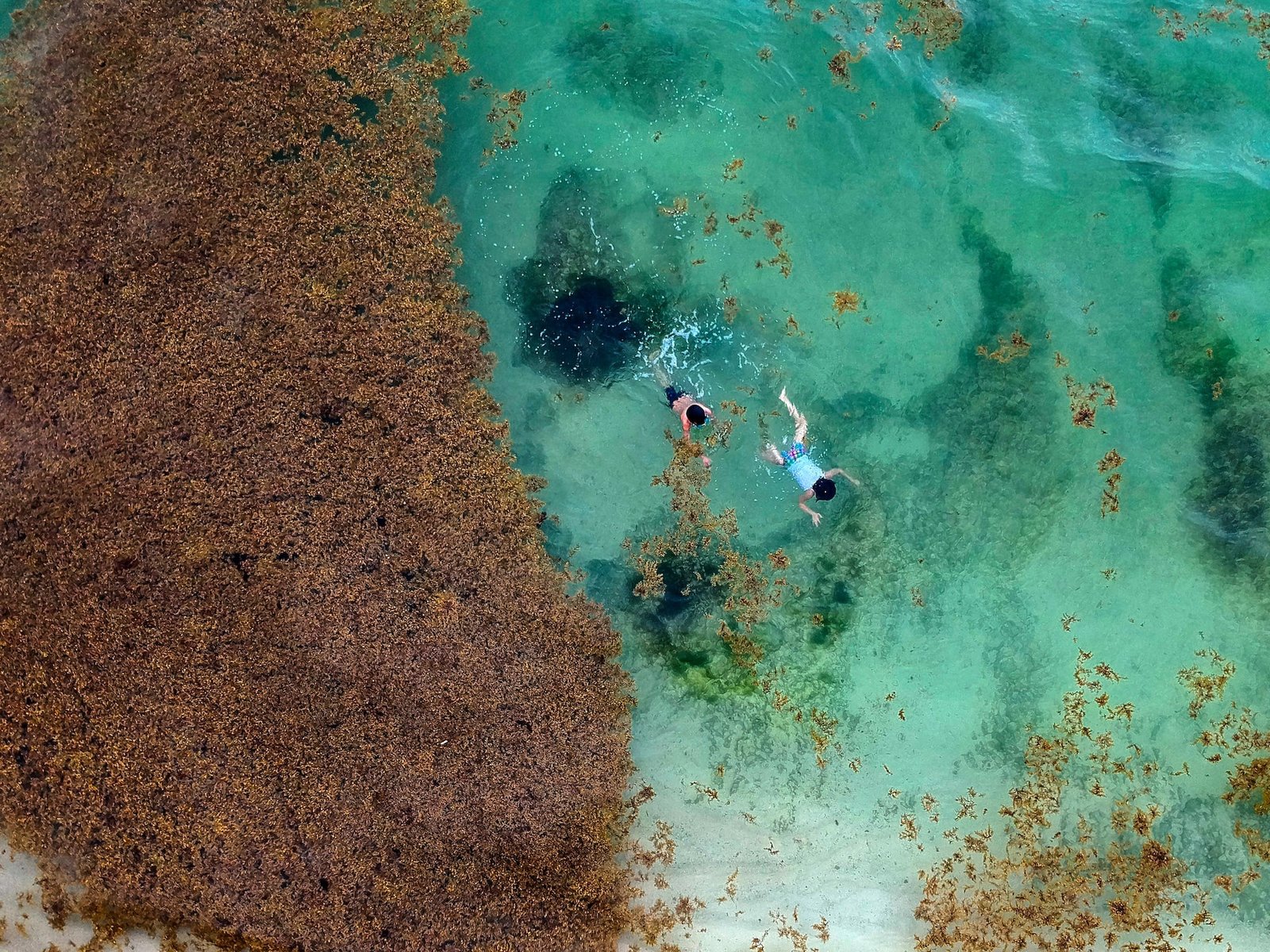
Cancún, Quintana Roo — Mexican authorities are preparing for increased sargassum seaweed influx along Quintana Roo’s Caribbean coast during the upcoming Easter holiday season, according to monitoring data showing massive seaweed masses moving toward the region.
The Caribbean Sargassum Monitoring Network predicts heavier seaweed arrivals during March and April, coinciding with peak vacation travel to popular destinations including Cancún, Playa del Carmen, Tulum and Cozumel.
Recent reports indicate 7,460 metric tons of sargassum have already accumulated in the Mexican Caribbean this year, while more than 280,000 metric tons are moving through the western Central Atlantic toward the Caribbean region.
Satellite monitoring has identified the Atlantic’s Great Sargassum Belt reaching historic volumes, with estimates exceeding 38 million metric tons offshore—surpassing even 2022 levels, previously considered one of the worst years for seaweed influx.
Containment Strategy Deployed
The Mexican Navy has activated a containment operation in the Mexican Caribbean, prioritizing the tourist corridor that includes Cancún, Playa del Carmen, Tulum and Cozumel.
The strategy involves deploying 16 naval units including one ocean vessel, 11 coastal boats and four amphibious sargassum collection vessels. Authorities have installed 9,500 meters of containment barriers to intercept seaweed before it reaches shore, with plans to add another 6,000 meters in coordination with state government.
The objective is to intercept sargassum offshore or in shallow waters, reduce beach accumulation, and mitigate environmental and tourism impacts during peak season.
Currents Determine Coastal Impact
According to marine seagrass specialist Brigitta Van Tussenbroek, large offshore sargassum volumes don’t automatically translate to increased beach arrivals.
“The mere presence of this algae offshore doesn’t mean there will be more sargassum on beaches,” Van Tussenbroek explained. “What really determines whether it arrives or not is the combination of wind and underwater currents. When these conditions favor it, the probability increases that sargassum will be pushed toward the coast.”
The researcher emphasized that sargassum behavior is dynamic and can change within days. She recalled that two years ago, early arrivals occurred due to shifting wind patterns.
“We saw something similar when northern and southern winds changed current behavior. That pushed more sargassum ashore earlier than usual. It wasn’t that there was more sargassum in the ocean, but conditions pushed it toward land. That’s why it’s very important not to alarm people based solely on offshore numbers,” she detailed.
Climate Change Connection
Van Tussenbroek also explained that accelerated sargassum growth in recent years relates to global phenomena.
“Climate change is rapidly multiplying the volume of sargassum floating in the ocean. This increases the risk of coastal arrivals in Quintana Roo, no longer just during a specific season but practically year-round,” she warned.
However, she insisted that not all biomass recorded in the Atlantic will reach Mexican Caribbean beaches.
“Having this enormous accumulation in the Atlantic doesn’t mean all of it will arrive here. It will depend completely on ocean currents, which in turn are dominated by trade winds. If conditions change, the sargassum trajectory also changes,” she noted.
Seasonal Predictions
Regarding what might occur during Easter and subsequent months, the specialist was cautious.
“We’ll probably continue seeing arrivals before the formal season begins, because these are patches breaking off from this great belt, but it’s very likely they’ll be smaller or similar to what we’ve seen in recent weeks,” she commented.
She added that phenomena like intense rains, tropical systems or wind changes can function as temporary barriers.
“In other years we’ve seen that during rainy season, winds help decrease arrivals in some areas. But this isn’t permanent. We can’t expect a tropical wave to keep patches away throughout the entire season. When those conditions disappear, sargassum can return,” she said.
Discover more from Riviera Maya News & Events
Subscribe to get the latest posts sent to your email.