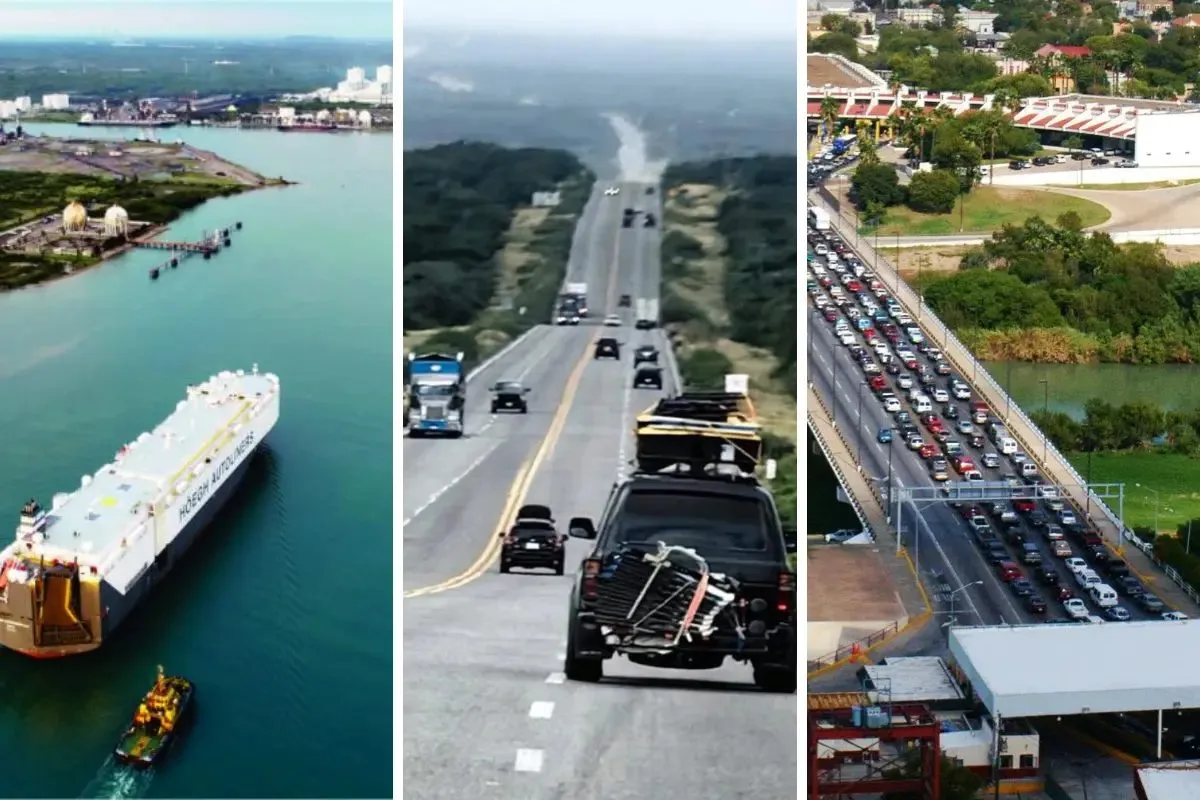
Mexico City — President Claudia Sheinbaum confirmed plans to build a major highway corridor along Mexico’s Gulf coast that will connect the Yucatan Peninsula with the country’s northern border, part of what she called one of the most ambitious projects in her national road infrastructure plan.
During her morning press conference, Sheinbaum said the Gulf of Mexico Corridor will feature four lanes running from the Yucatan Peninsula to Tamaulipas, allowing travelers to traverse the entire Gulf region.
“In Tamaulipas, it will essentially allow four-lane travel from the Yucatan Peninsula to Tamaulipas, covering the entire Gulf,” Sheinbaum said.
Jorge Mendoza, director of Banobras (the National Bank of Public Works and Services), detailed that the corridor represents one of the flagship investment projects in infrastructure. He explained that existing two-lane sections will be expanded to four lanes to improve traffic flow toward Mexico’s northern border.
The Tamaulipas state government announced in late January that construction on the Gulf of Mexico Corridor will begin this year with an investment of 40 billion pesos (approximately $2.3 billion USD). The project aims to connect southern, central, and northern regions of Tamaulipas, positioning the state as a logistical and economic growth hub.
Pedro Cepeda, Tamaulipas Secretary of Public Works, said the investment will start this year with coordination between state authorities and the federal Secretariat of Infrastructure, Communications, and Transportation (SICT). Initial work will focus on the Tampico Dos Bridge, constructing a bypass around the lagoon system to connect Altamira, Estación Manuel, Zaragoza Highway, and Victoria, continuing to the El Tejón interchange and reaching Reynosa.
Sheinbaum also announced a new investment package exceeding 150 billion pesos (approximately $8.6 billion USD) for 18 road projects across 11 states. She described it as a “very ambitious, historic highway program for the country” involving public and mixed investment, managed by SICT together with Banobras.
Mendoza added that the program aims to strengthen connectivity, reduce travel times, and improve road safety nationwide. Sheinbaum highlighted the economic development impact, noting that projects like the new Bavispe-Nuevo Casas Grandes highway will connect Sonora with Chihuahua, while the Tamazunchale-Huejutla route will better link the Huasteca region.
Discover more from Riviera Maya News & Events
Subscribe to get the latest posts sent to your email.