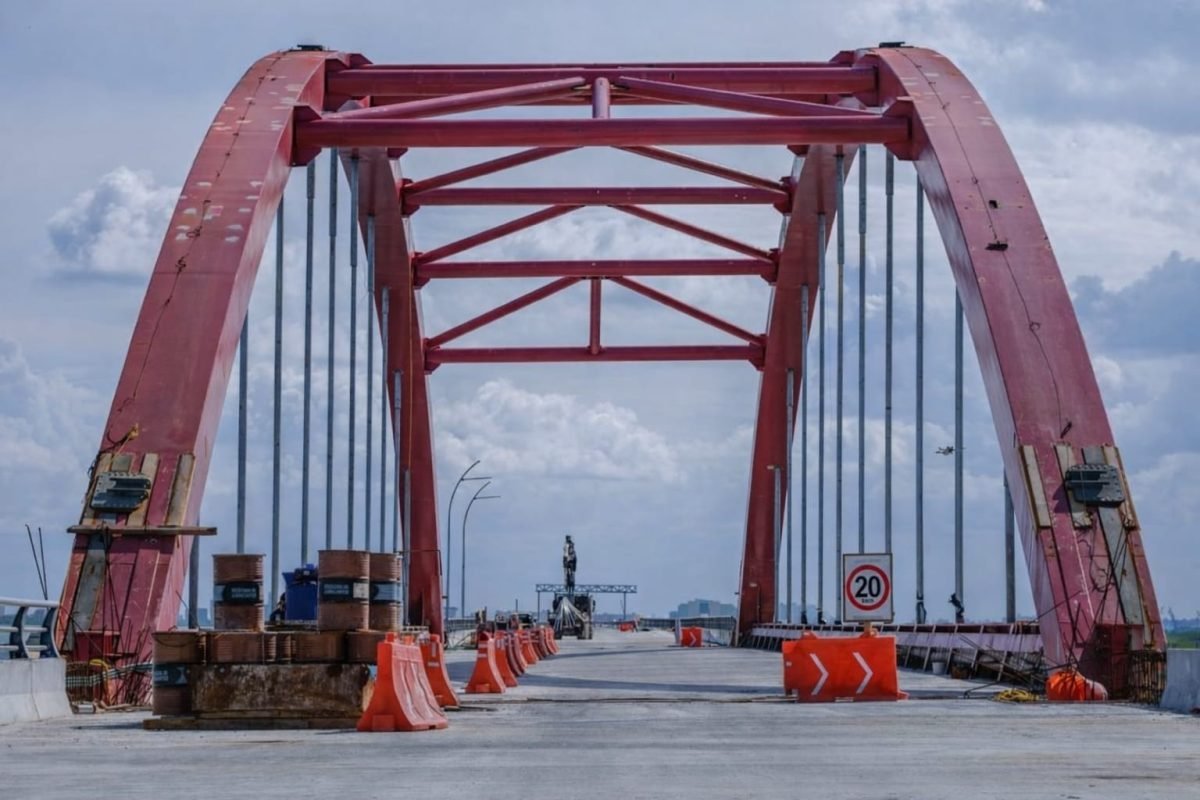
Cancún — The Nichupté Bridge, projected as the definitive road solution between downtown Cancún and the hotel zone, faces a new and indefinite delay in its inauguration. Despite being in the final phase of construction, the Secretariat of Infrastructure, Communications and Transportation (SICT) was forced to execute critical reinforcement work after detecting sinkings and cracks in its structure before its opening. This situation stalled the progress of the project, which barely managed to advance from 92% to 93% between December and January, evidencing the risks of having started the project without the required soil mechanics studies or Environmental Impact Assessment (MIA).
The central problem lay in the high karsticity of the lagoon bed, a limestone and cavernous terrain that was not properly evaluated before construction. Guido Mendiburu Solís, representative of the SICT in the state, admitted at the time that some sections presented mobility, which forced a redesign in the area known as “La Joroba.” In this section, the highest point of the bridge, additional piles and metal beams were installed to compensate for the soil’s low load-bearing capacity, which required increasing the foundation depth from 35 to 42 meters in an attempt to guarantee the infrastructure’s stability.
The urgency of this work became public after videos circulated on social media showing cracks in the concrete headers supporting the beams. Although authorities insisted that these cracks did not represent a structural risk and were a consequence of material tension, specialists pointed out that such defects were symptoms of the rush imposed from the beginning of the previous federal administration. Additionally, cracking was reported in sections that already had pavement, about which the official agency did not issue a clear technical position during initial inspections.
Financially, the technical contingency made the bridge the most expensive public work in the history of Quintana Roo. The initial budget, estimated at 5,580 million pesos, skyrocketed to nearly 10 billion pesos, practically double what was originally planned. This cost increase was attributed to emergency maneuvers, such as the construction of a 103-meter metal bridge to bypass a cenote up to 90 meters deep that was unexpectedly found in the route, an obstacle that should have been detected in the planning phases and not during pile execution.
With an opening date originally set for April 2024, the project accumulated up to two years of delay compared to its original plan. The SICT reported that, after completing the reinforcements, the structure underwent dynamic and static load tests to try to regain public confidence. However, the process was extended due to complementary lighting and safety work, leaving the concrete giant over the Nichupté Lagoon as a record of technical improvisation and budget overruns in the state’s memory.
Discover more from Riviera Maya News & Events
Subscribe to get the latest posts sent to your email.