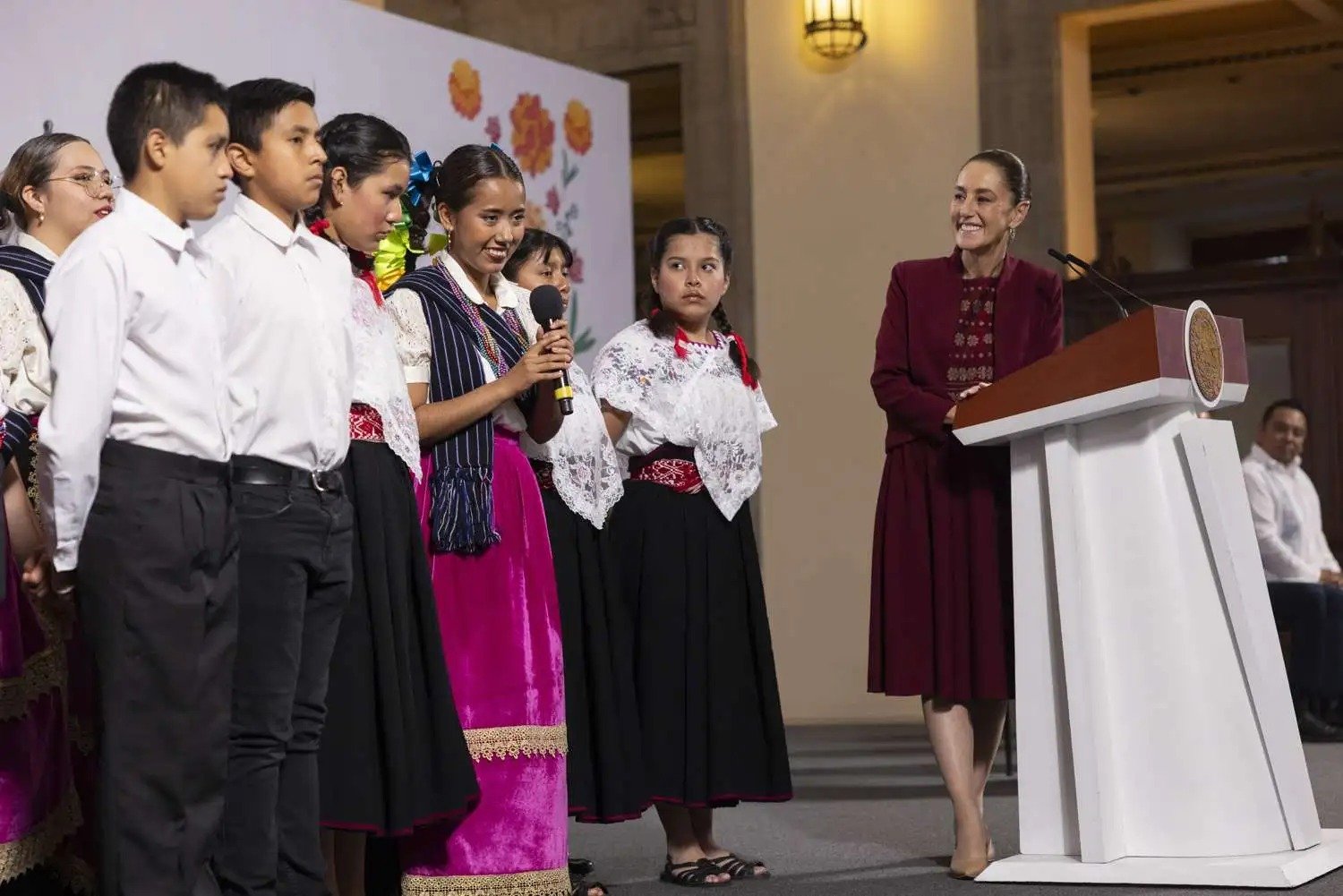
Mexico City — Today's morning press conference had a different tone, rhythm, and emotion. Neither statistics nor reports dominated the Treasury Hall; instead, the laughter, nerves, and energy of more than a hundred indigenous children filled the National Palace with life.
Dressed in colorful traditional attire, huarache sandals, and wide smiles, they took the microphone to speak—without scripts or poses—about the pride of belonging to their communities, of speaking their language, and of making music. They were the protagonists of the Fiesta de las Culturas Comunitarias Yoltlajtoli 2025: Voces Vivas, a project that seeks to preserve native languages and strengthen cultural identity from childhood.
"There are people who are ashamed to speak Nahuatl, but I am proud to be from Puebla and to speak my language," said one young girl with firmness, eliciting applause and looks of tenderness. Another child, from Cherán, Michoacán, explained that singing in Purépecha "is one of the most beautiful things possible."
As reporters noted every word, the Orquesta Monumental de PILARES, comprised of girls and boys from Puebla, Guanajuato, and Oaxaca, performed traditional melodies that made the walls of the National Palace resonate.
Amid this "People's Mañanera," President Claudia Sheinbaum listened attentively and smilingly, and used the moment to send a message about Michoacán, where violence recently took the life of Uruapan Mayor Carlos Manzo.
"We are not going to leave Michoacán," she assured. "We must embrace the youth, give them options through culture, through education, through art. No young person should see delinquency as a life option."
The president announced that this coming Sunday she will present the Plan Michoacán for Peace and Justice, focused on addressing the root causes: more schools, more sports, more culture, more hope. "That is the true security strategy," she emphasized.
Today, among flutes, saxophones, drums, and languages that endure, culture prevailed over fear. The children—with their spontaneity and symbolic strength—reminded everyone that Mexico's future is also written in Nahuatl, in Purépecha, in Hñähñu. And that art, as one of the young girls said, "is a way of speaking from the heart."
The morning concluded with a long, warm round of applause. It was not for the officials, but for those children who, without intending to, turned the presidential conference into a lesson in pride, identity, and hope.
Discover more from Riviera Maya News & Events
Subscribe to get the latest posts sent to your email.