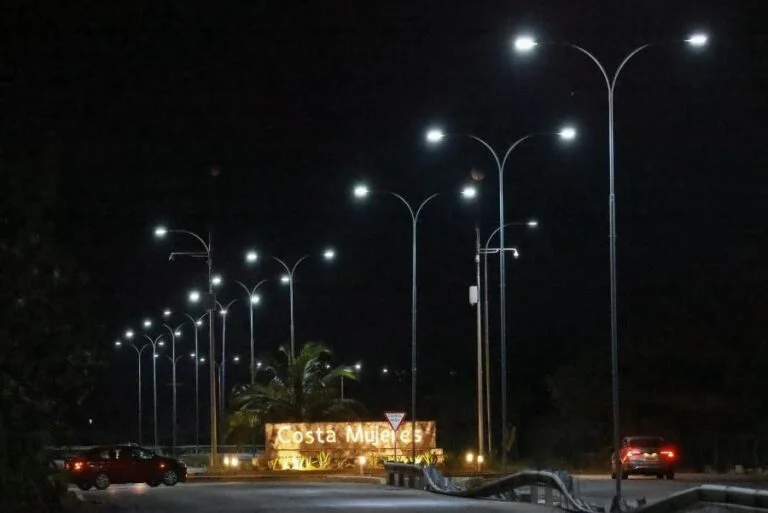
Chetumal — In a resolution with significant fiscal implications for municipalities in Quintana Roo, Mexico’s Supreme Court of Justice of the Nation (SCJN) has invalidated the Public Lighting Right fee scheme applied in the municipality of Isla Mujeres, declaring it unconstitutional for failing to eliminate the link between the fee and electricity consumption by homes and businesses, and for establishing differentiated and arbitrary parameters for charging property owners without contracts with the Federal Electricity Commission (CFE).
In its decision, the Court considered that the new scheme implemented by the government of Atenea Gómez Ricalde starting in February of this year violates the constitutional principles of proportionality, equity, and tax legality.
The highest court ruled that this method of collecting the Public Lighting Right generates the following unconstitutional flaws: it turns the fee into a tax on energy consumption, which is a matter reserved for the Congress of the Union, by maintaining the link between public lighting and private electricity consumption; it establishes unequal treatment between users with CFE contracts and property owners not registered with the state-owned company; and it creates legal uncertainty by lacking legal limits for setting the rate for users without CFE contracts.
The unconstitutionality action, marked with number 40/2025, was filed on March 24, 2025, by the National Human Rights Commission, against Article 115 of the Isla Mujeres Municipal Finance Law, reformed in February of the same year.
This decision creates a fiscal problem for the vast majority of municipalities in the state, because it is the second scheme established for collecting the Public Lighting Right that the SCJN has invalidated as unconstitutional, meaning any type of collection that municipalities carry out using either of the two forms is illegal.
In fact, in the unconstitutionality action ruling issued against the collection in Isla Mujeres, the SCJN issued an exhortation to the State Legislative Power so that, “in subsequent legislative measures similar to those analyzed in this ruling, within the framework of its configurative freedom and taking into account the considerations of this ruling, it refrains from incurring the unconstitutional flaws that motivated the declaration of invalidity of the challenged norm.”
The first model that was invalidated is the one that establishes a fee of 5% on CFE billing and another of 2 Units of Measurement and Update (UMA) per year for those without private electrical service.
That model is the one the SCJN first declared unconstitutional in the case of the municipality of Tulum, last September, for establishing a link between public lighting and private consumption by users, which are concepts without any real relationship, in addition to having a differentiated charge among taxpayers.
This method of charging for public lighting remains in effect in Bacalar, Puerto Morelos, Cozumel, and Othón P. Blanco, where the state capital, Chetumal, is located.
The second model, which has now also been declared unconstitutional starting with the Isla Mujeres case, charges from 2.5% to 5% on CFE billing and an unspecified amount determined by the Municipal Treasury for property owners without private electrical service.
In addition to Isla Mujeres, this charging method is the one applied by the municipalities of Benito Juárez, where Cancún is located, and Playa del Carmen.
As explained at the beginning, this scheme was declared unconstitutional because, in addition to maintaining the flaws of the first, it allows arbitrariness by not establishing a fixed fee for people without CFE contracts.
In addition to invalidating a revenue tool for the municipality of Isla Mujeres, the SCJN’s resolution also created a new problem for the municipality of Tulum, since through a reform approved last week by the State Congress, it sought to correct the method of charging the Public Lighting Right, after the first model was invalidated, by establishing the second model, which has now also been declared unconstitutional.
The invalidation of the two collection models in effect in the state places these municipalities in a difficult fiscal situation, since public lighting revenues are significant.
With the first model, Bacalar, which collects the least, has budgeted revenues of 4 million pesos per year, while Puerto Morelos reaches 16 million pesos; Cozumel, 24 million; Tulum, 29 million; and Othón P. Blanco, 37 million pesos.
With the second collection model, the one that collects the least, Isla Mujeres, receives 31 million pesos, while Playa del Carmen captures 86 million and Benito Juárez, 253 million pesos in revenue.
But this latter model has now also fallen, condemned by unconstitutionality, for maintaining the fee equivalent to a percentage of CFE billing and allowing the Municipal Treasury to freely impose a rate for those not registered with the state-owned company, including owners or possessors of rural, suburban, or urban properties, without clear parameters for its determination.
The only municipalities that officially do not charge the Public Lighting Right are the poorest ones: José María Morelos, Felipe Carrillo Puerto, and Lázaro Cárdenas, because despite the first collection model being in effect for them, through supplementary application of the State Municipal Finance Law, their Revenue Laws do not include that concept in their collection.
On the other hand, in the case of Tulum, which just switched to the second model to recover the collection, it aims to save itself from a new invalidation with an addition it established, whereby the Municipal Treasury will publish each year the amount to be paid for the Public Lighting Right, dividing the annual cost of operating and maintaining the service by the number of CFE users and property owners without electrical service but with lighting.
However, it maintains the link of charging a percentage of the electricity consumption bill to CFE users, while the rate for property owners without electricity but with lighting remains undetermined until published by the Municipal Treasury.
Discover more from Riviera Maya News & Events
Subscribe to get the latest posts sent to your email.