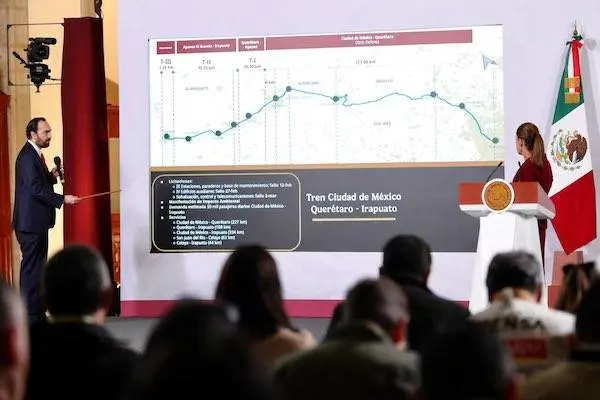
Mexico City — The Mexican government has secured nearly 25 million square meters of land for new passenger rail routes across eight states, officials announced. The land will be used to develop strategic routes connecting major cities in northern and central Mexico.
The federal government secured 24,892,000 square meters across 1,905 properties in 54 municipalities. Priority routes include AIFA-Pachuca, Mexico City-Querétaro, Querétaro-Irapuato, and the connection between Saltillo and Nuevo Laredo.
Community Dialogue and Land Acquisition
Authorities conducted direct negotiations with 123 ejidos (communal land holdings) to ensure project viability. They held 70 democratic assemblies involving more than 3,500 people interested in regional development.
The process resulted in the acquisition of 633 parcels, with officials emphasizing respect for community decisions. “This land release is carried out with the social commitment not to harm people,” said the head of Sedatu (Urban Development and Territorial Planning Secretariat).
Indigenous Consultation and Rights Protection
The project incorporated prior consultation mechanisms in 12 indigenous communities to ensure respect for their territories. Authorities organized 26 informational sessions where 921 people expressed opinions about the railway infrastructure.
This coordinated work with INPI (National Institute of Indigenous Peoples) ensures technological progress doesn’t violate the rights of indigenous communities. Officials emphasized the importance of involving populations through awareness and reconciliation processes.
Andrés Lajous, director general of TrenesMx, reported that a ruling has been issued for manufacturing 47 train units for the Northern Trains. These will serve an estimated daily demand of 70,000 passengers on the Mexico City-Querétaro-Irapuato and Saltillo-Nuevo Laredo segments.
Social Impact and Relocation
A key achievement was the relocation of families with a 28 million peso investment in housing. Conavi (National Housing Commission) benefited 44 families, providing 33 new houses and financial resources to 11 others for home acquisition.
This effort aims to improve living conditions for those who previously lived along the historical right-of-way. The government approach prioritizes social welfare, ensuring no one is displaced without secure housing.
Job Creation and Economic Development
Construction of trains to Pachuca and Querétaro has already generated more than 25,000 direct jobs. These positions strengthen local economies and offer technical development opportunities in various regions.
The Maya freight train shows 25 percent progress, consolidating the southeast Mexico logistics network. State and federal administrations maintain 12 permanent brigades to address any citizen concerns arising from the works.
Historical Context and Connectivity Goals
Historically, Mexico’s passenger rail system was dismantled, limiting efficient mobility between major cities. The current administration seeks to reverse this lag through a modern network of high-capacity passenger trains.
The Mexico City-AIFA segment is projected to begin operations soon, while other routes should be ready by 2027. “We thank the population for their collaboration; right-of-way issues are always complex,” noted Mexico’s President.
Discover more from Riviera Maya News & Events
Subscribe to get the latest posts sent to your email.