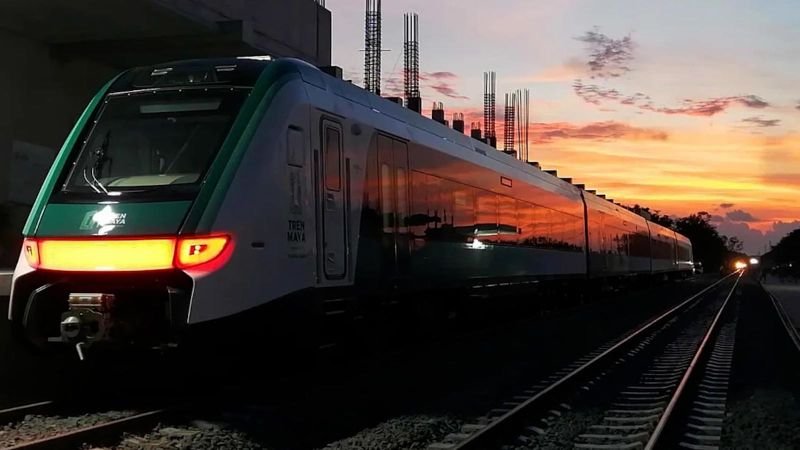
The return of passenger trains in Mexico is advancing as a long-term bet, ambitious in projections and discourse, costly in execution, and still uncertain in timing.
Over recent weeks, the government has intensified dissemination of progress, tenders, and technical studies for a railway network that aims to be operational by 2028, but which already commits significant resources from the 2026 budget.
Railway Horizon
The most advanced case is the Mexico–Toluca Interurban Train “El Insurgente,” a project that began over 13 years ago and is now entering its final phase. With 57.7 kilometers in length, double electrified track, and an estimated capacity of 140,000 daily passengers, the project is in testing and its inauguration is expected in early 2026.
This train will operate at speeds between 90 and 160 kilometers per hour and will have 20 units, each with capacity for 719 users.
Its infrastructure includes a cable-stayed bridge unique in the world for its curved design, built with six thousand tons of reinforcing steel. Still, the project’s historical delay has become a mandatory reference for evaluating the rest of the network.
Tenders in Progress
Further north, the Regulatory Agency for Railway Transport (ARTF) published the tender for Section A of the Saltillo–Nuevo Laredo Train, spanning 18 kilometers, while Section B, of 30 kilometers, is already in process. Both are located in the Monterrey Metropolitan Area, a region betting on passenger service to link industrial and logistical activity.
In a morning conference, Andrés Lajous Loaeza, head of ARTF, explained that three proposals are also being evaluated for the manufacture of 47 railway cars that will serve both this route and the Mexico City–Querétaro–Irapuato route.
“The evaluation will determine which is the most convenient in terms of technical compliance and price,” he stated, emphasizing that 65% of the content must be of national integration.
Construction in Progress
In projections, the Saltillo–Nuevo Laredo Train, also called the Gulf of Mexico Train, will have a total length of 396 kilometers and an estimated demand of 7.5 million annual passengers.
The trains will operate at speeds between 160 and 200 kilometers per hour, allowing trips of less than two hours between Monterrey and Nuevo Laredo.
The plan includes a massive and very complex work according to technicians: 52 railway bridges, 108 drainage works, and 42 vehicular crossings, plus three main stations in Nuevo Laredo, Anáhuac, and Lampazos.
According to ARTF, this work will generate 10,922 direct jobs and 32,766 indirect jobs.
“The railway unites us: it unites individuals, it unites communities,” stated the controversial and questioned governor of Tamaulipas, Américo Villarreal Anaya.
Cost and Expectations
In total, Phase I of the railway program—initiated in 2025—adds up to 787 kilometers of dedicated routes including Mexico City–Pachuca, Mexico City–Querétaro, Querétaro–Irapuato, and Saltillo–Nuevo Laredo.
The official promise is a modern network, with electric and diesel-electric trains, capable of redefining regional mobility.
The challenge, however, is not minor: meeting deadlines, containing costs, and demonstrating that, this time, the railway renaissance can reach its destination.
Discover more from Riviera Maya News & Events
Subscribe to get the latest posts sent to your email.