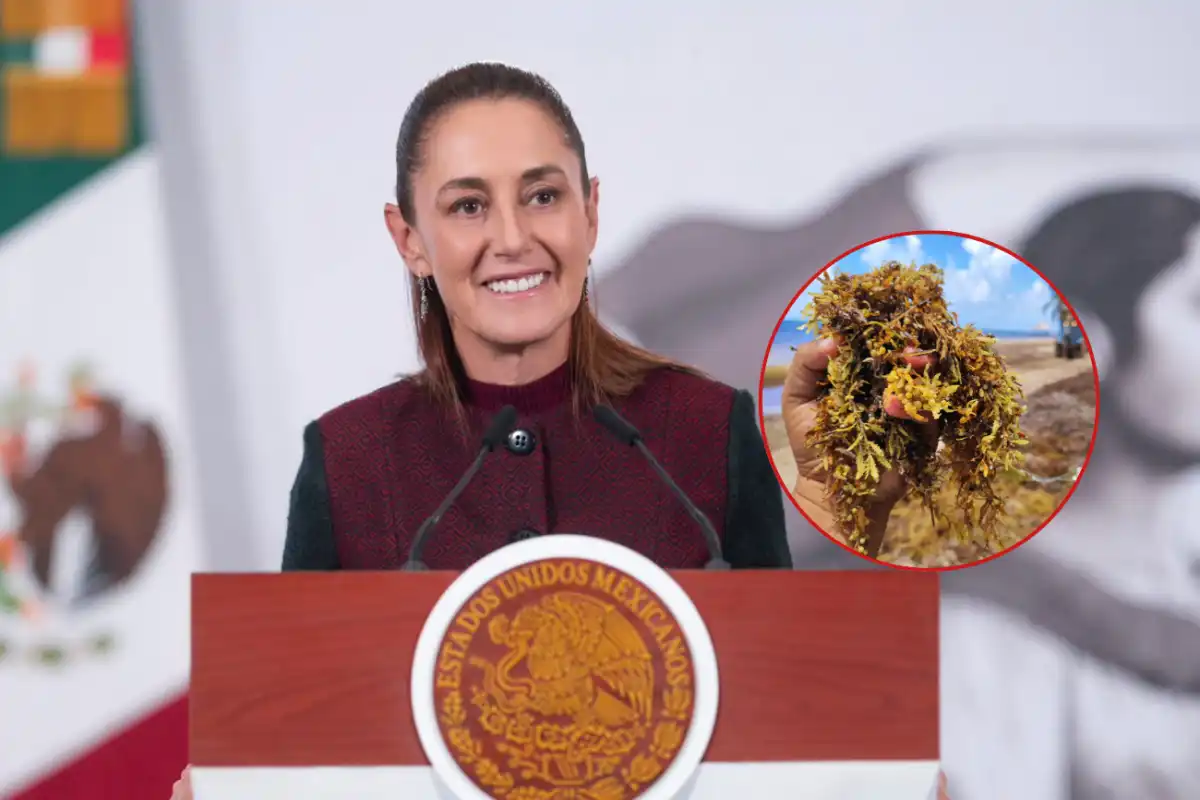
Cancún, Quintana Roo — Mexican President Claudia Sheinbaum announced coordinated efforts between federal, state, and municipal authorities to combat what experts predict could be a record-breaking sargassum season along the Caribbean coast.
During her Wednesday press conference, Sheinbaum emphasized that “impressive work” is underway to prevent the seaweed from reaching beaches through marine barriers and agreements with hoteliers and businesses to reinforce containment at strategic points.
The president highlighted collaboration between the Quintana Roo government, the Environment Ministry (Semarnat), and the Science Ministry on projects to utilize sargassum for energy generation or new materials production.
She also noted the operation of a satellite monitoring system involving the Mexican Navy that tracks sargassum concentrations in real time, predicts movement patterns, and provides information to tourists and service providers.
“We’re working to prevent sargassum from reaching the beach because once it arrives, it contaminates and becomes much more difficult to collect and recycle,” Sheinbaum explained.
The president added that a Mexican Official Standard now allows sargassum collection in open waters before contamination occurs, facilitating industrial use as a national fishery resource and enabling equipped vessels to gather it in federal waters.
Unprecedented Season Forecast
Sheinbaum’s statements come amid growing concern among experts. Esteban Amaro, director of the Sargassum Monitoring Network in Quintana Roo, warned that 2026 could become the most intense season on record.
Data from the University of South Florida’s Optical Oceanography Laboratory shows sargassum volume increased from 0.45 million tons in December 2025 to 1.7 million tons in January 2026—an unprecedented figure for the start of the year.
Navy reports indicate approximately 10,400 tons of biomass were already counted in the region by February 17. The primary concern is a 280,097-ton mass detected in the Atlantic, steadily advancing westward and potentially impacting Mexican Caribbean coasts directly.
Projections indicate:
- February continues the upward trend that began in November
- March and April will see significant increases, coinciding with Easter holidays
- June and July could mark the season’s peak, exceeding 75% of historical values during high tourist season for international events
Containment Strategy
Responding to pressure from hotel and restaurant sectors, federal, state, and municipal authorities have advanced a contingency plan for the Cancún–Playa del Carmen–Tulum–Cozumel corridor.
The strategy includes operating 16 surface units: one ocean vessel, 11 coastal vessels, and four amphibious sargassum collectors. Currently, 9,500 meters of containment barriers are installed, with plans to add 6,000 more meters in coordination with the state government.
“The growth curve for 2026 is already at levels above similar periods in previous years,” warns the Navy’s monitoring report, which urges accelerating offshore infrastructure placement to protect ecosystems, local economies, and Mexico’s tourism image.
Discover more from Riviera Maya News & Events
Subscribe to get the latest posts sent to your email.