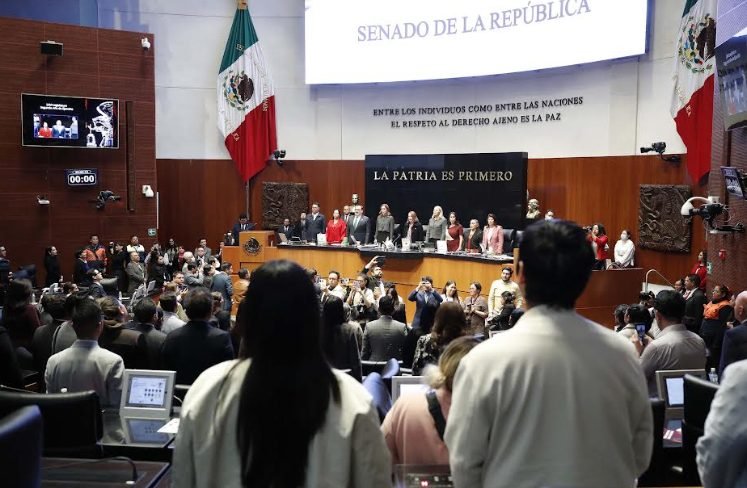
Chetumal, December 11. Mexican senators left for vacation starting Wednesday without having approved the reform to guarantee free access to the country’s public beaches, regulate and monitor the opening of public access points to them, and establish one day of free entry per week to protected natural areas. As a result, none of these benefits will be applicable in Quintana Roo during the high tourist season of December 2025 and January 2026.
A significant portion of the responsibility for this unnecessary postponement of the reform lies with Quintana Roo senator Eugenio “Gino” Segura Vázquez, who delayed the review of the bill for two months after it was sent by the Chamber of Deputies, despite arriving with unanimous support from all political parties.
Delayed Committee Review
The Senate Tourism Committee, chaired by Gino Segura, received the reform bill sent by the Chamber of Deputies on October 8 but did not review it until December 9 to issue its ratification report, one day before the senators’ final session of the year. Consequently, this report was not included among the matters submitted for voting on Wednesday, December 10.
Further Delays Expected
Following the closure of the ordinary session period, which senators moved up by 21 days since the legal deadline to conclude it was December 31, the reform for free beach access will have to wait to be voted on until February 2026 or later. This delay is due to the complete lack of interest shown by the coordinator of the Morena majority, Adán Augusto López Hernández, and the president of the Board of Directors, Laura Itzel Castillo Juárez.
More concerning is that Quintana Roo senator Gino Segura was another who showed no interest in preventing the unnecessary stalling of a reform that has unanimous support from the parties represented in the Congress of the Union. This is particularly significant given the problems the state faces regarding restricted access to public beaches, which was emphasized by the case of the municipality of Tulum, especially since the start of operations of the militarized Jaguar Park.
Key Provisions of the Reform
It is worth recalling that this reform would establish that access to maritime beaches and the contiguous federal maritime-terrestrial zone be free, permanent, and open to all people, without distinction of origin, nationality, or social condition.
It prohibits the imposition of charges, fees, or restrictions for entry, except in cases justified by environmental protection, public safety, or national interest.
Furthermore, it orders the creation of a National Beach Registry, based on the joint identification and validation of urban, semi-urban, and rural layouts, in accordance with Urban Development Programs, Ecological Zoning Programs, and Protected Natural Area Management Programs.
Municipalities would have the obligation to register beach access points in their cadastres and Public Property Registries, guaranteeing their permanence and ensuring their recognition in processes of buying and selling, boundary rectification, and adjacency.
Additionally, it establishes the obligation to grant one day of free entry per week to protected natural areas, which expands access to those with recreation zones, such as National Parks. Quintana Roo has several of these reserves with beaches within them.
These legal modifications are very important because they would end the tourism model that privatized beaches in several states of the Republic and recover the right to free access to any beach in the country.
Committee Performance Questioned
On another note, it is noteworthy that although he sought and celebrated obtaining the presidency of the Senate Tourism Committee, Gino Segura has only held four meetings in more than a year at its helm. He canceled one scheduled in November for the Mundo Maya Group, dependent on the Secretariat of National Defense (Sedena), to present its Institutional Program. This prevented important details from being known about the operation of the Maya Train, the hotels and airports it manages, Mexicana de Aviación, and the Jaguar Park in Tulum.
In this way, the Senate Tourism Committee has been unproductive in benefits for the inhabitants and visitors of Quintana Roo and other Mexican destinations. It acted with concerning delay and “turtle-like slowness” in the case of a measure that has a clear positive effect for the state and the entire country, such as the reform on free beaches.
Discover more from Riviera Maya News & Events
Subscribe to get the latest posts sent to your email.