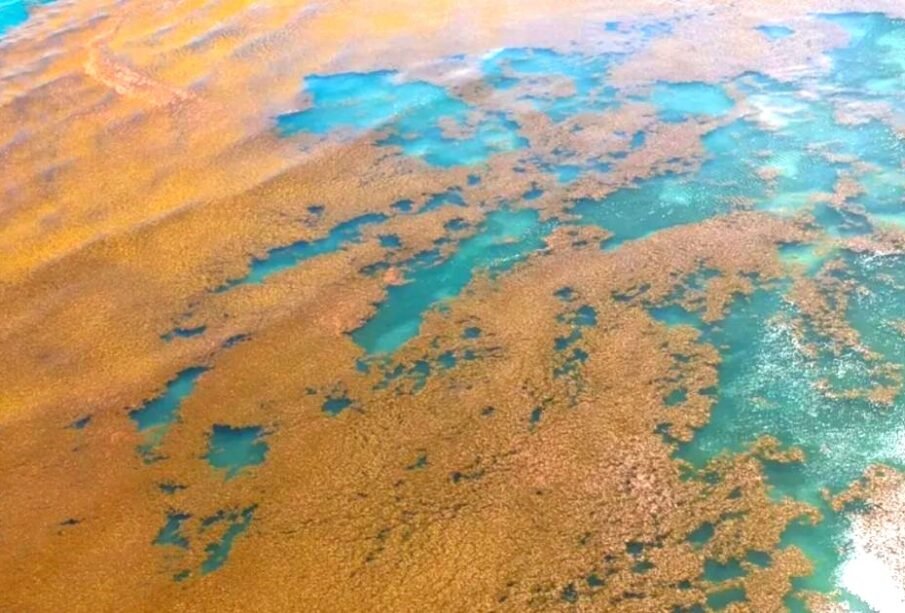
Quintana Roo, Mexico — The Mexican Navy (Semar) has detected at least seven sargassum clusters in the Mexican Caribbean waters off the coast of Quintana Roo, with an estimated volume of 127 tons, although the arrival alert remains at green, indicating low probability of significant impact on the state’s beaches.
The Mexican Navy told media that it identified these sectors in Mexican Caribbean waters, which could approach the coasts of Quintana Roo during the weekend.
The detection is the result of satellite monitoring and oceanographic tracking conducted by the naval agency, and forms part of the permanent surveillance system to anticipate the presence of this macroalgae in key tourist zones, it reported.
According to the report, the areas with the highest probability of beaching are Mahahual and Xcalak, located in the south of the state, while Cancún and the north of the state do not appear on the current risk map.
The naval authority indicated that it maintains permanent surveillance and recommended municipalities in the south of the state to reinforce preventive cleaning and containment actions, in order to mitigate possible environmental and tourism impacts.
The sargassum phenomenon in the Mexican Caribbean usually intensifies between April and July, but in 2026 observers and monitoring have detected atypical arrivals since January, which coincides with scientific analyses that point to changes in marine currents, temperatures, and trajectories of the macroalgae from the Atlantic to the Caribbean region.
Monitoring networks, such as the Quintana Roo Sargassum Monitoring Network, have documented early Sargassum flotations, although so far no severe impacts on tourist beaches have been reported.
Separately, the Gulf and Caribbean Sea Oceanographic Institute of the Mexican Navy reported that in the Mexican Caribbean a total biomass of 8,327 tons of sargassum was detected, distributed in five clusters close to the coasts of Quintana Roo, although with low probability of arrivals in the coming hours and days.
The information is contained in the institute’s report as of January 16, 2026, prepared from satellite composition of the last seven days, images from the University of South Florida, and surface marine current models from the European Commission-Copernicus Marine Service (CMEMS).
“Total biomass in the Mexican Caribbean of 8,327 tons, detected through satellite images corresponding to January 15, 2026,” it stated.
According to the bulletin, the closest cluster is located 42 kilometers from the coast, with an estimated biomass of 1.2 tons, and could approach seven kilometers from the east coast of Cozumel in the next 48 hours.
“In the next 48 hours it could approach 7 km from the east coast of Cozumel, with probable low arrivals of sargassum.”
Another relevant group, with 27.2 tons, is located 21 kilometers from the coast and could approach 16 kilometers from Xcalak, also with low probability of beaching.
“In the coming hours it could approach 16 km from the east coast of Xcalak, with probable low arrivals of sargassum.”
The highest volume cluster identified in the report reaches 47.8 tons, but is located 66 kilometers from the coast, with a trajectory without possibility of arrival in the following 24 hours.
Two other groups, with biomasses of 3.5 and 20.5 tons, are located between 47 and 115 kilometers away, without immediate risk of beaching on the Quintana Roo coastline.
Discover more from Riviera Maya News & Events
Subscribe to get the latest posts sent to your email.