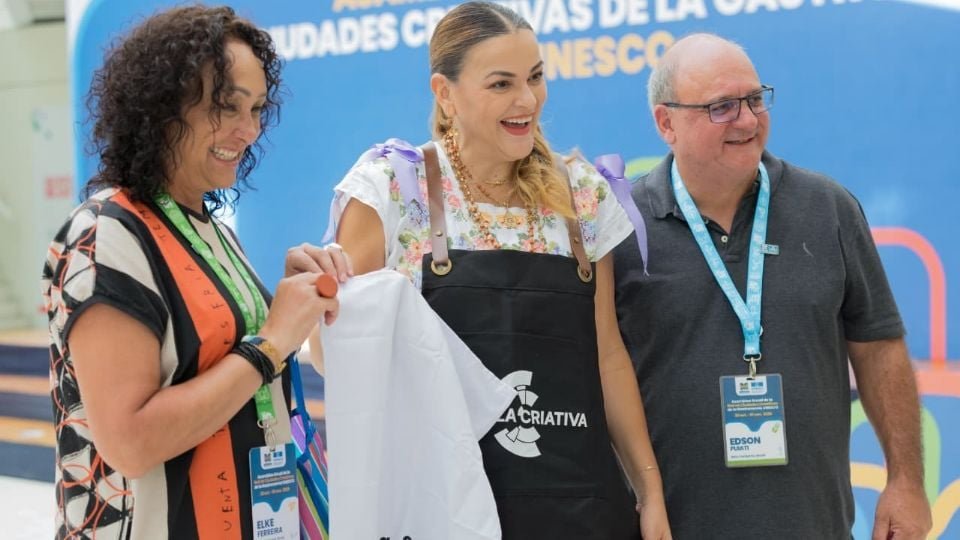
Mérida, Mexico — In the context of one of the most important festivities of Mexican tradition and culture, the Day of the Dead, Mérida has reaffirmed its global leadership as the host of the UNESCO International Assembly of Creative Cities of Gastronomy. The event was inaugurated by Municipal President Cecilia Patrón Laviada before representatives from more than 20 cities across five continents.
“We are filled with pride to welcome you to this city that has learned to tell its own story through its aromas, its flavors, and its colors. Mérida has been, for centuries, a mosaic of textures and seasonings born from corn, achiote, chili, and recado, and seasoned by a heritage that has transcended from generation to generation,” expressed the mayor during a ceremony at the "Silvio Zavala Vallado" auditorium of the Centro Cultural Olimpo.
The mayor recalled that gastronomy is not only something to be savored; it also generates employment, boosts local economies, and strengthens identities, highlighting that culinary creativity is a pathway to sustainable development.
She highlighted Mérida's pride in its culinary heritage, its hospitality, and its commitment to sustainable development, noting that this gathering coincides with one of Yucatán's most cherished celebrations, the Janal Pixán, where the mucbipollo or pib becomes a symbol of identity, memory, and family union.
“The pib is the joy of these sad days, the epicenter of a unique festival that unites memory with fire, earth, and corn. More than a food, it is the living memory of our grandmother's house and part of what makes us unique, because these are days when we remember those who have passed before us, but we keep their memories firm with great affection in our hearts,” the mayor stated emotionally.
The municipal leader recommended that the guests let themselves go and fall in love with this ancestral culinary creation, a dish that is best enjoyed when eaten with the hands, so they can feel its texture, warmth, and flavor in every bite—a definitive experience that they must live.
Yucatecan gastronomy, a living heritage of Mayan culture fused with European and Caribbean influences, presents itself as one of the most genuine expressions of the Meridan soul, a reflection of its history, its territory, and its diversity.
For her part, María Rosalía Couoh Chalé, representative of the Meliponario Kuchil Kaab of the Comisaría of Xcunyá, indicated that as a young Meridan woman, an indigenous woman, and the daughter of a wise woman, she is proud of her roots—a generation that does not want to forget, that wants to learn and share. A generation that, like the melipona bees, works united and silently for the common good, building a sweetness of respect and wisdom.
“Thank you for allowing the voice of a daughter today, the voice of the new generations, to be able to say with pride, I am Rosalía, daughter of Anselma, guardian of the melipona bees, of the Mayan legacy, and heir to honey and the word. Welcome to Mérida,” she concluded.
In welcoming the attendees of this meeting, Flora Zapata Mendiolea, General Coordinator of Social Justice and Human Development of the Mérida City Council, told visitors that she hopes these days will be filled with dialogue, learning, and inspiration.
“Being the host of the 2025 Annual Assembly of Creative Cities of Gastronomy is not only a recognition: it is a historical responsibility and an opportunity to demonstrate to the world that Yucatecan cuisine is an art that unites, that inspires, and that transcends borders. May the conversations we have here continue to nourish the creativity and heart of our cities,” she added.
In her speech, Colleen Swain, President of the UNESCO Creative Cities of Gastronomy Subnetwork and Focal Point for the City of San Antonio, Texas, expressed that Mérida is committed to its cultural identity, but it is also an example of promotion, teaching, and learning.
The international meeting, which will run until November 1, constitutes a space for dialogue and cooperation where the cities will share experiences, proposals, and best practices on public policies regarding gastronomic innovation, sustainability, tourism, and cultural cooperation.
The program includes keynote conferences, working groups, cultural activities, tastings, and culinary presentations, where visitors will be able to enjoy the richness of Yucatecan gastronomy in all its expression, as well as the experience of the Festival de las Ánimas.
The city of Mérida was recognized by UNESCO in this Network of Creative Cities in 2019, and as host of the Annual Meeting of the UNESCO Creative Cities of Gastronomy Subnetwork, it welcomes representatives from Denia (Spain), Phetchaburi (Thailand), Östersund (Sweden), Florianópolis (Brazil), Iloilo (Philippines), Bendigo (Australia), Tucson (United States), Fribourg (Switzerland), Thessaloniki (Greece), Bergamo (Italy).
Also in attendance are representatives from San Antonio (United States), Arequipa (Peru), Belo Horizonte (Brazil), Yangzhou (China), Phuket (Thailand), Portoviejo (Ecuador), Kuching South (Malaysia), Usuki (Japan), Buraydah (Saudi Arabia), Saint Petersburg (Russia), and Jeonju (South Korea).
With this celebration, Mérida reaffirms its role as a culinary reference for Mexico and the world, a city that not only preserves its traditions but projects them into the future as a symbol of creativity, identity, and hope.
Accompanying the mayor were Elogia Poot, representative of the Traditional Cooks; Carlos Alberto Estrada Pinto, rector of the Universidad Autónoma de Yucatán; Luis Carlos Zea Mares, Program Assistant of the UNESCO Office in Mexico; and Jorge Alejandro González Sánchez, coordinator of the Ibero-American Network of Research in Culture and Knowledge of Food Systems, and Senior Researcher at the Centro de Investigaciones Interdisciplinarias en Ciencias y Humanidades of the Universidad Nacional Autónoma de México.
Also present were Claudia González Góngora, president of the Business Coordinating Council and of the Cámara Nacional de la Industria de Restaurantes y Alimentos Condimentados CANIRAC Yucatán; Flora Zapata Mendiolea, general coordinator of Social Justice and Human Development; Armando Casares Espinosa, technical secretary of the Tourism Unit of the Mérida City Council; among other authorities and guests.
Discover more from Riviera Maya News & Events
Subscribe to get the latest posts sent to your email.