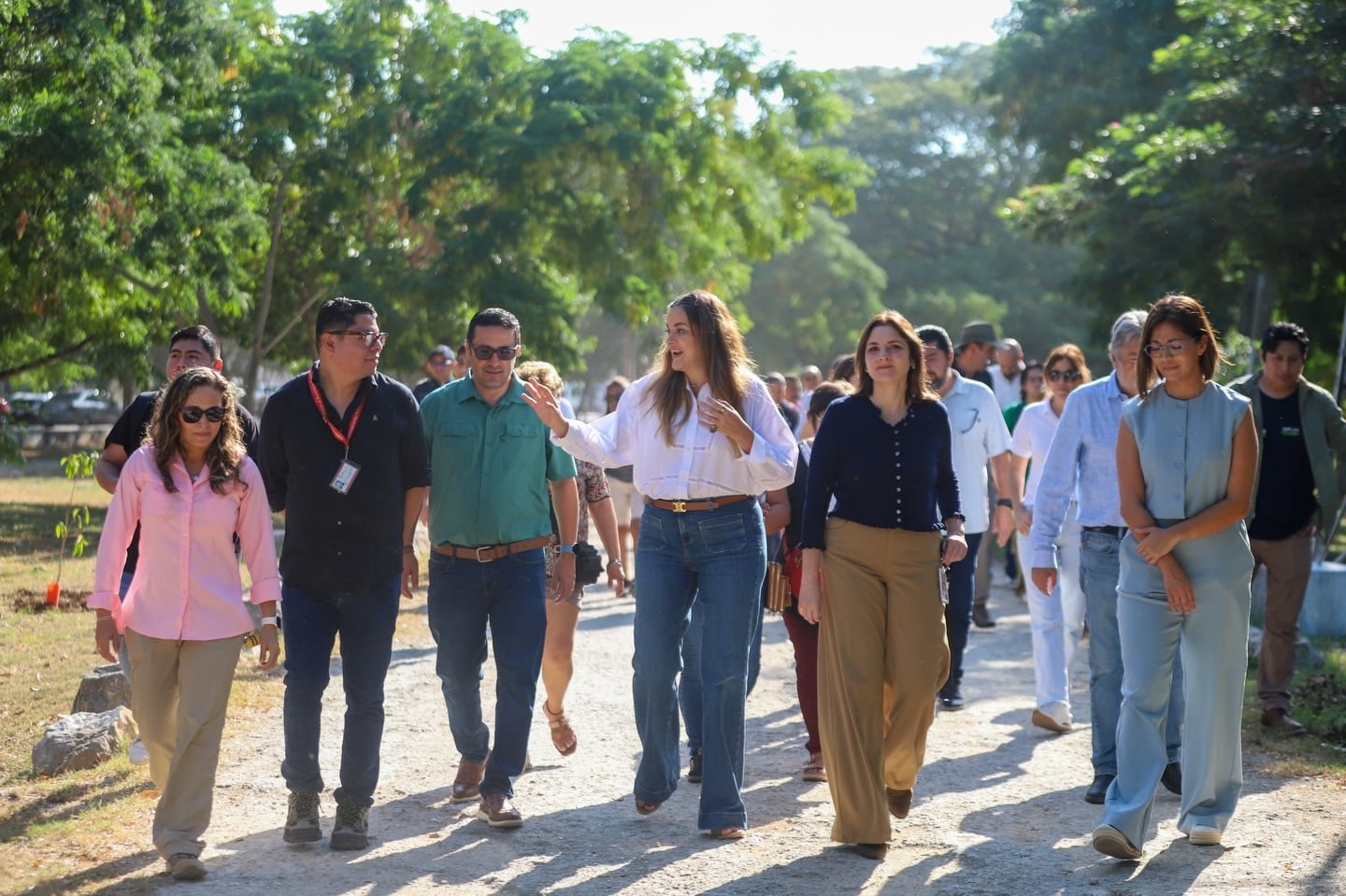
Mérida, Yucatán — Mérida has begun construction of the first urban bio-corridor in the city’s history, a project that forms part of the Municipal Green Infrastructure Plan and aims to create a greener, more resilient, and environmentally responsible city.
Municipal President Cecilia Patrón Laviada, with support from Germany’s GIZ, launched the project in the western zone, explaining to residents gathered at the Poniente Ecological Park: “With this project we connect Mérida’s green areas with each other, with actions like a rain garden, a community garden, and a pollinator refuge to support infiltration, agroecological production, and biodiversity.”
The mayor stated that the project seeks comprehensive infrastructure with biodiversity within the city, encompassing specific interventions in the Poniente Ecological Park and also in the Plan de Ayala Sur 3 area.
As a space of high environmental value, the goal is to consolidate this emblematic park located in the Yucalpetén neighborhood as a key ecological node within the biopark subsystem, which will translate into human well-being, biological connectivity, and adaptation to climate change.
The comprehensive intervention project in the Poniente Ecological Park contemplates actions planned at five key points: reforestation with native species, creation of recreational spaces, implementation of bioengineering, installation of rain gardens, and development of community murals.
Additionally, it will be developed through a schematic plan with three lines of action: the first, with technical basis and nature-based solutions with five interventions; the second, with a social focus, through participatory processes in 20 workshops; and the third, seeking sustainability, with maintenance, replicability, and monitoring measures that will be reflected in three technical documents.
“Every square meter recovered, every native tree planted in each restored area, will add up to face challenges we already feel in the municipality, like extreme heat and the deterioration of our green areas,” Patrón Laviada elaborated.
The creation of bio-corridors is a huge step toward an ecologically sustainable Mérida, which will feature these spaces with life paths that restore habitats, allowing fauna to return and tree cover to increase.
The mayor emphasized that this will also help “cool” the city, a key action in improving people’s health and creating an environment with infrastructure that breathes with a new, greener future for today’s and tomorrow’s families.
The Mérida City Council now has a Municipal Technical Committee for Green Infrastructure in which specialists, civil society, academia, and municipal departments participate, contributing their vision regarding biodiversity, mobility, public space, and climate change.
Simultaneously, rehabilitation actions have been carried out at the Poniente Ecological Sports Field, located in Yucalpetén with an investment exceeding 3 million pesos, as part of community and sports strengthening for surrounding families.
Various citizen participation actions are also being added, such as the “Urban Wetlands Exploratory Walk” where neighbors learn about the areas with technical and educational accompaniment.
Finally, during this tour, the mayor thanked the Cities Adapt initiative carried out on behalf of the Federal Ministry for the Environment, Climate Protection, Nature Protection and Nuclear Safety of the Federal Republic of Germany, the International Climate Initiative (IKI), and the German Technical Cooperation (GIZ) Mexico, for trusting Mérida and investing resources that now translate into greener, cooler, and more vibrant spaces.
“Your support is reflected in a Green Mérida that develops with responsibility, sustainability, and humanity, in this international cooperation of having cities committed to their environment and their inhabitants.”
Collaborating institutions of this project, which originates from private initiative, join these acknowledgments, with support from prestigious and reliable companies like COMEX, CEMEX, and UNAM, which, with the contribution of Karla Rodríguez, conducts relevant biological monitoring.
Accompanying the mayor were councilor Paulina Sánchez Díaz; Carlos Francisco Viñas Heredia, general coordinator of Ordered Development and City Management; Gerardo González Alfaro, from the Global Cities Adapt Project, director of the Component for Mexico, German Society for International Cooperation (GIZ); directors Luis Jorge Montalvo Duarte, of Municipal Public Services, and Ana Patricia Ríos Muñoz, of the Municipal Planning Institute; Jorge Luis Avilés Lizama, technical secretary of Planning, Monitoring and Evaluation; and representatives of associations and companies.
Discover more from Riviera Maya News & Events
Subscribe to get the latest posts sent to your email.