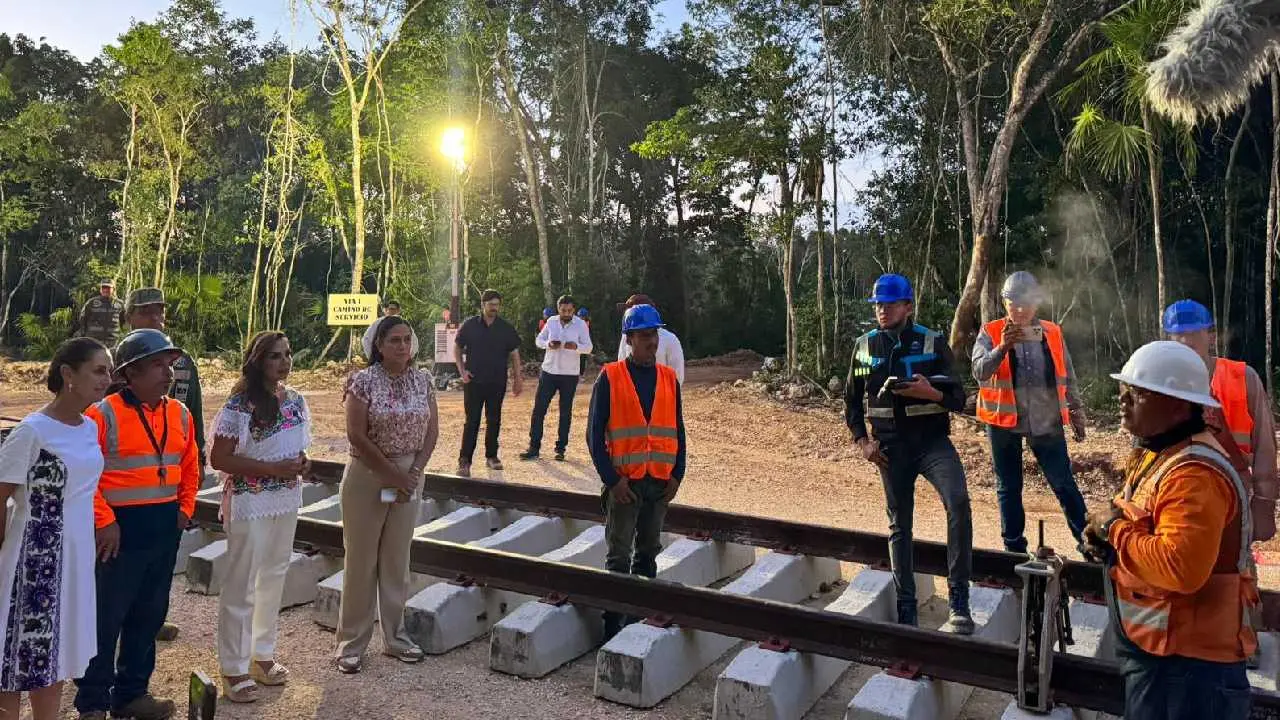
The Maya Train, the flagship megaproject of former President Andrés Manuel López Obrador, announced in 2018 and with construction beginning in June 2020, is already presenting significant and irreversible socio-environmental impacts. These were documented by the “Civil Observation Mission on the impacts and effects of the Maya Train project” in Quintana Roo and Campeche, specifically in sections 5, 6, and 7.
The findings of the Civil Observation Mission report determined serious and irreparable violations of individual and collective human rights, indigenous rights, and the rights of nature.
Increased Violence and Military Presence
Among the findings gathered by the Civil Observation Mission is an increase in criminal and institutional violence in the territory. An example of this occurs in the southern sections, where rural territories with low crime rates previously predominated.
According to the organizations responsible for the report, criminal disputes were concentrated in the tourist cities of Cancún and Playa del Carmen, but with the construction and operation of the Maya Train, they now reach the municipalities of Felipe Carrillo Puerto, Bacalar, and Othón P. Blanco.
The Civil Observation Mission highlights that the military occupation has increased the perception of insecurity and impunity in the Yucatán Peninsula. The social and human rights violence it documented was presented in a report prepared by organizations such as the Indigenous and Popular Regional Council of Xpujil, the defenders of Carrillo Puerto, Quintana Roo.
Also involved in the work were Cenotes Urbanos, the Mexican Civil Council for Sustainable Forestry, the International Tribunal for the Rights of Nature, the Frayba and 3 human rights centers, Kanan Human Rights, Greenpeace Mexico, Jaltun, the Latin American Geopolitics Observatory (OLAG), the Observatory of Multinationals in Latin America (OMAL), Diverse Territories for Life (TerraVida), and the Cantukun Collective of Kinchil.
Academic researchers also joined the tours to produce the report, including Alicia Castellanos and Carlos Rodríguez from the Metropolitan Autonomous University (UAM); Giovanna Gasparello from the National Institute of Anthropology and History (INAH); and, as observers, members of the Office in Mexico of the United Nations High Commissioner for Human Rights.
Irreversible Environmental Degradation
The Civil Observation Mission followed up on the sentence of the International Tribunal of the Rights of Nature, which identified the case as the Maya Train Megaproject.
At the time, the eighth local hearing of the International Tribunal of the Rights of Nature evaluated the implementation of the railway transport project, which proposed a territorial reordering plan in the Yucatán Peninsula. It warned of the destruction and ecological degradation of ecosystems, as well as the well-being of the Maya people and the sustainability of their cultures and ancestral territories.
In the sentence issued, the tribunal held the Mexican State responsible for violating the fundamental rights of nature and the Maya people, as well as the right to the regeneration of their biocapacity and the continuation of their cycles and vital processes free from human alterations.
The mission evidenced in its report that parallel works to the construction and operation of the megaproject have also generated widespread, irreversible, and accelerated environmental degradation.
The deforestation of more than 11,000 hectares of jungle, the fragmentation of ecosystems, the perforation and destruction of cenotes and caverns, the alteration of wetlands, the contamination of the aquifer, and the loss of habitat for emblematic species are already visible in the evaluated sections 5, 6, and 7. To date, no mitigation action has been taken.
The organizations point to the irresponsible actions of the Secretariat of National Defense (Sedena), and the omissions of the Federal Attorney for Environmental Protection (Profepa) and the Secretariat of Environment and Natural Resources (Semarnat).
The report also highlights the importance of the forest territories of the Yucatán Peninsula, which is part of the Maya Forest, recognized as “the second largest tropical forest massif in Latin America.” It contains the biological corridors “Yum Balam-Sian Ka’an-Calakmul” which house ecosystems of significant biological value.
The Civil Observation Mission determined that the works to install the train tracks, such as warehouses, maintenance areas, access roads to the route, and material banks, have generated irreversible environmental impacts.
The impacts are due to the loss of ecological connectivity from the fragmentation of the territory, deforestation, the destruction of flora and fauna habitat, the filling of wetlands, and damage caused to the underground and surface hydrological system.
Furthermore, accompanied by experts from the College of the Southern Border (Ecosur), the mission toured the wetlands around the Chaac estuary, in the municipality of Othón P. Blanco, where testimonies described how the construction of the track and alternate works interfered with natural hydrological flows.
The interventions damaged mangroves, generating serious repercussions. One example was the floods of 2023 and 2024 that impacted urban and agricultural areas in Bacalar, Chetumal, and other towns in southern Quintana Roo.
Real Estate and Tourism Expansion
In 2018, with the then-recent announcement of the construction of the Maya Train megaproject, land speculation and the anticipation of increased profitability for businesses that would connect with López Obrador’s flagship project “multiplied, by far, the impacts,” warned the Civil Mission in its report.
The organizations pointed out that the changes indicate an increase in insecurity for the population of the Yucatán Peninsula. Regarding social impact, they documented that the fencing off of public space, the alienation of places and activities, and the isolation of the local population are part of the consequences determined by the military presence in the territories crossed by sections 5 and 6 of the Maya Train.
Along section 7, the organizations detected impacts on private property and the productive activities of rural communities, by military personnel in charge of the train’s construction.
This was documented with the complaints that the Civil Mission collected regarding the intrusion of military personnel into properties and plots, which involved the breaking of fences and the abandonment of a large amount of waste and stone material in cultivated lands.
These actions rendered the lands unusable, directly affecting the productive activities of the ejidatarios.
The Maya Train works also brought the extraction of large quantities of liquid from local wells, even drying up cisterns and water holes. One case was that of inhabitants of communities in the municipality of Calakmul who denounced the appropriation of water from these sources by military personnel, without any mediation to obtain the community’s consent.
The organizations warn of the real estate boom in the Yucatán Peninsula. The College of Civil Engineers pointed out that the construction of the Maya Train and the Tulum airport, in the municipality of Felipe Carrillo Puerto, led to irregular urbanization and speculation on land prices, which has grown up to 400% since 2019.
The organizations denounce that this has been accompanied by the omission of action by environmental institutions.
Another point where the push for irregular urbanization and land appropriation is evident is the highway section from Cancún to Tulum, “with special dynamism,” they note, since the train construction began.
This is due to the creation of a corridor for real estate speculation between Federal Highway 307 and the Maya Train railway lines. This involves 57 kilometers from the exit of Playa del Carmen to Tulum, passing through Puerto Aventuras, Akumal, Chemuyil, and Jacinto Pat.
The megaproject gave way to new real estate investment areas with the 23 kilometers from Tulum to the junction with the road to the Felipe Carrillo Puerto Airport. The report revealed that urbanization and real estate speculation on socially owned lands are not under control. So far, neither federal nor local authorities have worked on this problem.
On the contrary, the proliferation of hotel projects, tourist spaces, condominiums, real estate and residential developments, commercial and service centers in jungle areas that lack environmental permits and construction licenses is increasing.
According to the Mexican Association of Real Estate Professionals, between late 2023 and October 2024, more than 600 real estate projects were counted in the area.
Discover more from Riviera Maya News & Events
Subscribe to get the latest posts sent to your email.