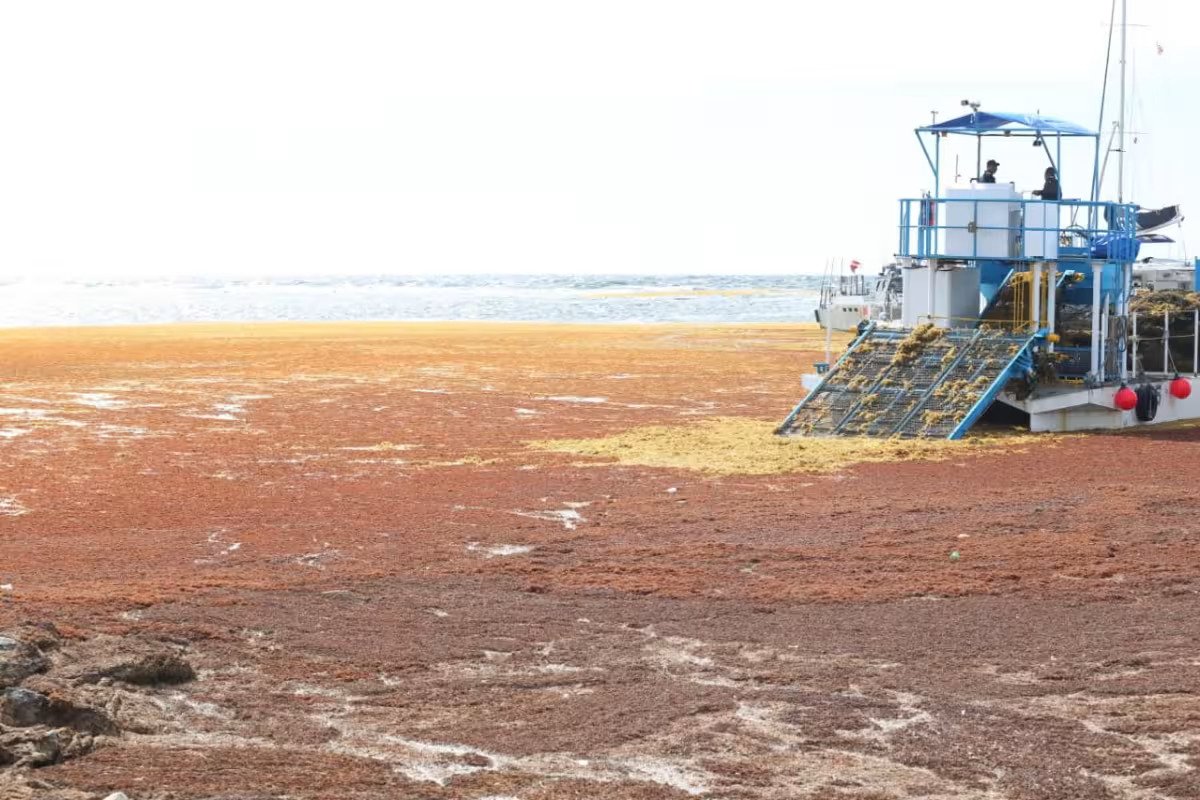
Mahahual, Quintana Roo — Tourism operators and residents in southern Quintana Roo are criticizing what they call insufficient preparation for what’s forecast to be a record sargassum season, with only the Mexican Navy taking significant preventive action ahead of an expected 15-20% increase in seaweed arrivals compared to 2025.
Local business owners in Mahahual, the main beach destination in the southern part of the state, say municipal authorities have failed to coordinate timely measures despite projections showing this could be the most intense sargassum season on record. Forecasts indicate the worst impacts will hit during the second half of February, intensifying through Easter and summer, with Tulum, Playa del Carmen, Puerto Morelos and Cozumel expected to be most affected.
“Right now we don’t see any attention. The Navy is the only one taking action to prevent the seaweed from washing ashore because from the municipality we haven’t seen anything,” said Samuel Interian, a tourism service provider in Mahahual’s coastal zone. He noted that in previous years, the Othón P. Blanco municipality had already activated temporary employment programs by this time to staff sargassum collection efforts.
Gerardo Pérez Zafra criticized the lack of coordination meetings to address the macroalgae arrival, while Luis Rangel, manager of a Mahahual restaurant, lamented that “the cold has moved away and conditions are right for sargassum to start arriving.” He confirmed that along the Costa Maya, only the Navy has acted by installing part of the sargassum barriers.
Economic Threat
The tourism sector, the region’s economic engine, faces additional challenges as spring reservations could be affected without efficient seaweed management. Hotel workers separately noted that cleaning and containment costs run into millions of dollars, while water activities and visitor experiences are compromised.
During the previous sargassum season, authorities collected a record 92,783 tons in Quintana Roo, and projections suggest over 110,000 tons could be collected in 2026.
Óscar Rébora Aguilera, head of the State Ecology and Environment Secretariat (SEMA), said an initial investment of 130 million pesos is planned for the expected macroalgae contingency, in addition to what hotel owners must pay to keep beachfronts clean and what each coastal municipality spends on sargassum collection.
Federal Deputy Ernesto Sánchez asserted that government-implemented measures are insufficient to contain the sargassum volume forecast for the 2026 season.
Navy Coordination
The Mexican Navy has conducted preventive maintenance on surface units that collect sargassum and other equipment to be used during this year’s collection strategy. Navy officials reported they have held meetings with personnel from the federal environment ministry, Quintana Roo’s Ecology and Environment Secretariat, directors of the Federal Maritime-Terrestrial Zone from municipalities, business sector representatives and civil society.
These meetings aim to standardize criteria for creating a Sargassum Arrival Alert System and 2026 season collection reports. Additional meetings have been held with the State Environmental Monitoring Center, the Executive Directorate of Oceanographic and Atmospheric Research and Monitoring, and personnel from the Navy’s Gulf and Caribbean Sea Oceanographic Institute to discuss improvements in tracking sargassum biomass bulletins in the Caribbean Sea.
Residents criticized the apparent lack of coordination among authorities, which they say could affect visitor arrivals to the region.
Discover more from Riviera Maya News & Events
Subscribe to get the latest posts sent to your email.