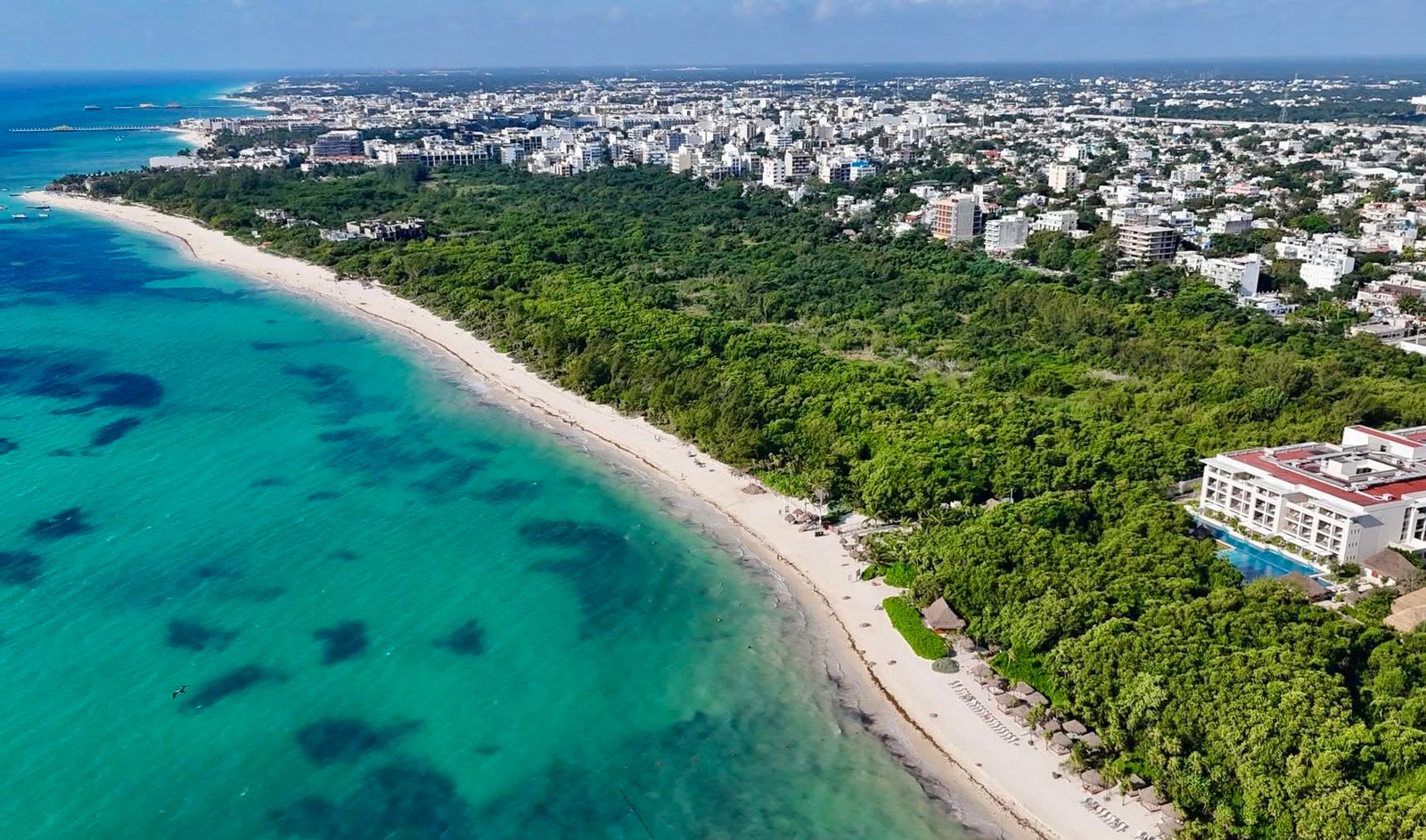
Playa del Carmen, Quintana Roo — The future of Chen Zubul, a 40-hectare stretch of mangrove and jungle widely considered the last significant “green lung” dividing the Colonia Luis Donaldo Colosio neighborhood, remains legally undefined as federal authorities determine whether the land is public or privately owned.
The property, covering approximately 398,505 square meters, contains extensive mangrove wetlands and serves as habitat for a range of wildlife including snakes, coatis, raccoons, and crocodiles. Its ecological importance has placed it at the center of growing public attention amid continued urban expansion in Playa del Carmen.
Who Owns Chen Zubul?
Armando Rivas Zavala, regional representative of the National Institute for Sustainable Land (INSUS), confirmed that the land’s ownership status remains under federal review.
“Chen Zubul is a property that, in theory, belongs to the federal government (…), but we do not know,” Rivas Zavala said. “There is a presumption that there may be private owners. The exact legal situation of the property has not yet been determined.”
According to Rivas Zavala, the matter is currently being analyzed by Mexico’s Secretariat of Agrarian, Territorial and Urban Development (SEDATU), the federal agency responsible for land regularization and territorial planning.
The uncertainty is not minor. In Mexico, land classified as federal property follows one legal pathway; privately held land follows another; and ejido or communal land follows yet another. Until the status is clarified, long-term decisions about conservation, development, or formal protection cannot move forward.
Push for Protected Status
Rivas Zavala has previously stated that there is a process underway to potentially declare Chen Zubul an Área Natural Protegida (ANP), or Protected Natural Area.
The proposal stems from citizen petitions calling for preservation of the site to prevent real estate or tourism development. However, no timeline has been established for a decision.
Protected Natural Area designation in Mexico typically requires environmental studies, land tenure clarification, and federal or state decrees depending on jurisdiction. Without certainty over ownership, advancing that process becomes legally complex.
Ecological Importance in an Urbanizing City
Chen Zubul sits within one of the fastest-growing urban areas in Quintana Roo. Playa del Carmen’s population has expanded dramatically over the past two decades, driven by tourism, real estate investment, and migration from other parts of Mexico and abroad.
Mangrove ecosystems like those found at Chen Zubul are protected under Mexico’s General Wildlife Law (Ley General de Vida Silvestre). Mangroves play a critical ecological role by:
- Acting as natural flood buffers during storms and hurricanes
- Filtering pollutants before they reach coastal waters
- Serving as breeding grounds for fish and bird species
- Stabilizing soil in a region characterized by porous limestone terrain
In the Riviera Maya’s karst landscape, wetlands also help protect the fragile underground aquifer system that supplies drinking water throughout the region.
Environmental advocates argue that losing one of the last intact green corridors within the city could have long-term consequences for drainage, biodiversity, and urban heat mitigation.
A Parallel to Colonia Colosio’s Legal Process
Rivas Zavala indicated that the legal clarification process for Chen Zubul may follow a model similar to that used in Colonia Luis Donaldo Colosio itself.
Over the past year, INSUS personnel have conducted on-the-ground data collection throughout Colosio, gathering documentation from residents who claim property ownership and seek legal certainty over their homes.
Colonia Colosio has long been known for its complex land tenure history, including federal, ejido, and private claims. Regularization efforts aim to provide residents with clear titles, which in turn allow for infrastructure investment and legal protection.
If Chen Zubul contains overlapping or disputed claims, a similar verification and reconciliation process may be required before any formal conservation designation can proceed.
Development Pressure in a High-Value Corridor
The land’s size and location make it significant not only environmentally but economically. Forty hectares within Playa del Carmen represent a substantial tract in an area where real estate demand remains high.
Recent years have seen rapid condominium construction, hotel expansion, and mixed-use developments throughout the city. Environmental groups have frequently raised concerns about deforestation and wetland filling linked to development projects across the municipality.
Without defined ownership and zoning clarity, Chen Zubul remains in limbo — vulnerable to speculation but not formally slated for construction.
The Issue of Land Invasions
Rivas Zavala also addressed the broader issue of land invasions in Solidaridad, including the case of San Judas Tadeo, located along the extension of Avenida Juárez between Avenida Lilis and near the In House area.
He acknowledged that irregular settlements become more complicated to resolve over time.
“As time passes, the situation becomes more complex,” he said. “The first measure is to stop the growth of the invasion, given the difficulty of regularizing it.”
He emphasized that recently formed invasions are especially difficult to manage because authorities must distinguish between individuals genuinely seeking housing security and organized groups exploiting land informally. He also warned that such areas often present safety risks.
“Mechanisms are being sought, but basically it has to be a reconciliation of interests,” he added.
Illegal settlements complicate long-term urban planning and can intersect with environmentally sensitive zones, further complicating land use decisions.
Business Dispute Adds Another Layer to the Pulmón Verde Controversy
The ongoing legal uncertainty surrounding Pulmón Verde has recently drawn further public attention following statements by local dive operator Bahía Divers – Playa del Carmen.
In a public communiqué shared on social media, the company stated that it had relocated its operations to the area known as Oasis Maya / Pulmón Verde after being assured by an individual that he held legal authority over the property. According to Bahía Divers, the company later discovered that the person allegedly did not have the legal right to administer, lease, or commercially exploit the land.
The business claims it was “induced” to move equipment and activities to the site based on those representations. However, subsequent public posts circulating online dispute that version of events, labeling aspects of the company’s statement as “false.” As of now, no court ruling has been publicly announced clarifying the matter.
The dispute underscores the broader uncertainty surrounding ownership and authorized use of the 40-hectare property. With federal authorities still reviewing whether the land is public domain or privately held, and amid proposals to designate the area as a Natural Protected Area, commercial activity within Pulmón Verde remains legally sensitive.
Observers note that until ownership and zoning questions are definitively resolved, businesses, investors, and land buyers operating in the area face potential legal and environmental risk.
What Happens Next?
At this stage, no official determination has been made regarding Chen Zubul’s ownership. Until SEDATU and relevant federal authorities complete their review, the property remains legally undefined.
If confirmed as federal land, authorities could move toward formal protection or management designation. If private claims are substantiated, conservation efforts would require negotiation, acquisition, or zoning regulation.
The absence of a clear timeline leaves residents, environmental groups, and developers watching closely.
A Broader Question for Playa del Carmen
Chen Zubul’s unresolved status highlights a larger tension facing Playa del Carmen: how to balance rapid urban growth with environmental preservation in a region defined by fragile ecosystems.
As the city continues to expand north and west, the preservation of remaining green corridors becomes increasingly significant. Whether Chen Zubul becomes a protected natural area, remains undeveloped, or follows another path will likely signal how local and federal authorities intend to manage similar spaces in the future.
For now, the land sits in legal limbo — ecologically valuable, economically attractive, and administratively unresolved.
Discover more from Riviera Maya News & Events
Subscribe to get the latest posts sent to your email.