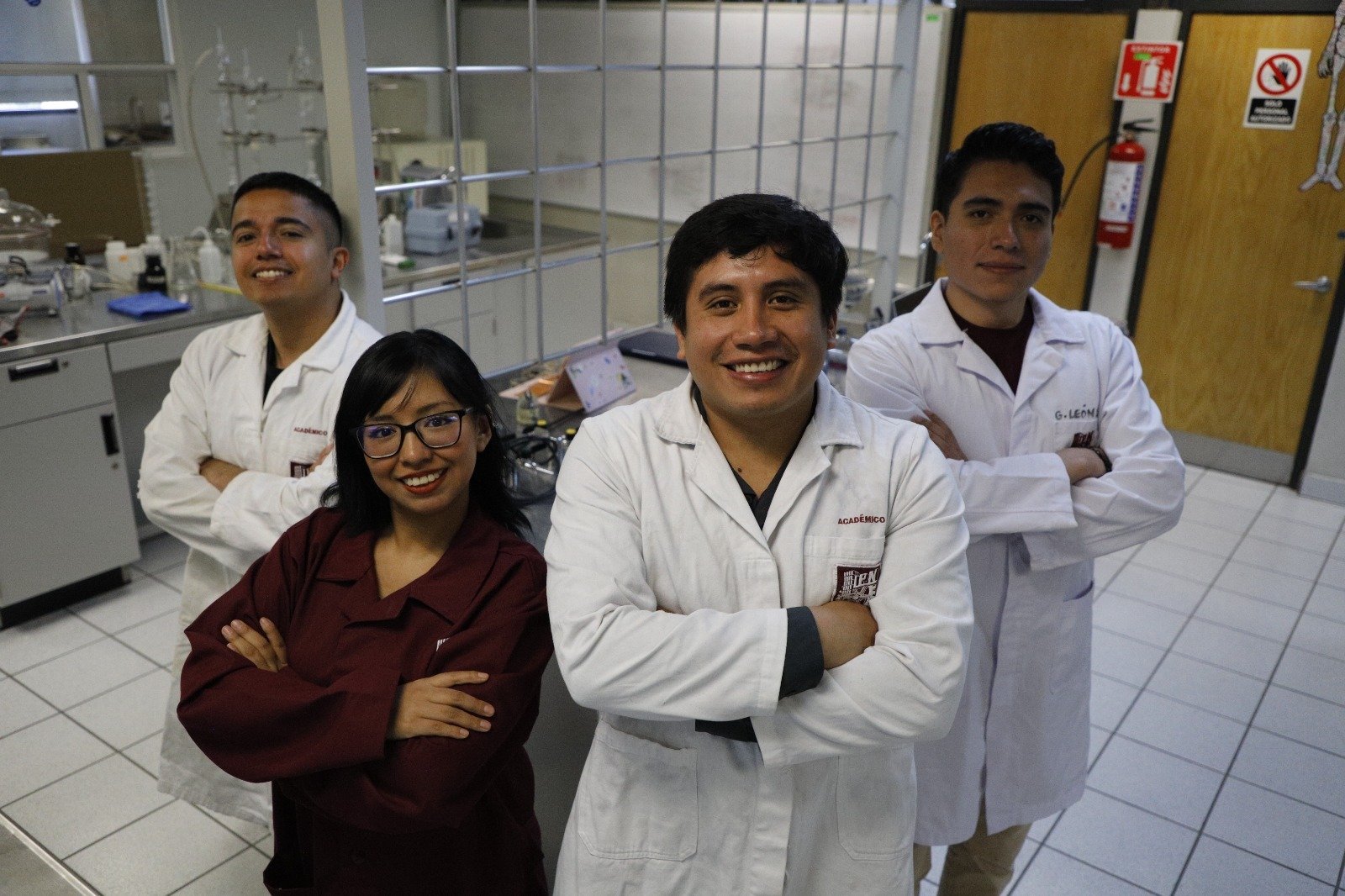
A group of graduate students from the National Polytechnic Institute (IPN), a higher education institution in Mexico, is developing electrodes from charcoal extracted from sargassum or brown algae to degrade pollutants from wastewater.
The proposal by Geovani Flores, Frida López López, Ángel Eduardo Lugo Dorantes, and José Fernando Carmona Neri aims to create an integrated system with a sustainable approach, using solar panels to supply the necessary energy during the decontamination process.
The young researchers successfully removed pollutants present in wastewater provided by a textile company.
The water contains pigments used in denim dyeing. Despite indigo being one of the most difficult colors to remove in water treatment processes, which makes many conventional methods insufficient, this technology seeks to purify most of the organic and inorganic matter in such discharges, according to the specialists.
With the guidance of scientist Jorge Alberto Mendoza Pérez, the students use a technique called pyrolysis, a chemical process that involves heating organic matter in the absence of oxygen to decompose it without burning, chemically transforming dehydrated sargassum.
“We know that sargassum is a residue, an environmental liability that is constantly arriving on the coasts of Mexico and other places, but in this case, it has greatly affected the coasts of the southeast,” Mendoza Pérez told Xinhua.
He mentioned that it has affected both the environment and the economy from a tourism perspective, and that this residue “is very difficult to manage and has become a real ‘headache’ down there in the southeast.”
In this context, pyrolysis or decomposition of a material through temperature becomes a viable alternative to utilize this material that currently represents an environmental problem in Mexico.
The researcher explained that through this process, carried out at high temperatures and with specific times, the sargassum is chemically transformed to obtain a solid fraction known as “biochar” or charcoal.
To this “biochar” base, they incorporate special catalysts developed by themselves, aiming to modify sizes and produce carbon or graphene nanotubes (a very light material), composed of a single layer of carbon atoms with uniform nanometric dimensions.
Environmental systems engineer Giovanni Flores Sánchez explained that once the “biochar” is obtained, “we endow it with different metals to make it a better conductor and we manufacture these electrodes and begin testing using water from the textile industry.”
“And that is where we notice that we have a 90 percent removal rate regarding the pigment present in these wastewaters,” mentioned the engineer.
He explained that the industry mainly uses indigo blue in its processes as a dye, so this compound has a considerable environmental impact, as if it does not receive adequate treatment and is discharged directly into water bodies, its high color concentration can cause hypoxic conditions, meaning death of fauna.
Environmental engineer Frida Concepción López López emphasized that the proposal responds to both the needs of the industry and water treatment, so the next step is to bring this technology to the textile sector.
“Normally, existing technologies are expensive, maintenance is expensive, implementation of technologies is very difficult. Our technology, on the contrary, seeks to have easy maintenance, simple operation, and lower operational cost, benefiting both water quality and the industry,” stated López López.
The students work with sargassum collected in the state of Quintana Roo (southeast), in the Mexican Caribbean, in collaboration with Vive Planeta Azul, the Civil Association responsible for its collection in the locality to dry it.
Additionally, the team verifies that the electrodes meet the quality standards established by international norms.
Recently, the Mexican students won first place in the InnoDrop Water Talent Incubator, which promotes ideas and innovation and recognizes the entrepreneurial spirit focused on solving the main water security challenges facing Mexico.
With their proposal, the young IPN researchers not only offer an alternative to address water pollution but also demonstrate that an environmental problem like sargassum can be transformed into a high-impact technological solution.
Discover more from Riviera Maya News & Events
Subscribe to get the latest posts sent to your email.