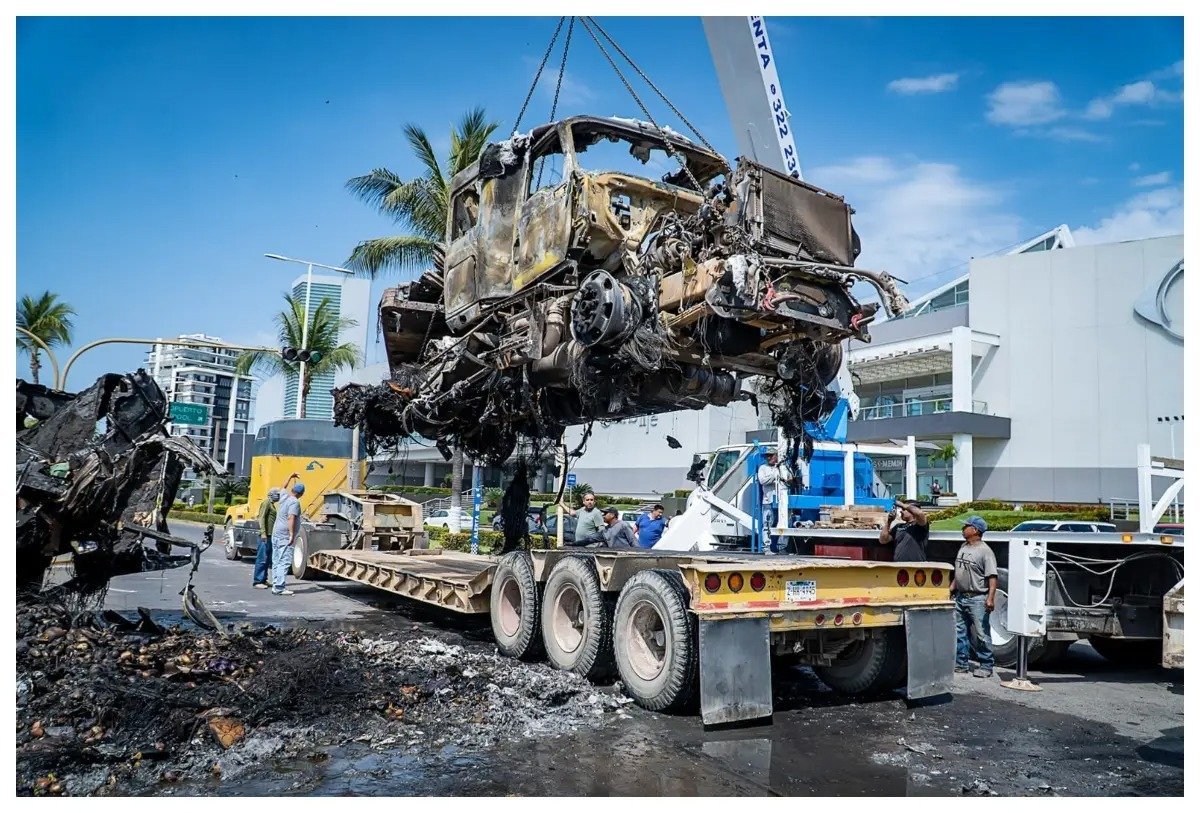
Mexico City — Insurance companies will not automatically cover vehicles burned during violence following the reported takedown of drug cartel leader Nemesio Oseguera Cervantes, known as El Mencho. Coverage depends entirely on specific clauses in individual auto insurance policies that determine eligibility for claims related to organized crime incidents.
Policy Criteria for High-Impact Event Claims
Eligibility for compensation for vehicles burned in violent scenarios, such as those recorded after operations against El Mencho, depends on the contractual conditions of each auto insurance policy. Industry experts confirm that “total theft” and “material damage” coverage are essential for claims to proceed. Basic liability policies, mandatory for driving on federal highways, do not cover damage to the vehicle itself or theft.
The Mexican Association of Insurance Institutions (AMIS) has clarified that damages or losses can be claimed according to these coverages. However, interpretation of exclusion clauses is a critical factor. Traditionally, some policies include sections that exclude damages from war, insurrection, riots, or acts comparable to terrorism. Nevertheless, federal jurisprudence has established that exclusion clauses for damages caused intentionally and violently by third parties (such as vandalism or illegal acts) only apply when the insured person themselves causes the incident, not when it’s provoked by external agents unrelated to the contractual relationship. This interpretation aims to preserve the main purpose of insurance contracts: providing financial protection to the insured.
In practice, if a vehicle is violently taken and subsequently burned, the event could be classified as “total theft with violence” or “material damage by fire resulting from an illegal act.” If these situations are covered in the policy, compensation may proceed. It’s crucial that the insured has purchased comprehensive coverage that includes fire damage in addition to total theft for greater security. Typically, a deductible applies, usually 5% for material damage and 10% for theft.
How to Optimize Insurance Claims for Vehicles Affected in Disturbances
For those affected by vehicle burnings during disturbances or organized crime acts, proper claim management is crucial for compensation eligibility. Data confirms that the first essential step is filing a report with the Prosecutor’s Office. It’s fundamental that this report be filed for “theft with violence” if the vehicle was stolen before being burned, not merely for “vandalism” or “arson.” The legal classification of the incident by prosecutorial authorities directly influences the insurance company’s assessment of the claim.
Subsequently, the insured must notify their insurance company of the incident within the timeframe established in the policy, commonly between 24 and 48 hours. Failure to report within this timeframe can affect the right to compensation. Experts strongly recommend preserving all possible evidence, such as photographs, videos, or testimonies that document the incident, in addition to providing the policy number and complete vehicle details to expedite the adjustment process.
In high-impact, high-risk situations, some insurance companies might opt to conduct claim adjustments remotely, adapting to security contexts. If the insurer denies payment and the user considers the refusal improper, they can approach the National Commission for the Protection and Defense of Financial Services Users (CONDUSEF) to request guidance or initiate a conciliation procedure. The insurance company bears the burden of proving that an exclusion clause exists if they intend to deny payment, and cannot reject the claim without basing their decision on law or contract terms.
Implications of Limited Coverage in Systemic Risk Scenarios
The limitation in widespread coverage for vehicles burned in systemic risk events, such as those associated with organized crime reactions, highlights a significant gap in the population’s asset protection. Data shows that a considerable percentage of Mexico’s vehicle fleet, up to 84% by some estimates, lacks comprehensive insurance coverage. This means most people affected by this type of incident would have no right to compensation, even if their vehicle is completely destroyed.
The absence of specific coverage for “organized crime acts” in many standard policies, and the reliance on “total theft” or “material damage” clauses, creates uncertainty and vulnerability. The restrictive interpretation of exclusion clauses, which favors the insured when damage is caused by third parties, represents an important legal advance. However, lack of knowledge about this interpretation and incorrect initial reporting can lead to payment denial.
From a risk management perspective, the current situation highlights the need for greater financial and insurance education among citizens. Proactive policy review, understanding coverage scope and limitations, and consulting with specialists are crucial preventive actions. For the insurance sector, technical analysis indicates an opportunity to develop clearer products adapted to emerging risks in the country, or to more effectively communicate the conditions under which existing coverages activate in organized violence contexts.
Discover more from Riviera Maya News & Events
Subscribe to get the latest posts sent to your email.