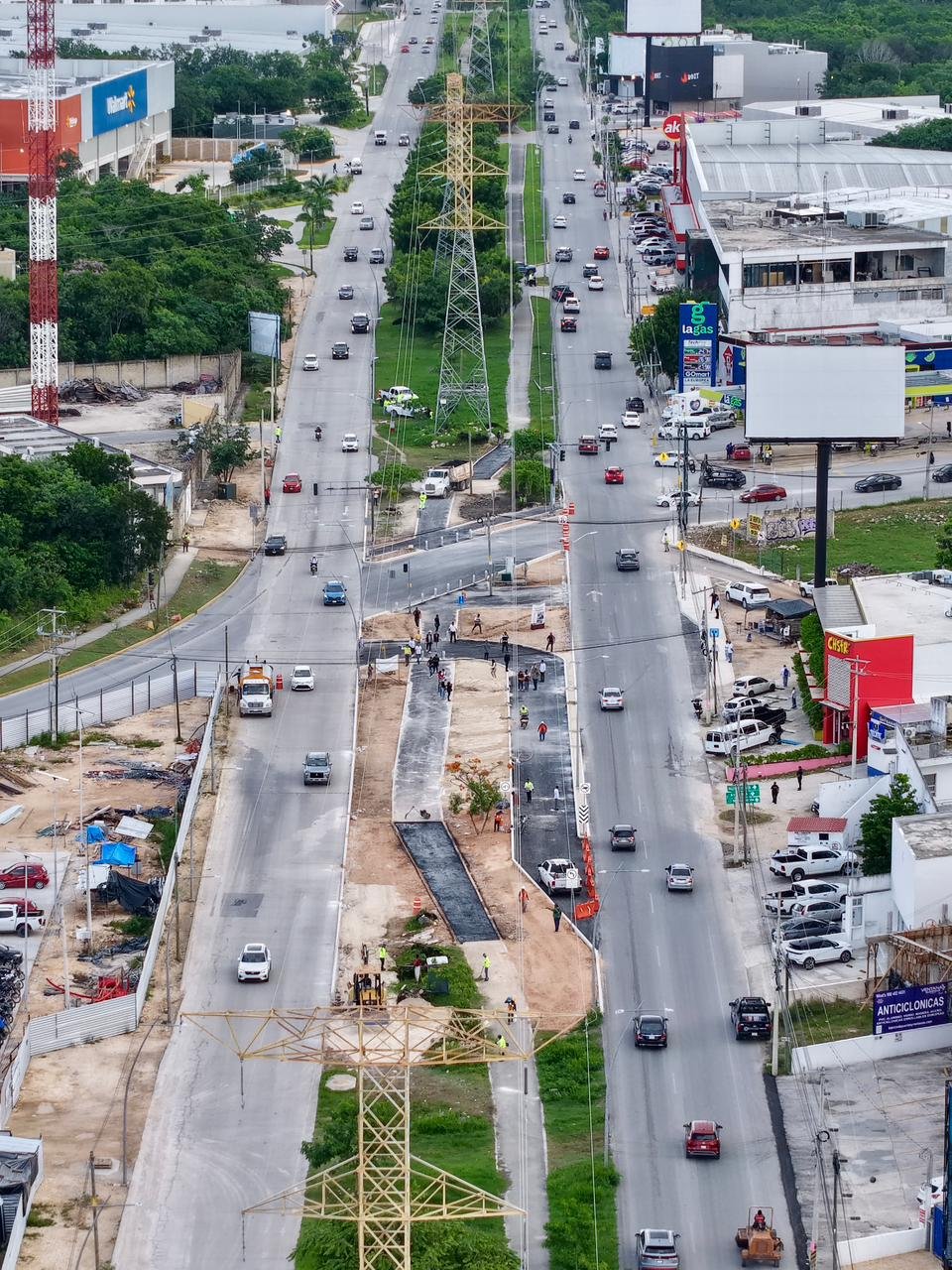
Huayacán Avenue was designed as a symbol of the new Cancún, a green corridor flanked by luxury residential areas, exclusive plazas, and the most modern gastronomic offerings in the southern part of the city. Its planning and consolidation began during the administration of Paul Carrillo around 2011, when the expansion of the asphalt surface was defined and the real estate growth that marked its first major boom almost 14 years ago was triggered. Today, however, the picture is very different.
Between 2023 and the end of 2025, it takes drivers up to 45 minutes to leave the area, a delay comparable to that experienced by students of the Technological University of Cancún during the works on Colosio Boulevard in 2022, when their journeys went from 15 to 45 minutes.
With its accelerated real estate development, high-end restaurants, and businesses oriented towards a premium market, Huayacán has consolidated as the Cancún equivalent of areas such as Masaryk or Polanco in Mexico City, a high-value enclave that offers a first-class lifestyle but now faces a traffic collapse that threatens to surpass its own modernization.
Very similar and proportionally to what the now largely forgotten Yaxchilán Avenue was, in the 1990s and early 2000s it was a wonderful area as the commercial, hotel, and gastronomic epicenter of the Cancún that was triggering its growth.
Saturation has ceased to be a temporary phenomenon; it responds to the chain of road works, partial closures, installation of sanitary networks, and accelerated growth of businesses and housing that far exceeded the capacity of existing roads.
To this is added a profound urban change: Huayacán and the entire southern part of Cancún have become an area practically independent from the rest of the city. Its strategic location connected to the airport, direct access to Playa del Carmen and the Riviera Maya, the Periférico with destination to Yucatán, and fluidity towards the hotel zone and downtown transformed it into a kind of city within the city.
More than 50 residential areas established in this sector depend almost entirely on Huayacán and Avenida 135, its most important parallel artery, while avenues such as Colegios, Bonfil, and Colosio itself have been integrated into an urban system that functions as a network… but without a master plan to organize it.
The State Strategic Projects Agency announced the extension of Huayacán by nine kilometers to link Federal Highway 180 with 307 and connect with the Maya Train loading station.
The donation of land by Grupo Palace and Tierra y Armonía will allow opening an alternative to Kabah Avenue, which for years was the only important access to the south.
At the same time, the City Council is modernizing the intersection with Avenida 135, incorporating new asphalt surface, curbs, sidewalks, accessibility ramps, and intelligent traffic lights connected to the municipal monitoring center. On paper, everything should improve mobility; in practice, delays have not subsided.
In August 2025, complete sections were repaved with heavy machinery and crews of more than 40 workers. That same month, the commercial development of the Southern Polygon gained strength, a new plaza of 15,000 square meters with anchor brands, the first 7-Eleven with a drive-thru format, and a recently inaugurated Chedraui Selecto.
The investment exceeds one billion pesos, consolidating the area’s value but also increasing pressure on a road system that does not grow at the same speed as population density.
To this are added the works of Aguakan, which since 2024 has been executing installations of drinking water and sanitary drainage networks during nighttime hours with partial closures.
In 2025, the interconnection of a 1,600-meter collector between Isla Mujeres Avenue and Ceiba Street also began, with lane reductions that will remain until 2026. These interventions, necessary to regularize services, deepen the bottleneck already suffered by thousands of users.
Meanwhile, Huayacán has become a recurring scene of accidents and acts of violence: crashes due to speeding and wet pavement, rollovers, vehicle rescues, and a fatal tragedy recorded in March 2025, when a motorcyclist lost her life after being hit by a dump truck.
The mix of constant works, poor asphalt surface, potholes, partial repairs, and lack of safe crossings aggravates the risk for drivers, pedestrians, and motorcyclists.
The saturation of billboards adds another front; despite official announcements, the avenue remains plagued by metal and concrete structures that were not removed after the last storms and have already fallen onto vehicles. The visual pollution and danger they represent have been denounced by experts for more than two decades.
To this are added urban coexistence problems: closures due to rehabilitations, work schedules that overlap with traffic peaks, nighttime drag races by people in a state of drunkenness, irregular operation of some businesses, and a recent homicide that keeps residents of Altura Residencial Cumbres on alert.
More than 200 inhabitants have requested authorities to apply noise, capacity, and schedule regulations to prevent the area from losing even more quality of life.
Huayacán Became a Bottleneck Because the Entire Southern Zone Grew Without an Integral Mobility Project
Avenida 135 faces exactly the same problems: more residential areas, more businesses, more flow, and the same infrastructure from a decade ago.
Addressing one road separately will not resolve the collapse while all feed the same axis without alternative routes or adequate turnarounds.
Neighbors and users propose ideas ranging from interconnecting Huayacán with parallel avenues such as Chac Mool and Colegios, to enabling road distributors, functional turnarounds, elevated pedestrian crossings, and a permanent program for removing dangerous billboards. They also request a thorough review of the traffic light system, access to residential areas, and relief routes that allow distributing traffic towards Colosio, Periférico, and 307 without forcing all movements to pass through the same avenue.
The opening in February of last year of Chac Mool Avenue, which today receives thousands of drivers daily, represents a valuable alternative to relieve Huayacán.
Its width and ease of incorporation make it a strategic road, but its potential is limited by a critical problem: the junction with Colosio Boulevard.
There, a deficient design generates a bottleneck that allows the advance of only one or two vehicles per turn, forcing long lines and completely slowing down circulation. The incorporation, improvised due to the lack of integral planning, turns a wide and comfortable avenue into a conflictive stretch when trying to exit towards Colosio, nullifying much of the expected benefit of this work.
Without these adjustments, the “avenue of value” will continue to be a sea of cars, noise, works, and risks.
The imminent opening of the Nichupté Bridge adds another evident pressure to the equation. This new access towards the hotel zone will be a natural magnet for thousands of drivers who today demand alternative routes to get to work without losing hours in traffic. A considerable part of the inhabitants of southern Cancún works precisely in the hotel strip and depends on a daily commute that is already unsustainable. With the bridge operating, the flow towards that main connection will increase significantly, and Huayacán will be one of the preferred corridors for those seeking to save time.
If mobility measures are not taken prior to its opening, this project that should improve connectivity could become a turning point for Huayacán Avenue, which today already operates at its limit. The southern zone records accelerated growth of residential areas and commercial activity, and without an integral plan that distributes vehicular load among several arteries, the new access could trigger a greater collapse. The Nichupté Bridge represents an opportunity to reorganize the traffic of the entire city, but it will only work if accompanied by a real strategy that considers accesses, turnarounds, coordinated traffic lights, and relief routes that prevent Huayacán from continuing to absorb traffic that has already exceeded its capacity.
The responsibility is shared and begins by establishing a truly effective mobility plan that accompanies the accelerated growth of southern Cancún.
Authorities must harmonize commercial expansion with safety and the well-being of those who live and work in the area, not limit themselves to executing immediate works that only patch daily traffic jams. Developers have the obligation to invest in functional accesses to prevent saturation from falling on a single road, and citizens must respect speed limits, avoid speeding, and reject commercial practices that operate outside regulations.
Huayacán can recover its innovative spirit, but only if all its actors understand that mobility and safety are not an accessory to development but the very foundation that will allow sustaining it in a city that already exceeds one million inhabitants.
Discover more from Riviera Maya News & Events
Subscribe to get the latest posts sent to your email.