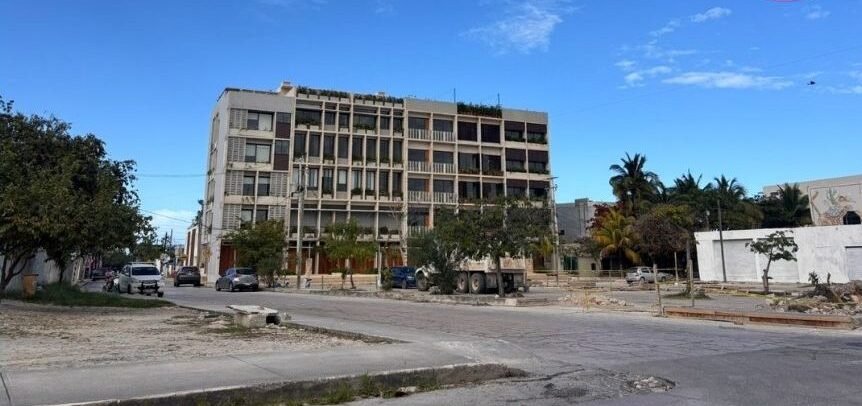
Cancún, Quintana Roo — The streets of Donceles 28, once filled with the voices of pioneers who built this Caribbean paradise, now groan under the weight of high-end concrete as Cancún undergoes an unprecedented urban transformation at age 55.
What residents are witnessing is not merely an aesthetic renovation but what critics call a “social cleansing” disguised as property value increases, where gleaming glass facades threaten to erase the identity of historic neighborhoods block by block.
The Real Estate Siege of Supermanzana 64
The Donceles 28 and Lombardo Toledano neighborhoods, originally designed for the working-class families who supported Cancún’s emerging tourism industry, have become prime targets for major developers. Proximity to the state’s most exclusive areas has created a “mirror effect” with projects like Puerto Cancún artificially inflating living costs.
Property values in the city center have increased by up to 30% in commercial assessments, while residential rents have risen an average of 20% in the last fiscal cycle alone. This asset inflation has triggered an aggressive mutation in land use in the foundational zone.
Single-story family homes are rapidly disappearing, replaced by vertical condominiums and short-term vacation rentals operated primarily through platforms like Airbnb. This transition dramatically alters the population density for which the city’s original infrastructure was designed, creating unsustainable pressure on basic services in neighborhoods that were once quiet local family areas.
Residents report that storm drainage networks and electrical supply systems—designed decades ago for low-impact housing—are being overwhelmed by five- or six-story buildings housing dozens of temporary residents. This overload causes constant failures in basic services for founding neighbors, who see their daily quality of life diminishing proportionally to the increasing height of surrounding buildings.
Market Forces Versus Community Identity
The conflict divides the city into two irreconcilable visions fighting to define the destination’s future.
The real estate sector, represented by organizations like AMPI (Mexican Association of Real Estate Professionals), acknowledges the phenomenon but frames it within a narrative of “dynamism, modernization, and urban renewal.” Their central argument emphasizes the need for legal certainty and regulation to prevent fraud, seeing the arrival of digital nomads and foreign capital as a golden opportunity to rehabilitate areas showing signs of deterioration or abandonment.
For developers, verticalization represents not aggression but the natural evolutionary step of a city with global aspirations. They argue that private investment brings collateral improvements in security and lighting while stimulating the local economy through high-end service consumption.
From this perspective, resistance to change is viewed as an obstacle to the state’s economic progress, maintaining that the market must naturally depurate less efficient zones to make way for projects generating greater fiscal and tourism returns.
For historical residents, the view is radically different. For neighbors in Donceles or Supermanzana 64, “modernization” means administrative eviction. Older adults, many with fixed and limited pensions, now face property taxes assessed with luxury zone criteria, making their homes financially unsustainable in the medium term.
They denounce what they call a silent but constant “real estate harassment”: purchase offers seeking to fragment neighborhood cohesion and replace corner stores with specialty coffee shops alien to the popular economy.
The Dual City and Loss of Soul
The fundamental rupture in Cancún is the crystallization of a “Dual City” model where some people’s prosperity is built on others’ displacement. While new developments feature private security, reinforced hydraulic infrastructure, and first-world services, original residents who maintain the daily operation of the tourism machinery are displaced to remote peripheries, increasing inequality gaps and commute times.
This social fragmentation generates alienation where citizens no longer recognize their own environment. The social fabric, composed of neighborhood support networks built over decades, breaks when homes become impersonal hotel rooms.
The question floating in the Caribbean’s humid air is whether a city can truly prosper if its social foundations are sacrificed at the altar of real estate speculation and square-meter returns.
The Silent Community Trauma
Specialist Sandybel Robaldino warns that gentrification in Cancún reveals itself as a psychosocial phenomenon eroding identity and mental health, generating a “silent community trauma.” This process affects everyone from children losing their school and social environments to the economically active population.
It manifests through grief over the loss of emblematic spaces like Parque de las Palapas, sustained socioeconomic stress, and social fragmentation evidenced in discriminatory expressions like “from Portillo backward.”
In Cancún’s urban core and peripheries, where global tourism displaces local daily life and new migrant settlements face precarious conditions, residents must survive between anxiety, depression, and loss of belonging due to a power reorganization without regulation that prioritizes economy over human wellbeing.
Discover more from Riviera Maya News & Events
Subscribe to get the latest posts sent to your email.