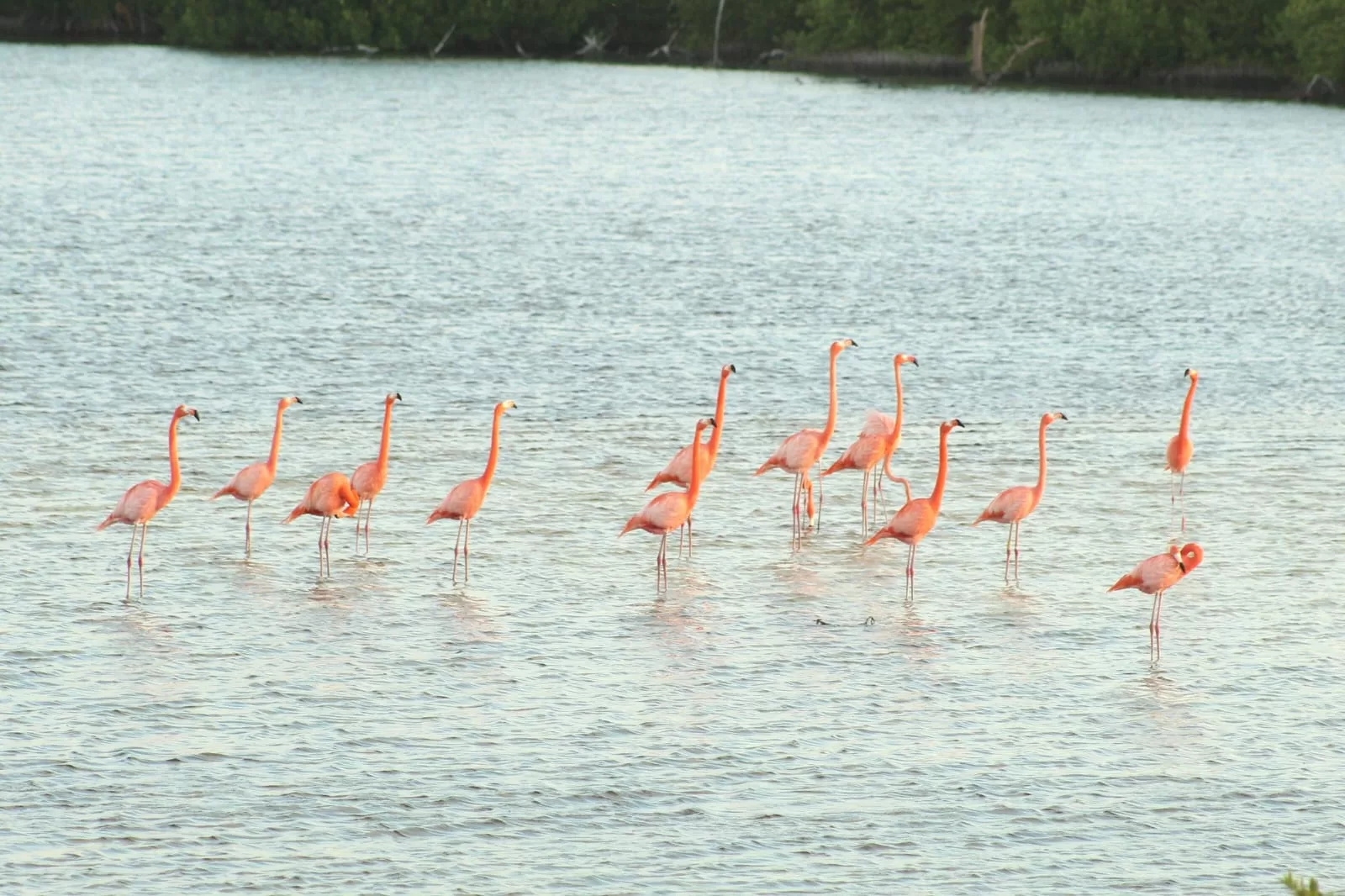
Cozumel, Mexico — The consistent presence of the American Flamingo (Phoenicopterus ruber) in the wetlands of the Punta Sur Ecotourism Park continues to serve as an indicator of the conservation status of this ecosystem, resulting from the protection, monitoring, and environmental management work carried out by the Cozumel Parks and Museums Foundation (FPMC).
The recurrent observation of this species in Laguna Colombia, a Protected Natural Area located within Punta Sur, responds to the shelter and feeding conditions offered by the site.
According to specialists, the flamingo plays a relevant role in the ecological balance of wetlands, so its permanence is considered a positive signal about the environmental health of the area.
More Than Two Decades of Records
Since Punta Sur was declared a Protected Natural Area in 1996, sightings of flamingos began to be documented. Starting in 2000, banded individuals were recorded, which allowed for tracking of specific specimens. Following the site’s reclassification in 2011 as the Laguna Colombia State Ecological Park, the FPMC strengthened monitoring schemes.
The area director, Jesús Benavides Andrade, explained that each year the presence of groups exceeding 30 specimens has been documented, as well as flamingos identified through bands, which confirms the importance of the site within their routes and zones of permanence.
Monitoring work is carried out in coordination with the National Commission of Natural Protected Areas (CONANP), the state government, and non-governmental organizations. This effort is part of a program of more than 25 years that promotes the banding of the American Flamingo in Mexico to understand its dispersion, migratory routes, and population dynamics.
In Punta Sur, specimens with band combinations such as DLAS, DHHT, HZTN, ABBB, and DXZZ have been identified. The latter has generated special interest, having been recorded for the first time in 2000 and observed recurrently since then. The sighting of the current season represents the most recent record of its permanence in the zone.
Non-Invasive Ecosystem Monitoring
Sightings are reported to Flamenco Lab, a citizen science initiative led by the Pedro y Elena Hernández A.C. Foundation, which allows the information to be integrated into regional and international databases. Although the species is considered a winter resident, records have been documented in different months of the year in Punta Sur.
The monitoring is supported by innovative techniques such as the use of drones for censuses and population counts, under non-invasive protocols. The images obtained have allowed observation of cooperative feeding behaviors, through which flamingos stir the substrate in search of crustaceans and microalgae, favoring soil aeration, the nutrient cycle, and the biodiversity of the lagoon.
FPMC specialists emphasize that the American Flamingo acts as a natural bioindicator. Its presence and behavior allow for the evaluation of the wetland’s conservation status and the early detection of possible environmental changes, reinforcing the importance of permanent monitoring in Punta Sur.
Discover more from Riviera Maya News & Events
Subscribe to get the latest posts sent to your email.