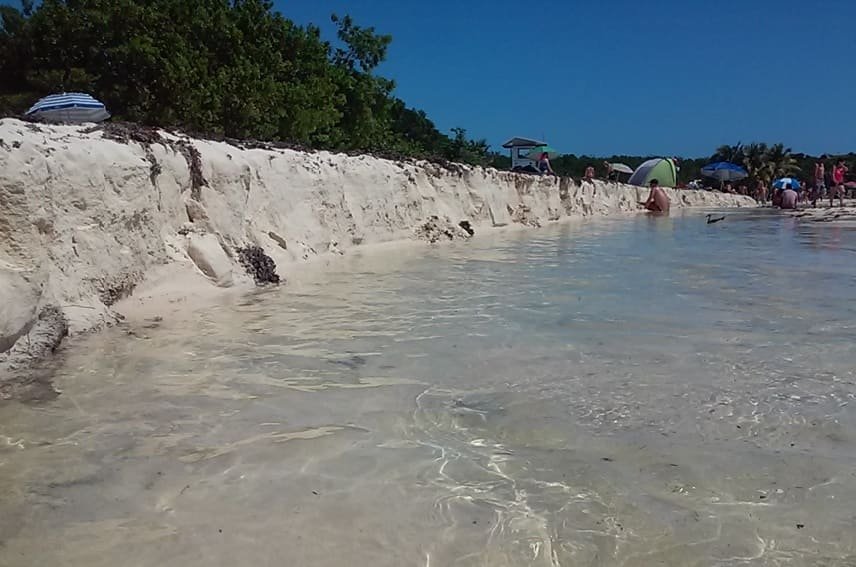
Riviera Maya, QR — Citizens and civil society organizations have asked the Ministry of Environment and Natural Resources (Semarnat) to deny the request for an extension of the current authorization. “We request the government of Quintana Roo to comply with environmental impact legislation for beach restoration in the northern part of the state,” reported Cemda, the Mexican Center for Environmental Law.
Civil society organizations, citizen groups, and academics expressed concern about recent statements from the head of the Quintana Roo Environment Secretariat, indicating that the beach restoration project in the northern zone of the state will proceed without a new Environmental Impact Statement (DIA).
This is based on an environmental permit issued in 2009 and a simple administrative extension, despite environmental, regulatory, and territorial conditions having changed substantially in over fifteen years. We raise the following concerns:
Recognized Insufficiency of the Current Environmental Authorization
Only the beach restoration project in Cancún requires a new executive project and a new Environmental Impact Study (EIA), because the currently proposed area (from Playa Las Perlas to Punta Nizuc) is not covered by the original authorization.
Additionally, statements from the Environment Secretariat indicate that the state project intends to include new municipalities like Puerto Morelos, confirming that the 2009 authorization is not legally sufficient to support the planned works.
Furthermore, Mexican law requires that EIAs be modified or updated for expanded projects, those with significant changes, or those that have been in effect for more than 5 to 10 years, in accordance with the General Law of Ecological Balance and Environmental Protection (LGEEPA) and NOM-059-SEMARNAT.
A Regional Project with Intermunicipal Impacts
The beach restoration of northern Quintana Roo is a regional project, not an isolated intervention. It involves multiple municipalities with distinct ecosystems and legal frameworks, whose impacts are interconnected by coastal dynamics.
Among the involved municipalities are Benito Juárez (Cancún), Puerto Morelos, Isla Mujeres (including Costa Mujeres), Playa del Carmen, and Cozumel, spanning more than 30 kilometers of coastline.
Some of these municipalities are within the influence area of federally protected natural areas (ANP), such as the Puerto Morelos Reef National Park and the Mexican Caribbean Biosphere Reserve, established in 2016 but nonexistent at the time of the original authorization.
The Environmental Impact Study (EIA) authorized in 2009, originally limited to the municipalities of Cancún, Playa del Carmen, and Cozumel, is materially and legally insufficient to support the expansion of the project to Puerto Morelos and the incorporation of 33.5 additional kilometers of coastline.
The magnitude, territorial scope, and current environmental conditions require the preparation and submission of a new Environmental Impact Statement, not a simple modification of the existing one, incorporating updated studies of bathymetry, coastal dynamics, and sand volumes, according to requirements established by SEMARNAT itself.
While authorities have indicated that the evaluation is framed within the National Restoration Plan and has considered expedited response procedures for emergency situations, these procedures do not exempt the entity from full compliance with the environmental evaluation process, whose resolution, if appropriate, is expected in the first quarter of 2026.
Substantial Environmental Changes Since 2009
The Mexican Caribbean has experienced profound environmental transformations: sea level rise, increased intensity of hydrometeorological events, and the massive and recurrent arrival of sargassum seaweed since 2015, a phenomenon that was nonexistent in 2009.
Additionally, the reefs that form part of the Mesoamerican Reef System are in critical condition, as their coverage has decreased from 19% to 13% since 2009. The 2023 bleaching event was the most severe recorded with approximately 40% of corals severely affected. The remaining corals face increasingly serious threats, hence the need for protection and restoration.
It must also be considered that since 2009 new protected natural areas have been created and the marine and coastal conservation framework has been strengthened. The aforementioned variables were not and could not have been considered in the original authorization; therefore, insisting on its validity contravenes the environmental precautionary principle.
Lack of Evaluation of the Original Project’s Performance
It is particularly concerning that there is no comprehensive public evaluation of the performance and environmental impact of the project authorized in 2009, despite multiple sections of the coastline exhibiting persistent or worsening erosion.
Additionally, it is necessary to verify compliance with the conditions of the current authorization. The accelerated loss of sand in Playa del Carmen demonstrates that poorly designed or insufficiently evaluated interventions can exacerbate the problem instead of solving it.
Ecological Fragility and Protected Species
The sandy beaches of northern Quintana Roo are part of a highly fragile and interconnected ecological system – beaches, dunes, reefs, and seagrasses – essential not only for tourism but also for the nesting of sea turtles, species protected by Mexican law.
Four main species of migratory sea turtles nest in the northern part of the state: the green turtle, the loggerhead, the hawksbill, and the leatherback turtle. These species are listed in NOM-059-SEMARNAT-2010 as protected species: Chelonia mydas is classified as endangered, Eretmochelys imbricata as critically endangered, while Caretta caretta and Dermochelys coriacea are categorized as vulnerable.
These turtles nest on the beaches of Quintana Roo, making several beaches in the region key turtle nesting sanctuaries or camps for their conservation. Various organizations and government authorities, such as the National Commission of Natural Protected Areas (CONANP), carry out protection programs that include beach patrols, relocation of nests to protected enclosures, and release of hatchlings.
Additionally, the beaches of Quintana Roo also host shorebirds such as the pectoral sandpiper, the ruddy turnstone, the brown pelican, and the osprey, which would be affected by this beach restoration project, as they depend on sandy habitats for feeding and resting.
Other important species include the magnificent frigatebird and herons like the reddish egret, whose feeding zones are altered by sand compaction or sediment removal.
Furthermore, invertebrates like the pink conch, the Caribbean spiny lobster, and beach crabs inhabit intertidal zones and could suffer direct mortality from machinery or loss of shelters during restoration. These organisms, some of which are listed in NOM-059-SEMARNAT, are key to the food webs that sustain turtles and birds.
International Commitments, Human Rights, and Citizen Participation
Implementing the project without a new Environmental Impact Study (EIA) could violate the human right to a healthy environment, recognized in Article 4 of the Constitution, as well as the right to information and citizen participation in environmental matters, guaranteed by national legislation and the Escazú Agreement, of which Mexico is a State Party.
Also at risk is compliance with international commitments such as the Inter-American Convention for the Protection and Conservation of Sea Turtles and the Convention on Biological Diversity, among others. For all the above, we respectfully request the authorities of the Quintana Roo government:
- Transparency of information and compliance with their responsibilities, avoiding conflicts of interest and incurring administrative and environmental liability.
- Prepare a new Regional Environmental Impact Assessment that considers current conditions of coastal ecosystems, impact mitigation, and compliance with current environmental legislation.
- Incorporate updated information and apply the best available science, in accordance with what is established in the Constitution and the General Law of Humanities, Sciences, Technologies, and Innovation.
We urge the Ministry of Environment and Natural Resources (Semarnat) to deny the request for extension of the current Environmental Impact Authorization and to demand the preparation and evaluation of a new comprehensive, regional, and updated Environmental Impact Study.
Additionally, we request that it guarantee access to information and citizen participation in the environmental impact assessment process, in accordance with the General Law of Ecological Balance and Environmental Protection, its regulation on EIA, and the Escazú Agreement.
Finally, the agency must ensure that any decision is based on science, legality, transparency, and human rights, not on obsolete environmental authorizations.
Beach restoration must be a real long-term solution, not an additional source of environmental and social conflict. Protecting the coastal ecosystems of Quintana Roo is protecting the future of the Mexican Caribbean and its communities.
Discover more from Riviera Maya News & Events
Subscribe to get the latest posts sent to your email.