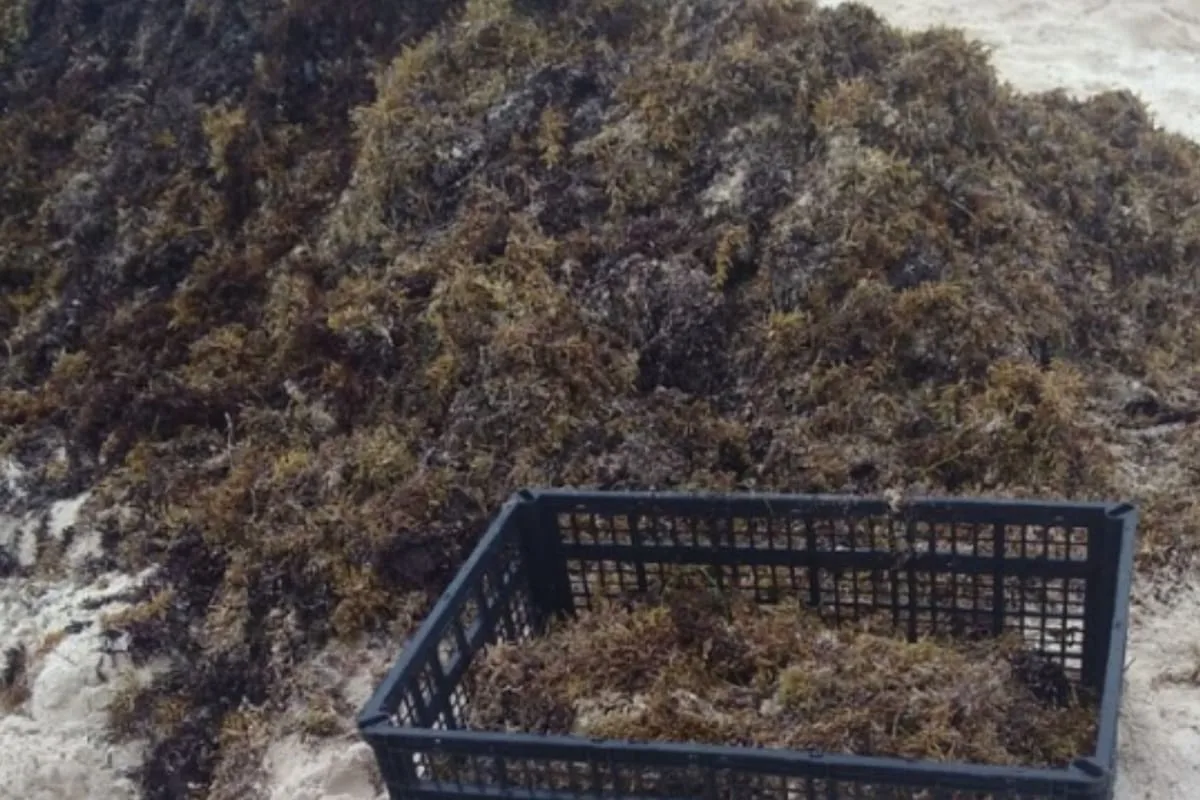
Cancun — The sargassum season in the Mexican Caribbean, which typically begins in March, commenced unusually early this year with the macroalgae recorded in Isla Mujeres in January, triggering scientific and operational alerts across Quintana Roo.
According to researcher Rosa Rodríguez of the National Autonomous University of Mexico's (UNAM) Institute of Limnology and Marine Sciences in Puerto Morelos, this year's behavior anticipates a more complex scenario than 2025. "This year is shaping up to be terrible," Rodríguez stated, referring to the volume observed in the Atlantic.
Unprecedented Early Figures
The sargassum concentration figures, derived from international satellite monitoring, show a significant increase. In January, 9.5 million tons of sargassum were recorded in the Atlantic. By February, the figure rose to 13.6 million tons. These numbers exceed the historical records for the first two months of 2025, which were 7.8 and 4.3 million tons, respectively.
According to Rodríguez, while not all sargassum reaches Mexico, approximately 10% of the total in the Atlantic impacts Quintana Roo. If the trend continues, 2026 could surpass the levels of 2025, a year in which the recorded amount doubled compared to 2022.
Causes and Current Presence
Experts link the increase in sargassum volume to several factors: climate change, the warming of the seas, ocean acidification, and changes in ocean currents. The increase in water temperature favors the accelerated proliferation of this floating macroalgae, which travels from the central Atlantic to the Caribbean.
Regarding current presence, Isla Mujeres has registered sargassum since the second week of January. By the second week of March, signs were already being reported in other areas of Quintana Roo. Municipalities such as Puerto Morelos and Playa del Carmen have begun preventive actions ahead of the anticipated massive arrival.
Containment and Collection Measures
Authorities are implementing various measures to manage the influx. In Isla Mujeres and Puerto Morelos, marine containment barriers have already been installed to prevent sargassum from reaching the beaches.
In Playa del Carmen, the "Sargassum Challenge 2026" program will be implemented. It includes a double barrier extending up to 5 kilometers, staff deployment at 15 cleaning points, and permanent operational coordination.
The Secretariat of the Navy is also mobilizing resources. Rear Admiral Topiltzin Flores Jaramillo, in charge of the strategy, reported that this year the ship Natans will operate, with a capacity to collect more than 200 tons daily. Additionally, smaller boats will be deployed, an amphibious vehicle will be used to transport the macroalgae to land, and collection at sea will be reinforced to prevent it from reaching the beaches.
Broader Impacts and Projections
Sargassum affects the image of beaches, tourist activity, fishing, marine ecosystems, and coastal water quality. Quintana Roo is one of Mexico's main tourist destinations, making the early arrival a concern that necessitates strengthened coordination between authorities, the hotel sector, and the scientific community.
Historically, the months with the highest accumulation tend to be May, June, July, and August. Given the arrival began in January, experts believe the season could last longer than usual.
Expert Recommendations and Context
Researchers are calling for constant satellite monitoring, action on the high seas before the mass arrival, investment in scientific research, and the promotion of solutions for utilizing sargassum. In a related development, a Mexican man has transformed sargassum into building blocks containing 40% algae, reducing housing costs in the Caribbean by up to 40%. UNAM has validated the first house built with this material for its resistance to earthquakes and hurricanes.
The early behavior of sargassum in 2026 is seen as part of a growing trend associated with global environmental changes. The coming weeks are considered crucial for measuring the real impact on the Mexican coasts. State and federal authorities have already activated protocols to contain a season that experts warn could be one of the most intense in recent years.
Discover more from Riviera Maya News & Events
Subscribe to get the latest posts sent to your email.