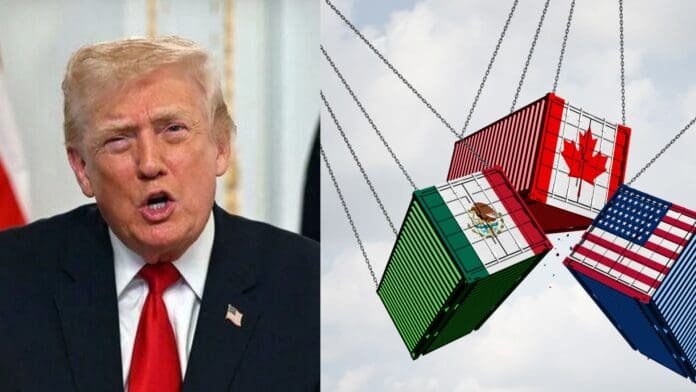
Washington, D.C. — U.S. President Donald Trump recently announced he is considering letting the United States-Mexico-Canada Agreement (USMCA) reach its end to seek a different trade agreement with both countries. His statements generated immediate reaction in economic and political sectors across the region.
During a conference in the Oval Office, Trump noted that the trade pact “expires in about a year” and that his administration will evaluate allowing it to conclude or negotiating a new trilateral understanding. He assured that he is considering other alternatives that, according to him, would benefit his country more.
The president accused both Mexico and Canada of having “taken advantage” of the United States under previous administrations. Without mentioning names, he attacked the Joe Biden administration, whom he blamed for having allowed what he called unfavorable agreements.
Nevertheless, it is important to remember that USMCA was promoted by Donald Trump himself during his first term and replaced the North American Free Trade Agreement (NAFTA) in 2020, which he had labeled as an unfair pact for the U.S. economy.
The treaty’s calendar establishes that in 2026 the three nations must evaluate whether to extend its validity for an additional 16 years, until 2042, or whether to opt for annual reviews until 2036, the date when it would reach its definitive end.
Donald Trump also defended the tariff policy implemented against his North American trade partners, arguing that these measures have increased government revenue and contributed to reducing the national debt.
The president highlighted in particular the tariffs applied to the automotive sector, indicating that these tariffs caused some companies to move operations to U.S. territory. He affirmed that, without such measures, many plants would continue producing in Mexico or Canada.
“They wouldn’t be here today if we didn’t have tariffs, they would be building their plants in Mexico and other places,” he stated.
Currently, USMCA includes updated rules on digital trade, intellectual property, labor conditions, and the environment, in addition to stricter rules for the automotive industry with the aim of strengthening regional production and keeping tariffs low among the three countries.
Specialists have emphasized that this agreement has been essential for the economic development of North America, boosting agricultural and industrial trade and guaranteeing a legal framework that provides certainty for investments and the workforce.
Therefore, if the treaty were canceled or renegotiated in a profound manner, it could generate uncertainty in the region, affecting production chains and trade relations that have been built over decades.
Discover more from Riviera Maya News & Events
Subscribe to get the latest posts sent to your email.