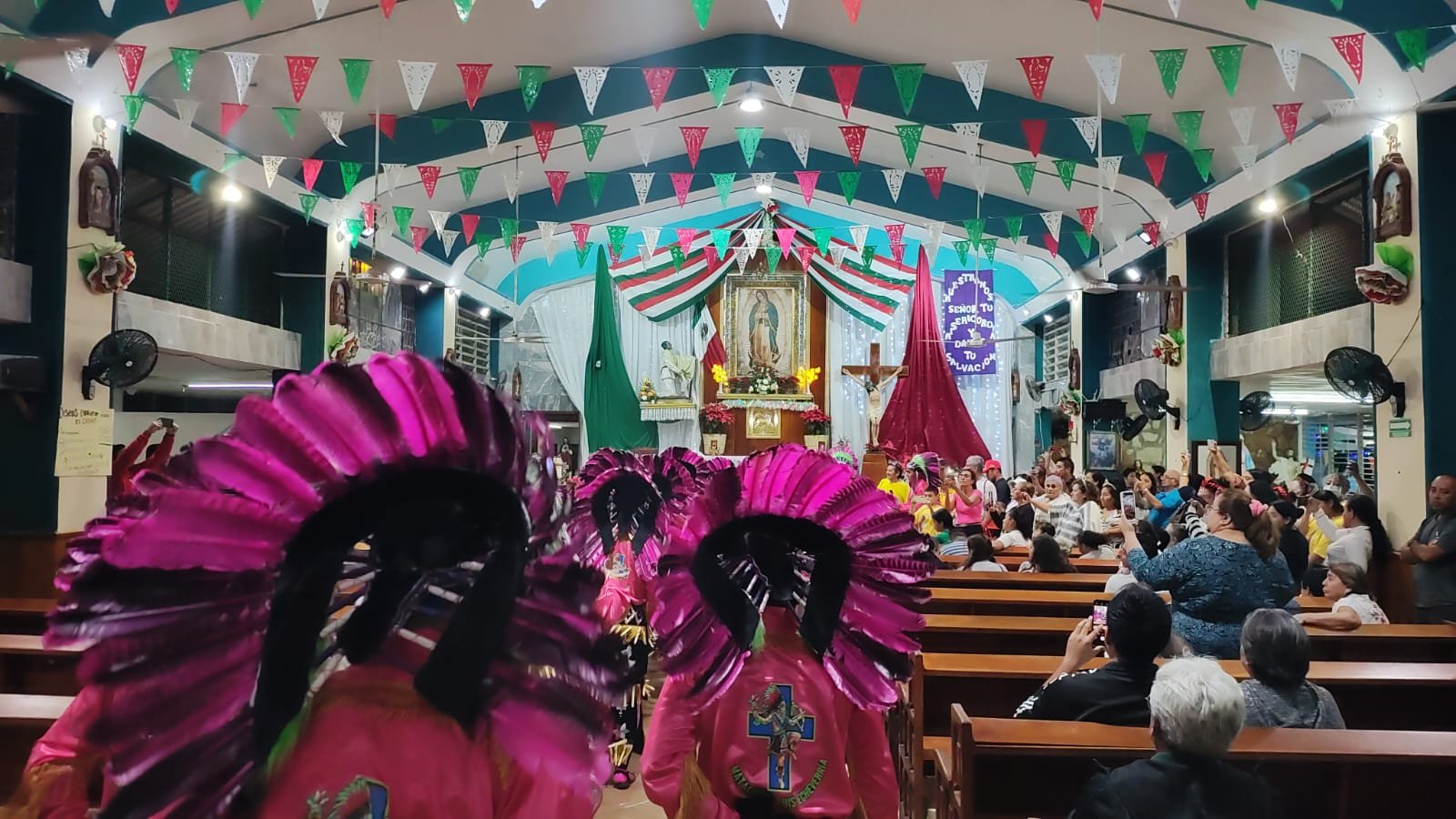
CHETUMAL, December 11 – The traditional Midnight Mass in honor of the Virgin of Guadalupe began at 10:00 PM on December 11 at the Guadalupana Church in Chetumal, located at the intersection of Francisco I. Madero Avenue and Mahatma Gandhi Street. Dozens of parishioners gathered at the venue to participate in one of the most significant religious celebrations for the country, in a national context marked by social tensions, violence, and uncertainty. The liturgy was presided over by David Martín Leal, parish priest of the Diocesan Marian Sanctuary of Our Lady of Guadalupe in Chetumal.
During his homily, the priest framed the celebration in a historical and symbolic perspective, recalling that in six years, in 2031, Mexico will commemorate the 500th anniversary of the Guadalupe apparitions. He noted that this date should not be assumed as a simple religious anniversary, but as an opportunity to reflect on the country’s direction and the need for spiritual, social, and community preparation to respond to current challenges.
The priest contextualized the apparition of the Virgin of Guadalupe during the period of Spanish colonization, when even the humanity and dignity of indigenous peoples were questioned. He recalled that it was the intervention of the Church, through missionaries and thinkers, that defended their human and spiritual condition. In that scenario, he said, the choice of Saint Juan Diego, a humble and powerless man, as the Guadalupe messenger represented a profound act of vindication and dignification of indigenous peoples.
Martín Leal emphasized that the Guadalupe image, studied even by international scientific institutions, has withstood attacks and remains intact after almost five centuries, consolidating itself as one of the most powerful symbols of national history. He stressed that the Virgin of Guadalupe belongs to the religious sphere and is an axis of identity, as well as social cohesion, present even in foundational moments such as the beginning of Mexico’s Independence movement.
From that historical reading, the priest presented the Virgin as a factor of national unity, capable of summoning fraternity in times of division. He called for recognizing each other as equals, without distinction of race or language, and warned that current polarization and social confrontation contradict the Guadalupe message of brotherhood. “Denying its importance in Mexico’s history is closing our eyes to one of the few narratives that have united us as a nation,” he emphasized.
The message took on a critical tone when referring to the loss of peace and coexistence in communities like Chetumal, contrasting the past tranquility with a current reality marked by insecurity and violence. The priest argued that this crisis cannot be understood solely from crime statistics, but from the rupture of the social fabric and the normalization of fear, phenomena that require shared responsibility among families, community, and institutions.
At another point in the homily, Martín Leal questioned the abandonment of family responsibilities, associated with excessive use of technology, and its negative effects on the formation of children and youth. He acknowledged that new generations seek to express themselves and demand a different world, which—he said—reveals a generational debt in education, accompaniment, and transmission of values. In that sense, he urged rescuing community traditions like “La Rama,” not as nostalgia, but as living tools of identity and social cohesion. “How long has it been since we’ve seen a branch in the neighborhoods? We would take a branch, put little pieces of cotton on it, and how happy we were, brothers, let’s return to those times.”
The priest invited people to resume family prayer, especially the rosary prayer every 12th in honor of the Virgin of Guadalupe, as a concrete act to pray for Mexico and peace. He also called for preparation towards 2031, both spiritually and materially, recalling that the temple was declared a Sanctuary since 1963. He closed by returning to the Guadalupe message of comfort—”Do not fear, am I not here, I who am your mother?”—as a response to the anxiety, depression, and fear that run through society, assuring that this “embrace” remains a real possibility of personal and collective transformation.
At the end, he exhorted parishioners to pray for outgoing Bishop Pedro Pablo Elizondo Cárdenas, of whom he said “upon turning 75, he presented his resignation.”
He concluded by stating “May the Blessed Virgin our mother help us, protect us, and bless us. May it be so.” After communion, and the final prayers to the Virgin of Guadalupe, the Mass ended minutes after 11:00 PM.
Discover more from Riviera Maya News & Events
Subscribe to get the latest posts sent to your email.